
Every year, 1.7 million work-related illnesses occur across UK workplaces, and the vast majority are preventable. Yet many small and medium-sized businesses still treat health and safety as a box-ticking exercise, or worse, assume it’s only relevant to large corporations with dedicated compliance teams. That assumption is costly. Fines, enforcement notices, and reputational damage fall on businesses of every size. This guide cuts through the confusion and gives you a clear, practical framework for implementing structured safety compliance, regardless of your sector or headcount.
Table of Contents
- What structured safety compliance means for UK SMEs
- The HSE’s five-step framework: The compliance backbone
- Manual kits vs digital tools: Finding the right structure
- Turning compliance into action: Practical steps for SMEs
- Common pitfalls and advanced tips
- Streamline compliance with the right tools and expert resources
- Frequently asked questions
Key Takeaways
| Point | Details |
|---|---|
| Structure cuts risk | Systematic safety compliance reduces accidents and fines for UK SMEs. |
| HSE’s five steps are law | Following the Health and Safety Executive’s risk assessment model is essential for compliance. |
| Digital tools boost traceability | Automation saves 90% of audit preparation time and tracks corrective actions more reliably. |
| Pitfalls come from poor tracking | Review procedures regularly to avoid common SME compliance failures. |
| Tailored solutions scale up | Start with folders and basic checklists, upgrade to digital as your business grows. |
What structured safety compliance means for UK SMEs
Structured safety compliance isn’t about drowning in paperwork. It’s about replacing ad hoc, reactive responses with a systematised approach that keeps your business consistently protected. Think of it as the difference between remembering to check your car’s oil when the warning light appears versus following a scheduled maintenance plan.
At its core, structured compliance uses systematic documentation, checklists, and digital tools to ensure regulatory adherence, audit readiness, and risk control. For UK SMEs, this means having the right processes in place before an incident occurs, not scrambling to produce records after the fact.
Here are the key components every SME should understand:
- Risk assessment: A documented evaluation of hazards in your workplace and the controls you’ve put in place
- Audit readiness: The ability to demonstrate compliance to the Health and Safety Executive (HSE) or an insurer at any point
- Corrective action: A recorded response to a hazard or near-miss, with a named person responsible and a completion deadline
- Method statement: A written sequence of work steps that outlines how a task will be carried out safely
Understanding the health and safety importance of these terms is the first step. You can also explore a full glossary of health and safety terms to build your working vocabulary.
“Structured compliance isn’t about complexity. It’s about consistency. A simple system that’s followed every time beats an elaborate one that’s ignored.” — The Compliance Kit
Scalability matters here. A sole trader in construction needs a different level of documentation than a 50-person facilities management company. But both need some structure, and the principles are identical.
The HSE’s five-step framework: The compliance backbone
UK law doesn’t leave compliance open to interpretation. The HSE’s five-step risk assessment process is the legal baseline for any business operating in the UK, and written assessments are mandatory for firms with five or more employees. Even if you have fewer than five staff, following this framework is considered best practice.
Here’s how the five steps break down in practice:
- Identify the hazards — Walk your workplace and list anything that could cause harm. Include physical, chemical, and ergonomic risks.
- Decide who might be harmed and how — Consider employees, contractors, visitors, and members of the public.
- Evaluate the risks and decide on controls — Assess the likelihood and severity of harm, then apply the hierarchy of controls.
- Record your findings — Document everything. Vague notes won’t satisfy an HSE inspector.
- Review and update — Revisit your assessment after any incident, change in process, or at least annually.
| Step | Action required | Compliance tip |
|---|---|---|
| 1. Identify hazards | Physical walkthrough and staff consultation | Include near-miss reports as a source |
| 2. Who is at risk | List all persons affected | Don’t overlook contractors and visitors |
| 3. Evaluate and control | Apply hierarchy of controls | Eliminate before substituting |
| 4. Record findings | Written documentation | Use a standard template for consistency |
| 5. Review | Schedule regular reviews | Trigger reviews after any incident |
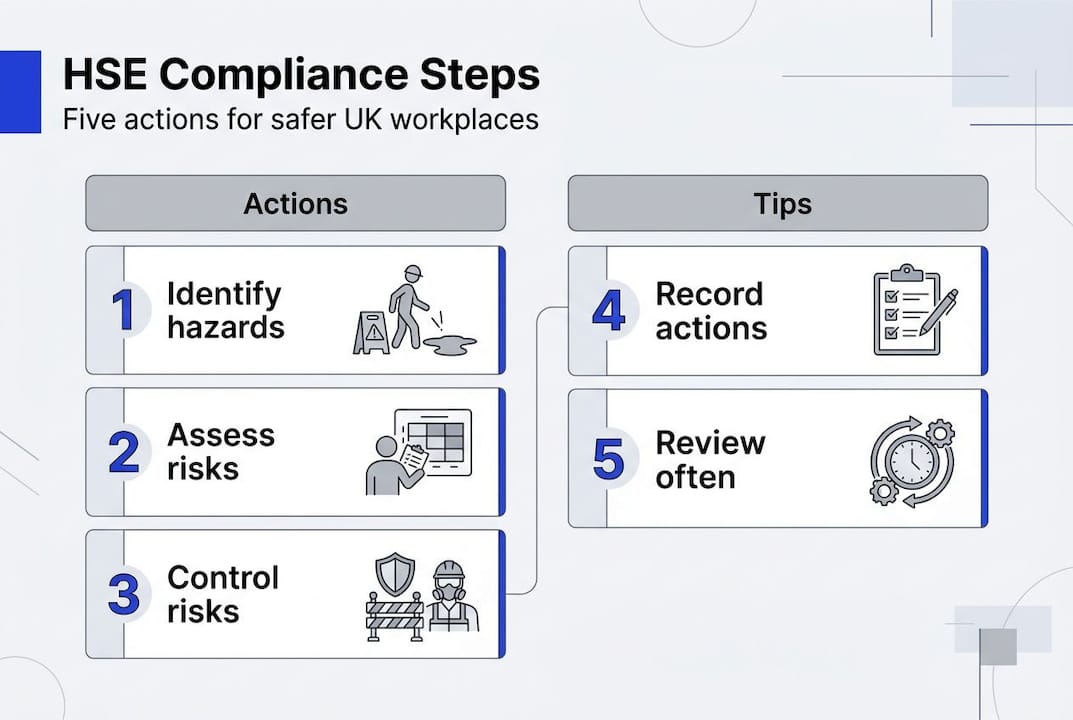
This framework underpins everything else in your compliance programme. Our site safety guide shows how this applies in construction and trade environments specifically. For a broader look at your legal obligations, the legal compliance for SMEs guide is worth bookmarking.
For a detailed walkthrough of each step, the risk assessment guide from Arinite is one of the clearest available for UK workplaces.
The HSE’s standard is not perfection. It’s suitable and sufficient. Your documentation needs to reflect the actual risks in your workplace, proportionate to the size and nature of your business.
Manual kits vs digital tools: Finding the right structure
Once you understand the legal framework, the next decision is practical: how do you actually manage your compliance documentation day to day? The answer depends on your business size, risk level, and operational complexity.

Manual systems use paper checklists, physical folders, and printed templates. They’re low cost, require no software, and work well for smaller, lower-risk businesses. A sole trader or a small team in a single location can manage compliance effectively with a well-organised folder and a consistent routine.
Digital tools, including Computerised Maintenance Management Systems (CMMS), are better suited to businesses managing multiple sites, complex workflows, or large teams. They automate scheduling, track corrective actions, and generate audit trails automatically. The results speak for themselves: digital CMMS systems yield 90% less audit preparation time, 40% fewer incidents, and 100% documentation compliance in measured studies.
| Feature | Manual system | Digital CMMS |
|---|---|---|
| Cost | Low | Medium to high |
| Audit trail | Manual, paper-based | Automated and timestamped |
| Corrective action tracking | Prone to gaps | Automated reminders and sign-off |
| Best suited for | Low-risk, single-site SMEs | Multi-site, high-risk operations |
| Scalability | Limited | High |
The HSE’s position is clear: the format matters less than the outcome. What counts is whether your system is suitable and sufficient for your risks. A paper folder that’s consistently maintained beats a digital platform that nobody uses.
Pro Tip: If corrective actions in your current system go unverified, your compliance structure has a gap. Whether you use paper or software, every action must have a named owner and a recorded completion date.
For practical guidance on building your documentation library, the health and safety essentials resource covers what SMEs in construction and trades need most. And if you’re wondering whether a standardised approach saves time, the evidence on standardising safety documents is compelling. You can also review what a full health and safety audit involves before your next inspection.
Turning compliance into action: Practical steps for SMEs
Knowing the framework is one thing. Embedding it into daily operations is another. Here’s a straightforward sequence for moving from basic awareness to structured compliance.
- Complete your HSE five-step risk assessment for every significant task or area in your business
- Build a compliance folder (physical or digital) containing your policy, risk assessments, training records, and incident logs
- Create recurring checklists for daily, weekly, and monthly safety checks relevant to your work
- Assign responsibility for each compliance task to a named individual, not just a job title
- Schedule a quarterly review of all documentation, even if nothing has changed
- Upgrade to digital tools when paperwork gaps or unverified corrective actions become a recurring problem
Proactive, structured systems are what prevent the majority of the UK’s 1.7 million work-related illnesses each year, and they deliver measurable return on investment through lower insurance premiums and reduced downtime. This isn’t just a legal obligation. It’s a sound business decision.
Common pitfalls at this stage include:
- Failing to update risk assessments after a process change or staff turnover
- Storing documents in locations that staff can’t easily access
- Treating training as a one-off event rather than an ongoing requirement
- Assuming a signed checklist equals a completed action
Pro Tip: Digital tools only work if your team knows how to use them. Budget time for training when you introduce any new compliance system. A well-trained team using a simple tool outperforms a confused team using an expensive one.
For a full breakdown of what documents you need, the documentation list covers every key record type for UK SMEs. If you’re looking to reduce the administrative burden overall, the simplifying compliance guide offers practical shortcuts. You can also review your SME health and safety duties under UK law to confirm you’re covering all bases.
Common pitfalls and advanced tips
Even businesses with good intentions make avoidable mistakes. Understanding where compliance commonly breaks down helps you stay ahead of enforcement action and, more importantly, actual harm.
The most significant structural weakness in paper-based systems is follow-through. 68% of corrective actions in paper-based systems are never verified as complete. That means hazards are identified, recorded, and then left unresolved. From a legal standpoint, this is arguably worse than not recording the hazard at all, because it demonstrates awareness without action.
Here are the most common pitfalls and how to avoid them:
- Not reviewing after incidents: Every near-miss or accident should trigger an immediate review of the relevant risk assessment
- Ignoring staff turnover: New employees change your risk profile. Update your assessments and induction records accordingly
- Misunderstanding ‘reasonably practicable’: This legal standard means balancing the level of risk against the cost and effort of controlling it. It doesn’t mean doing nothing because controls are inconvenient
- Overcomplicated documentation: More pages don’t mean better compliance. The HSE wants documentation that reflects real risks, not a library of generic templates
- Skipping periodic audits: Internal audits, even informal ones, keep you inspection-ready and surface issues before they escalate
“Suitable and sufficient” is the HSE’s benchmark. Your records must show you’ve genuinely assessed your risks and taken proportionate action, not simply filled in a form.
For a deeper look at how the role of HSE enforcement works in construction and trade sectors, that guide covers what inspectors actually look for. And if you’re evaluating whether a CMMS could close your verification gaps, the compliance management with CMMS overview is a useful reference.
Streamline compliance with the right tools and expert resources
Structured compliance doesn’t have to mean starting from scratch. At ACI Safety, we’ve built a library of professionally designed, editable templates specifically for UK SMEs who need to get audit-ready without spending weeks on documentation.
Whether you need a complete health and safety documentation list to understand what records you’re missing, guidance on what belongs in a health and safety file, or a faster route to simplify compliance across your operations, our resources are built for exactly that. Our templates cover risk assessments, RAMS, COSHH assessments, method statements, toolbox talks, and policy documents, all available as instant downloads in Word and PDF formats. Stop building compliance from a blank page.
Frequently asked questions
Do I need a written safety policy for fewer than five employees?
No. UK law requires a written safety policy and formal risk assessment only for businesses with five or more employees, though following the framework is still strongly recommended for smaller teams.
What is the main benefit of digital compliance tools for SMEs?
Digital tools reduce audit preparation time significantly and improve corrective action tracking. Studies show they can lower incident rates by up to 40% compared to paper-based systems.
How often should I review my safety compliance procedures?
Review your procedures after any incident or operational change, and at a minimum annually as standard practice to ensure your assessments remain accurate and relevant.
Does using checklists mean I’m compliant?
Not on its own. Checklists are a useful tool, but the HSE requires that risks are genuinely assessed, controls are implemented, and documentation is kept up to date to meet the suitable and sufficient standard.