
Understanding which health and safety documents your UK business legally requires can feel overwhelming. The moment you employ your first person, legal obligations increase significantly, yet many SMEs struggle to identify what documentation is truly mandatory versus merely recommended. Without the right documents in place, you risk serious fines, legal action, and workplace accidents. This article provides a comprehensive list of essential health and safety documents every UK business needs in 2026, helping you navigate compliance with clarity and confidence.
Table of Contents
- Health And Safety Documentation: Key Criteria For UK Businesses
- Essential Health And Safety Documents Every UK Business Needs
- Construction Projects: Specialised Health And Safety Documentation Requirements
- Leveraging Digitisation For Efficient Health And Safety Documentation Management
- Discover Health And Safety Templates And Tools To Simplify Compliance
Key takeaways
| Point | Details |
|---|---|
| Legal duties begin immediately | Employing even one person triggers health and safety obligations under UK law. |
| Written policies are mandatory | Businesses with 5 or more employees must maintain documented health and safety policies. |
| Documentation reduces risk | Proper records significantly lower accident rates and protect against legal penalties. |
| Construction requires extra documents | CDM 2015 mandates additional documentation for construction projects and contractors. |
| Digital tools streamline compliance | Cloud-based systems improve accessibility and cut documentation time by up to 35%. |
Health and safety documentation: key criteria for UK businesses
The Health and Safety at Work Act 1974 is the foundation of UK health and safety law, establishing employer duties to protect workers and others affected by business activities. This legislation creates a tiered system of obligations based on business size and complexity. Understanding these thresholds helps you identify exactly which documents your business must prepare.
The first critical threshold occurs when you employ your first worker. From that moment, you must conduct risk assessments, provide adequate training, and maintain safe working conditions. The second major threshold arrives at five employees, where UK law mandates written health and safety policies and recorded risk assessment findings for businesses with 5 or more employees. These requirements apply regardless of industry sector.
Employee counts include all workers on your payroll:
- Full-time permanent staff
- Part-time workers
- Casual employees
- Fixed-term contract workers
- Apprentices and trainees
Volunteers and genuinely self-employed contractors are excluded from these thresholds, though you still owe them certain safety duties. Getting your employee count right is essential for determining your documentation obligations. Many businesses underestimate their requirements by miscounting workers or assuming part-time staff don’t trigger compliance thresholds.
Beyond basic HSWA requirements, specific regulations impose additional documentation duties. The Health and Safety at Work Act 1974 works alongside sector-specific rules covering construction, chemicals, manual handling, and workplace facilities. Each regulation may require distinct records, assessments, or certificates. Review our safety compliance guide UK 2026 to understand how multiple regulations interact for your business type.
Essential health and safety documents every UK business needs
Every UK employer must maintain core documentation regardless of sector. These fundamental records form the backbone of legal compliance and demonstrate your commitment to worker safety. Missing even one critical document can expose your business to enforcement action during HSE inspections.

Your health and safety policy is an important document that all businesses need to have, serving as your formal commitment to workplace safety. Most health and safety policies are split into three parts: a statement of intent, responsibilities, and arrangements. The statement of intent outlines your general approach to managing health and safety. The responsibilities section identifies who does what, from directors to individual workers. The arrangements section details your practical systems for managing specific risks like fire safety, first aid, and accident reporting.
Risk assessments identify workplace hazards and document control measures to eliminate or reduce risks. You must assess all significant risks arising from your work activities, premises, and equipment. Record your findings when you employ five or more people, noting what hazards exist, who might be harmed, what you’re doing to control risks, and any further action needed. Keep assessments simple and focused on real risks, not theoretical possibilities.
Method statements describe safe work procedures step by step for specific tasks or activities. These documents explain how work will be carried out safely, what equipment is needed, what sequence to follow, and what precautions workers must take. Method statements are particularly important for high-risk activities like working at height, confined space entry, or operating dangerous machinery.
Training records demonstrate that workers have received necessary instruction and remain competent for their roles. Document induction training, job-specific instruction, refresher courses, and any specialist qualifications. Good records prove compliance and help you identify when refresher training is due. They also protect your business if an accident occurs and training adequacy is questioned.
Employers’ liability insurance documents must be displayed prominently and retained for 40 years. This insurance is legally required for most businesses with employees, covering compensation claims from workers injured or made ill by their work. Keep your current certificate of insurance and all historical certificates safely filed.
Pro Tip: Start with a health and safety policy template tailored to your business size and sector. Templates provide a compliant structure you can customise quickly, ensuring you don’t miss critical elements while keeping documentation relevant to your actual risks.
Construction projects: specialised health and safety documentation requirements
Construction businesses face additional documentation duties under the Construction (Design and Management) Regulations 2015. CDM 2015 mandates Construction Phase Plans, risk assessments, method statements and more for all projects. These regulations apply to all construction work, from major building projects to minor repairs and maintenance.
CDM Regulations 2015 aim to improve health and safety in the construction industry by ensuring proper planning and coordination throughout project lifecycles. The regulations create specific duty holder roles including clients, designers, principal designers, principal contractors, and contractors. Each role carries distinct documentation obligations.
Construction Phase Plans detail how health and safety will be managed throughout the construction phase. Principal contractors must prepare these plans before work begins, covering site rules, emergency procedures, welfare facilities, and arrangements for managing ongoing risks. The plan must be updated as work progresses and circumstances change.
RAMS (Risk Assessment Method Statements) combine risk assessments with detailed method statements for construction activities. These documents are fundamental CDM compliance tools, explaining what work will be done, what hazards exist, how risks will be controlled, and what safe working procedures will be followed. Our RAMS template examples UK provide industry-specific formats for common construction tasks.
Key CDM documentation requirements include:
- F10 notification forms for HSE (projects lasting over 30 working days or 500 person days)
- Pre-construction information packs detailing existing site hazards
- Construction phase plans covering site management arrangements
- Health and safety files containing as-built information for future work
- Contractor appointment records confirming competence and resources
- Site induction records for all workers entering the site
Recent enforcement cases highlight serious consequences of inadequate documentation. Failure to implement safe systems can lead to fines and serious injury, as recent cases show. Courts increasingly impose substantial penalties on businesses that cannot demonstrate proper planning and risk control through documented systems.
“Proper documentation is not bureaucracy, it’s evidence you’ve thought through the risks and planned how to work safely. Without it, you’re gambling with workers’ lives and your business’s future.”
Maintain comprehensive, accessible records for all construction projects. Use standardised method statement templates to ensure consistency across projects and make it easier for workers to follow safe procedures. Digital systems help you track which documents are current, who has read them, and when reviews are due.
Leveraging digitisation for efficient health and safety documentation management
Digital transformation is revolutionising how UK businesses manage health and safety documentation. Digitisation of health and safety documentation improves accessibility, efficiency, and compliance, enabling businesses to move beyond paper-based systems that are slow, error-prone, and difficult to update.
Cloud-based document management systems provide instant access to policies, risk assessments, and method statements from any location. This accessibility is invaluable for businesses operating across multiple sites or employing mobile workers. Site managers can pull up the latest RAMS on tablets, workers can review procedures on smartphones, and office staff can update documents without printing and redistributing paper copies.
Digital records cut documentation time significantly. Businesses report 25 to 35 percent reductions in time spent creating, updating, and filing health and safety documents after switching to digital systems. Templates, automated workflows, and version control eliminate repetitive manual work. Audit readiness improves by 15 to 20 percent because digital systems make it easy to locate required documents instantly during inspections.
Automated reminders ensure documents stay current. Digital platforms can alert you when policies need annual review, when risk assessments require updating after workplace changes, or when training certifications are about to expire. These prompts prevent the common problem of outdated documentation that fails to reflect current working practices.
Digital checklists and templates reduce errors and enhance consistency across your business. Standardised formats ensure every risk assessment covers required elements, every method statement follows the same logical structure, and every training record captures essential information. Workers find consistent documentation easier to understand and follow. Learn how to standardise health and safety documents effectively.
Key benefits of digital health and safety systems include:
- Centralised storage eliminating lost or misfiled documents
- Version control tracking changes and maintaining document history
- Search functionality finding specific information in seconds
- Secure backup protecting against document loss from fire or theft
- Collaboration features allowing multiple people to contribute and review
- Integration with other business systems reducing duplicate data entry
Pro Tip: Choose digital tools designed specifically for health and safety management rather than generic document storage. Specialist software includes built-in templates, compliance checklists, and industry-specific features that generic cloud storage cannot match. Prioritise user-friendly interfaces that require minimal training, especially if your workforce includes older employees or those less comfortable with technology.
Discover health and safety templates and tools to simplify compliance
Creating comprehensive health and safety documentation from scratch consumes valuable time many small businesses simply don’t have. ACI Safety provides professionally designed templates that give you a compliant starting point, letting you focus on customising documents to your specific risks rather than building everything from zero.
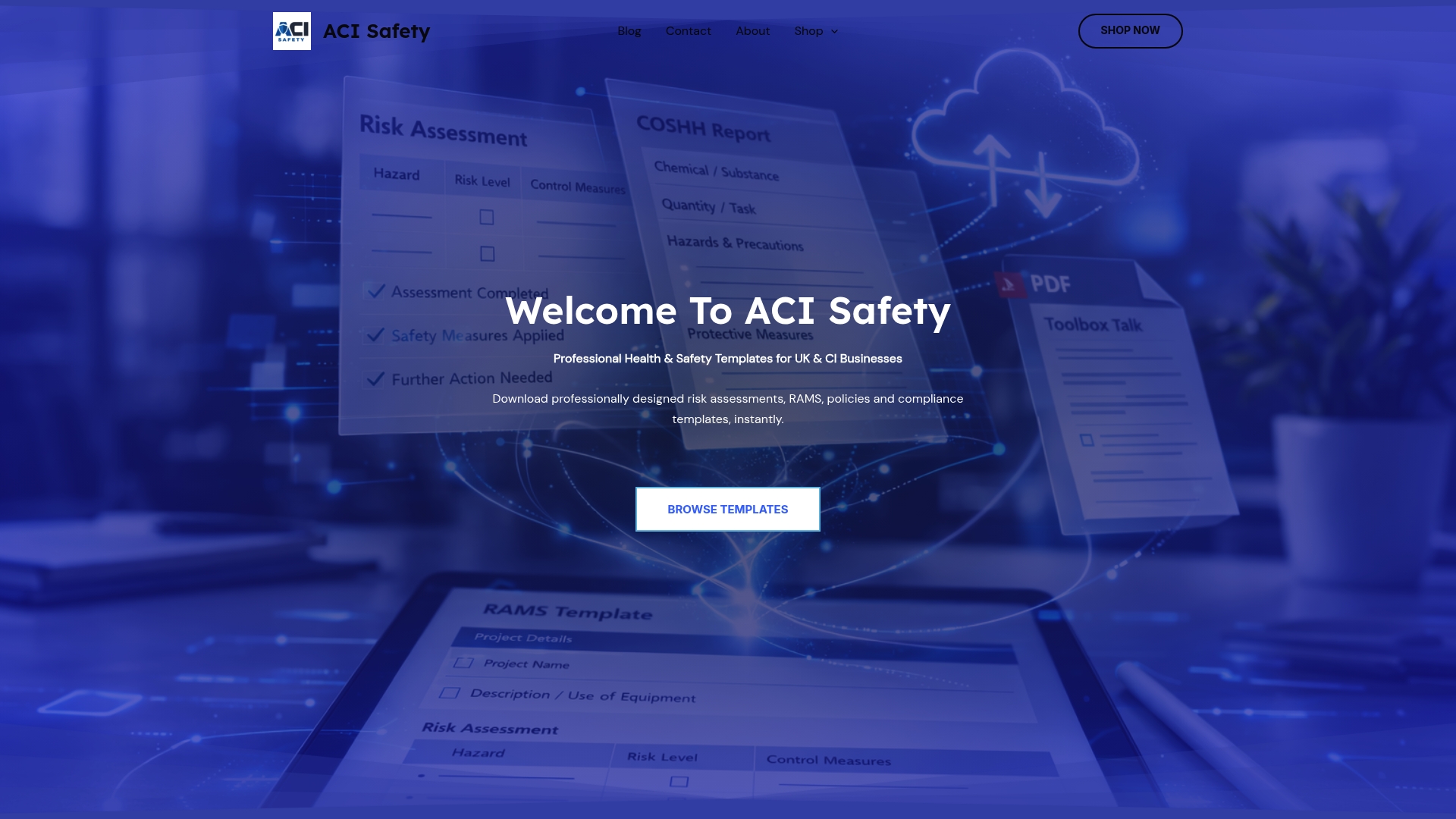
Our RAMS templates cover common construction and trades activities with pre-written risk assessments and method statements you can edit in minutes. Download instantly in Word and PDF formats, then tailor the content to match your exact working methods and site conditions. Each template follows HSE best practice and CDM 2015 requirements.
For businesses needing comprehensive policy documentation, our customisable health and safety policy templates provide the three-part structure required by law, with clear sections for your statement of intent, organisational responsibilities, and practical arrangements. Simply add your business details and specific procedures.
Explore our full range of method statement templates to build a complete documentation library efficiently. Every template is designed by health and safety professionals with deep understanding of UK regulations and practical site requirements.
FAQ
What documents make up a health and safety policy?
A compliant health and safety policy contains three distinct parts. The statement of intent declares your commitment to health and safety and must be signed by a senior person such as a director or business owner. The responsibilities section identifies who manages health and safety at each level of your organisation. The arrangements section describes your practical systems for controlling specific risks like fire, first aid, and accident reporting.
When is a written health and safety policy legally required in the UK?
Written health and safety policies become legally mandatory when you employ five or more people. This threshold includes all workers on your payroll: full-time, part-time, casual, and fixed-term employees. Volunteers and genuinely self-employed contractors are excluded from the count. Even if you employ fewer than five people, having a written policy demonstrates good practice and helps you manage risks systematically.
How often should health and safety documents be reviewed and updated?
Review your health and safety documentation at least annually or whenever significant changes occur. Triggers for immediate review include new equipment or substances, changes to work processes, accidents or near misses, new legislation, or organisational restructuring. Regular reviews ensure your documentation reflects current working practices and remains legally compliant. Set calendar reminders to prompt annual reviews even when no obvious changes have occurred.
What are the risks of not having proper health and safety documentation?
Inadequate documentation exposes your business to multiple serious risks. Failure to implement safe systems can lead to fines and serious injury, as recent cases show, with courts imposing penalties exceeding £100,000 for serious breaches. Beyond financial penalties, poor documentation increases accident likelihood because workers lack clear guidance on safe procedures. Your business also faces reputational damage, difficulty winning contracts, and potential director disqualification in severe cases.