
Many UK small business owners feel overwhelmed by health and safety compliance, uncertain about what the law actually requires and worried about costly mistakes. Business perceptions survey data shows 58% of SMEs find compliance challenging. Non-compliance risks substantial fines, legal action, and reputational damage. This guide clarifies your legal obligations under UK law and provides practical steps to achieve compliance efficiently. You’ll learn which requirements apply to your business size, how to implement essential processes, and how to avoid common pitfalls whilst protecting your employees and business.
Table of Contents
- Key takeaways
- Understanding health and safety compliance in UK SMEs
- Essential processes and frameworks for compliance
- Special cases and common challenges for SMEs
- Benefits of compliance and risks of non-compliance
- Simplify your health and safety compliance with ACI Safety
- Frequently asked questions
Key Takeaways
| Point | Details |
|---|---|
| Legal duties under HSWA | Your main legal duty is to protect workers and others from harm under HSWA 1974 and related regulations. |
| Size based obligations | The requirements you must meet depend on business size, with five or more employees needing written policies and recorded risk assessments. |
| Core employer duties | All employers must assess risks, provide training, consult workers, appoint competent people, maintain safe systems of work, and report serious incidents under RIDDOR. |
| Hierarchy and ALARP | Apply the hierarchy of controls and ALARP by eliminating hazards first, then substituting substances, engineering controls, administrative controls, and finally personal protective equipment. |
Understanding health and safety compliance in UK SMEs
Health and safety compliance means legally ensuring the health, safety and welfare of your employees and anyone affected by your business operations. UK SME compliance is primarily governed by HSWA 1974 and the Management of Health and Safety at Work Regulations 1999. These laws establish your fundamental duty to protect workers and visitors from harm.
Your specific obligations depend on your business size. If you employ fewer than five people, you don’t need a written health and safety policy or recorded risk assessments, though you must still assess risks and manage them appropriately. Once you reach five or more employees, written policies and documented assessments become mandatory. This threshold includes part-time, temporary and seasonal workers.
Every UK employer must fulfil several core duties regardless of size:
- Conduct suitable and sufficient risk assessments to identify workplace hazards
- Provide adequate training and information to employees about risks and controls
- Consult employees on health and safety matters affecting them
- Appoint competent persons to help manage health and safety
- Implement safe systems of work and maintain equipment properly
- Report serious workplace incidents under RIDDOR regulations
These requirements apply across all sectors, though specific industries face additional regulations. Construction sites, laboratories and facilities using hazardous substances must comply with extra laws covering their particular risks. Understanding which regulations apply to your operations forms the foundation of effective compliance.
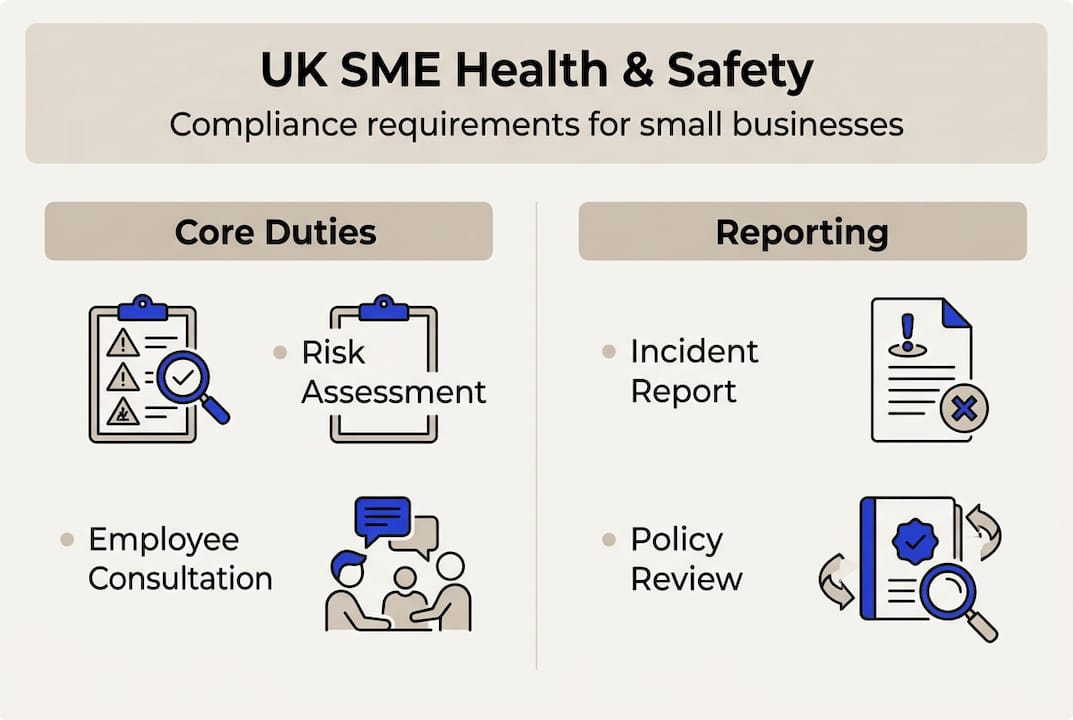
The law requires you to do what is reasonably practicable to protect people. This means balancing the level of risk against the time, cost and effort needed to control it. You’re not expected to eliminate every conceivable risk, but you must address significant hazards with appropriate measures. This practical approach recognises SME resource constraints whilst maintaining robust protection standards.
Essential processes and frameworks for compliance
Achieving compliance requires implementing specific processes systematically. Every employer must conduct risk assessments and document them if employing five or more people. Follow these essential steps:
- Identify hazards in your workplace by walking through your premises and observing work activities
- Determine who might be harmed and how, considering employees, visitors, contractors and vulnerable groups
- Evaluate risks and decide on control measures using established frameworks
- Record your findings and implement controls, documenting everything if you have 5+ employees
- Review assessments regularly, at least annually or when work activities change significantly
The hierarchy of controls provides a proven framework for managing risks effectively. This approach follows ALARP principles, ensuring risks are reduced as low as reasonably practicable. Apply controls in this order of effectiveness:
- Elimination: Remove the hazard completely where possible
- Substitution: Replace dangerous substances or processes with safer alternatives
- Engineering controls: Install physical barriers, guards, ventilation or other protective systems
- Administrative controls: Implement safe work procedures, training, signage and supervision
- Personal protective equipment: Provide PPE as a last line of defence when other controls are insufficient
Your written health and safety policy must outline your commitment, organisational responsibilities and practical arrangements. Keep it specific to your business rather than using generic templates that don’t reflect your actual operations. Include who does what, when and how for key safety activities.
Pro Tip: Review your risk assessments whenever you introduce new equipment, substances, procedures or work areas. Don’t wait for the annual review if your operations change.
Employee consultation strengthens compliance by tapping into frontline knowledge about workplace risks. Consult workers directly or through safety representatives on matters affecting their health and safety. This legal duty also helps identify hazards you might otherwise miss.

Appoint competent persons to assist with health and safety management. Competence means having sufficient training, experience and knowledge to fulfil the role effectively. For many SMEs, this might be you as the business owner, supplemented by external advice when needed. Maintain first aid arrangements appropriate to your workplace risks and ensure site safety measures are clearly communicated.
Report serious workplace incidents under RIDDOR, including fatalities, major injuries, dangerous occurrences and occupational diseases. You must notify the HSE immediately for fatal or major injuries and submit written reports within specified timeframes. Keep records of reportable incidents for at least three years.
Special cases and common challenges for SMEs
Counting employees correctly determines whether written policies and documented assessments are mandatory. Include all workers on your payroll, regardless of hours worked. Part-time staff working just a few hours weekly count equally with full-time employees. Temporary and seasonal workers also count towards the five-employee threshold during their employment period.
Sole traders and self-employed individuals generally face lighter obligations if they create no risk to others. However, you must still comply fully if your work affects other people’s safety. Construction workers, for example, must follow site safety rules and coordinate with other trades even when self-employed.
| Business type | Policy requirement | Assessment documentation |
|---|---|---|
| Under 5 employees | Not mandatory | Not mandatory but must assess risks |
| 5+ employees | Written policy required | Must document all assessments |
| Sole trader (no risk to others) | Exempt | Exempt |
| Sole trader (affects others) | Must comply | Must comply |
High-risk sectors face additional regulatory requirements beyond basic health and safety law. COSHH regulations govern workplaces using hazardous substances, requiring specific assessments and control measures. Construction sites must comply with CDM Regulations, establishing clear roles for clients, designers and contractors. Laboratories and facilities handling dangerous substances follow DSEAR requirements. Operations using lifting equipment must adhere to LOLER provisions.
Homeworking arrangements create compliance obligations many SMEs overlook. You remain responsible for employees’ health and safety even when they work from home. Conduct Display Screen Equipment assessments for homeworkers using computers regularly. Consider risks from electrical equipment, manual handling, workstation setup and working alone. Provide necessary equipment and guidance to manage these risks effectively.
Common SME challenges include:
- Balancing thoroughness with administrative burden when resources are limited
- Keeping documentation current as the business evolves
- Understanding which of numerous regulations actually apply to your operations
- Finding reliable, proportionate guidance rather than overwhelming technical detail
- Maintaining compliance during busy periods when safety can slip down priorities
Pro Tip: Focus your efforts on significant risks that could realistically cause harm. Don’t waste time documenting trivial hazards like using staplers or walking on flat floors. HSE provides simple tools designed specifically for small businesses that help you concentrate on what matters.
Managing multiple sites or mobile workers adds complexity. Each location requires risk assessment covering site-specific hazards. Mobile workers need clear procedures for working safely away from your main premises, including lone working protocols and emergency arrangements. Coordinate with other businesses when your employees work on shared sites or client premises.
Consultation requirements can seem daunting for small teams, but they needn’t be formal or complicated. Regular conversations about safety concerns, toolbox talks and team meetings satisfy legal consultation duties. Document key discussions and actions taken in response to employee input.
Benefits of compliance and risks of non-compliance
Non-compliance carries severe financial penalties scaled to business turnover. SMEs with turnover under £2 million face fines up to £450,000 for serious breaches. Between 2020 and 2024, over 5,000 workplace violations resulted in £211 million in fines. Average penalties for SMEs exceed £60,000, a substantial hit for any small business.
Financial penalties represent just one consequence of non-compliance. Consider these additional risks:
- Reputational damage that deters customers, partners and quality employees
- Director personal liability including potential imprisonment for gross negligence
- Increased insurance premiums or difficulty obtaining coverage
- Operational disruption from enforcement notices requiring immediate action
- Civil claims from injured employees seeking compensation
- Loss of contracts requiring health and safety credentials
“For SMEs operating on tight margins, a single major health and safety fine can threaten business viability. The financial impact extends beyond the penalty itself to legal costs, operational disruption and reputational damage that affects future trading.”
Conversely, effective compliance delivers tangible benefits beyond avoiding penalties. Insurance providers offer premium reductions to businesses demonstrating robust safety management. Fewer accidents mean reduced absence costs and maintained productivity. Employees feel valued when you prioritise their safety, improving morale and retention.
Compliance strengthens your competitive position when tendering for contracts. Many clients now require evidence of health and safety competence before awarding work. Professional documentation and clear safety procedures demonstrate you’re a responsible, reliable business partner.
Proactive compliance proves far more cost-effective than reactive responses to incidents or enforcement action. Implementing proper workplace safety measures prevents accidents that could otherwise result in injury, legal action and business disruption. The time invested in risk assessments and training pays dividends through smoother operations and protected reputation.
Key benefits include:
- Lower insurance premiums reflecting reduced risk profile
- Enhanced employee morale and reduced turnover
- Improved productivity from fewer accidents and absences
- Competitive advantage when bidding for contracts
- Protection from prosecution and civil claims
- Better relationships with regulators and clients
Small businesses often worry compliance will burden them with excessive bureaucracy. Practical UK health and safety guidance shows compliance needn’t be complicated. Proportionate measures tailored to your actual risks satisfy legal requirements without creating unnecessary paperwork. Focus on effective controls rather than elaborate documentation.
The HSE takes a supportive approach to SMEs genuinely trying to comply. Inspectors recognise small businesses face resource constraints and provide guidance to help you improve. Serious enforcement action targets businesses showing deliberate disregard for safety or repeated failures to address known risks.
Simplify your health and safety compliance with ACI Safety
Navigating health and safety requirements whilst running your business demands time and expertise many SMEs struggle to find. ACI Safety provides professionally designed documentation templates that help UK small businesses meet legal compliance requirements efficiently. Our editable templates cover risk assessments, method statements, COSHH assessments and health and safety policies tailored to your sector.
Standardising your health and safety documents can reduce administrative burden by over 40%, freeing your time for core business activities. Our essential documentation list ensures you have everything needed for compliance without unnecessary paperwork. Each template comes as an instant digital download in Word and PDF formats, ready to customise for your specific operations.
Our customisable health and safety policy template provides a structured framework you can adapt to your business quickly. Rather than starting from scratch or using generic policies that don’t fit your operations, you get professionally designed documents reflecting current UK requirements. This approach ensures legal robustness whilst maintaining the flexibility SMEs need.
Pro Tip: Professional templates provide a solid foundation, but always customise them to reflect your actual workplace risks and control measures. Generic policies fail to demonstrate genuine understanding of your specific hazards.
Frequently asked questions
Do I need a health and safety policy if I employ four people?
No, written policies become mandatory only when you employ five or more people. However, you must still manage health and safety effectively and assess risks even without documented policies. Consider creating written procedures anyway as good practice for consistency.
How often should I review my risk assessments?
Review assessments at least annually or whenever significant changes occur. New equipment, substances, work processes or premises all trigger review requirements. Don’t wait for scheduled reviews if your operations change. Maintaining current documentation ensures continued compliance and effective risk control.
What happens if an employee ignores safety procedures?
Employees have legal duties to follow safety instructions and cooperate with health and safety arrangements. Address non-compliance through your disciplinary procedures, providing additional training if needed. Document incidents and actions taken. Repeated or serious breaches may justify dismissal, but ensure you follow fair procedures.
Can I manage health and safety myself or must I hire a consultant?
You can manage compliance yourself if you have sufficient knowledge and time. Many SME owners successfully handle health and safety with support from HSE guidance and professional templates. Consider external advice for complex risks or specialist areas like COSHH or fire safety where expert input adds value.
What records must I keep and for how long?
Maintain risk assessments, training records, incident reports and health surveillance records. Keep RIDDOR reports for at least three years. Retain other health and safety records for the period they remain current plus a reasonable period afterwards. Good record keeping demonstrates compliance and provides evidence if questioned by regulators or in legal proceedings.
Do part-time workers count towards the five-employee threshold?
Yes, all employees count regardless of hours worked. Part-time, temporary and seasonal workers all contribute to the total when determining whether written policies and documented assessments are required. Count everyone on your payroll at any given time, not just full-time permanent staff.