
Navigating health and safety compliance can feel overwhelming when you’re running a small business in the UK. Terms like hazard, risk, SFAIRP, and COSHH often appear in guidance documents, but their practical meanings and applications aren’t always clear. Understanding these fundamental concepts is essential for meeting your legal obligations, protecting your workforce, and creating effective documentation. This guide breaks down the most important health and safety terminology you need to know, explaining each term in plain language and showing you exactly how to apply them in your day-to-day operations.
Table of Contents
- Key takeaways
- Understanding key health and safety terms: hazard, risk, and risk assessment
- Applying the principle of so far as is reasonably practicable (SFAIRP) in risk management
- Overview of COSHH and managing hazardous substances
- Manual handling risks and practical assessment for SMEs
- Resources to simplify your health and safety compliance
- Frequently asked questions
Key Takeaways
| Point | Details |
|---|---|
| Hazard versus risk | A hazard is something that could cause harm, while risk measures the likelihood and severity of that harm actually happening. |
| Written risk assessments | Written risk assessments are mandatory for five or more employees and you should follow the HSE five step approach to risk assessment. |
| SFAIRP standard | The law requires balancing risk against the effort, time and cost required to control it, accepting that perfect safety is unattainable. |
| Worker involvement | Involve workers directly in risk assessments to improve accuracy and buy in. |
| Regular reviews | Regular reviews and updates keep controls effective and reflect evolving operations. |
Understanding key health and safety terms: hazard, risk, and risk assessment
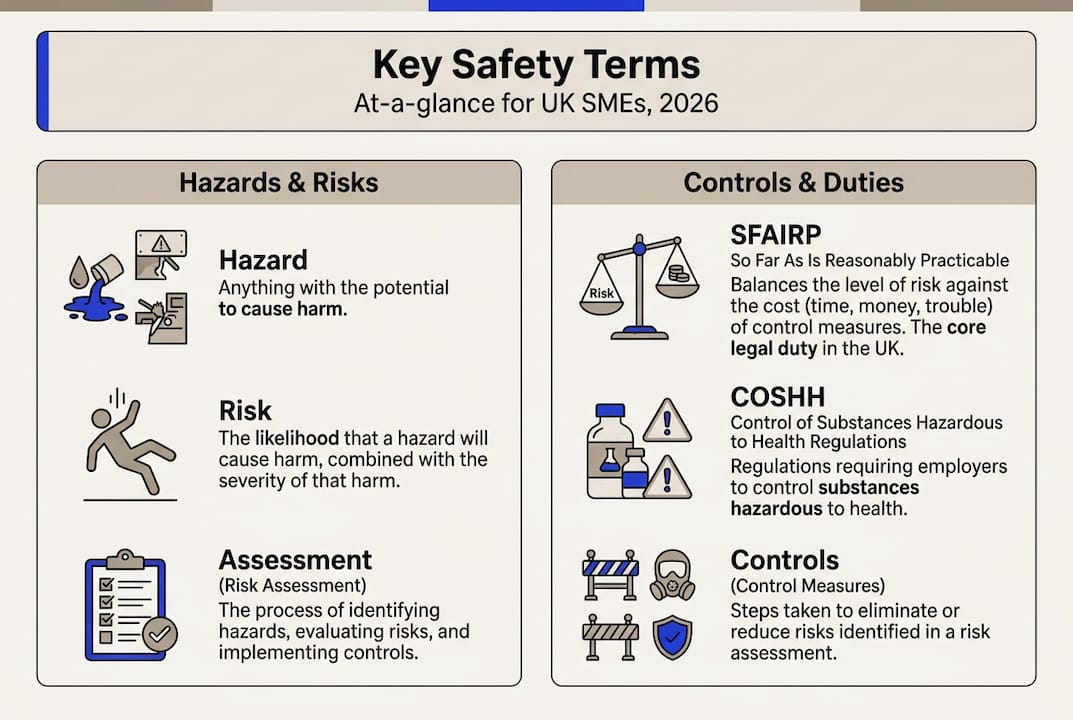
The distinction between hazard and risk forms the foundation of workplace safety management. A hazard is anything with potential to cause harm, such as chemicals, electricity, working at height, or even stress. Risk, however, measures the likelihood and severity of harm actually occurring from that hazard. Think of it this way: a bottle of cleaning fluid is a hazard, but the risk depends on factors like how concentrated it is, whether workers wear gloves, and how frequently they use it.
For UK businesses, understanding this difference matters because your legal duties centre on managing risks, not eliminating every possible hazard. That would be impossible in most workplaces. Instead, you assess each hazard to determine its risk level, then implement proportionate controls. This pragmatic approach recognises that some hazards are inherent to certain work activities.
Risk assessment becomes your primary tool for this process. If you employ five or more people, written risk assessments are mandatory under the Management of Health and Safety at Work Regulations 1999. Even smaller businesses benefit enormously from documenting their assessments. The HSE recommends a straightforward five-step approach:
- Identify the hazards present in your workplace
- Determine who might be harmed and how
- Evaluate the risks and decide on precautions
- Record your findings and implement them
- Review your assessment regularly and update when needed
This systematic method ensures you don’t overlook important risks and provides evidence of your due diligence. Your assessment should consider everyone who might be affected, including employees, contractors, visitors, and members of the public. Certain groups require special attention, such as young workers, pregnant employees, or those with disabilities, because they may face heightened risks from specific hazards.
Pro Tip: Involve your workers directly in risk assessments. They often spot hazards management might miss because they interact with equipment and processes daily. Their practical insights make assessments more accurate and controls more effective.
Regular reviews keep your assessments relevant as your business evolves. Significant changes like new equipment, different work methods, or site safety improvements trigger the need for updates. Even without major changes, annual reviews ensure your controls remain effective and you haven’t missed emerging risks.
Applying the principle of so far as is reasonably practicable (SFAIRP) in risk management
SFAIRP represents the legal standard underpinning nearly all UK health and safety duties. The Health and Safety at Work Act 1974 requires employers to ensure workplace safety so far as is reasonably practicable, meaning you must balance the level of risk against the time, money, and effort needed to control it. This principle acknowledges that absolute safety is unattainable and sometimes the cost of additional controls becomes grossly disproportionate to the tiny risk reduction they would achieve.
Understanding SFAIRP helps you make defensible decisions about safety measures. The law doesn’t expect you to spend unlimited resources on negligible risks. However, where risks are high and controls are reasonably affordable and practical, you must implement them. The key question becomes whether the sacrifice needed to implement a control measure is grossly disproportionate to the risk being addressed.
For small businesses, applying SFAIRP means taking a proportionate approach. If a simple, inexpensive guard can prevent serious injury from machinery, that’s clearly reasonably practicable and you must fit it. Conversely, if eliminating a minor risk would require shutting down your entire operation or spending hundreds of thousands of pounds, that likely exceeds what’s reasonably practicable. The burden of proof lies with you to demonstrate why a particular measure wasn’t reasonably practicable if challenged.
Consider practical examples. Installing non-slip flooring in a frequently wet area is reasonably practicable because it’s a one-time cost that prevents common slip injuries. Requiring full body harnesses for workers who occasionally need to reach items on shelves 1.5 metres high would be excessive, but providing stable step stools is entirely reasonable. The principle guides you toward sensible, proportionate controls.
Regular review of your control measures ensures they remain reasonably practicable as circumstances change. New technologies might make previously expensive controls affordable. Changes in your operations might make certain risks more significant, shifting the balance toward stronger controls. Staying current with essential health and safety documentation helps you track these decisions and demonstrate your reasoning.
Pro Tip: Document why you chose specific control measures and why you ruled out others. If an incident occurs or an inspector visits, this record demonstrates your thought process and shows you applied SFAIRP principles properly. It protects you legally and helps train new managers.
Overview of COSHH and managing hazardous substances
The Control of Substances Hazardous to Health Regulations 2002 (COSHH) establish specific requirements for managing chemicals and other hazardous substances in the workplace. These regulations recognise that many businesses use potentially dangerous materials as part of normal operations. COSHH requires assessment, prevention or control, monitoring, and training to protect workers from harm.
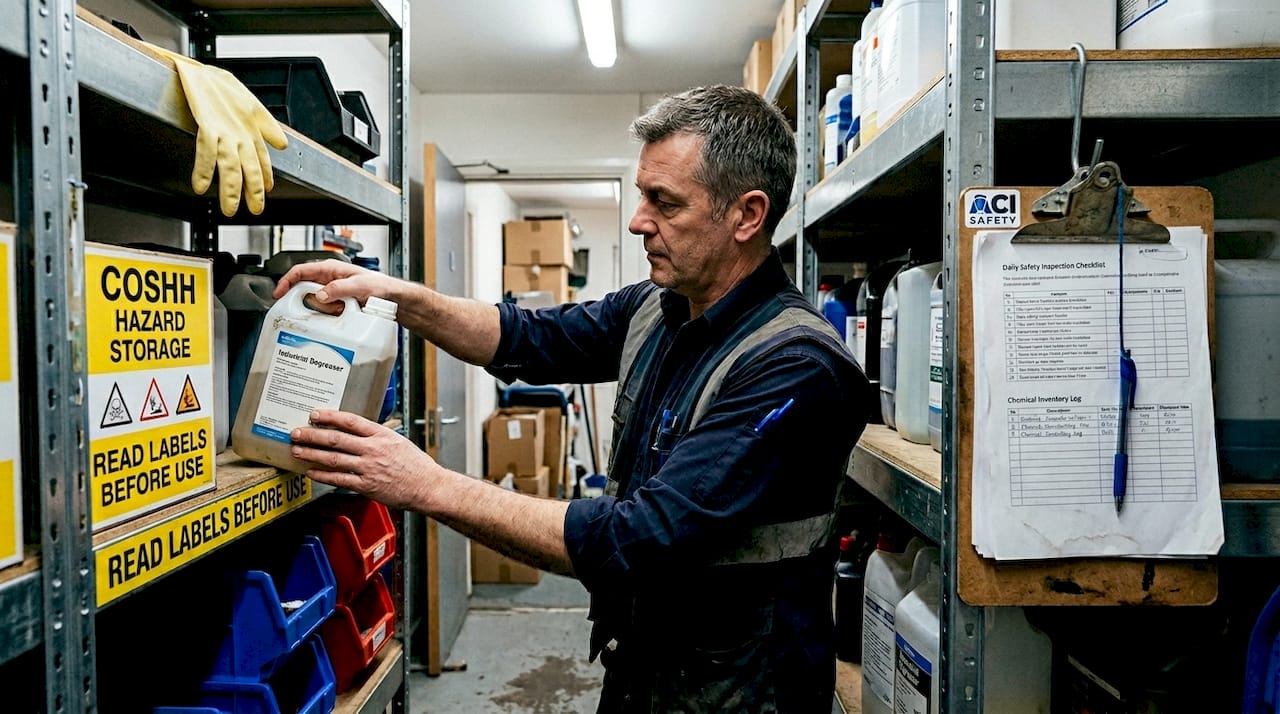
COSHH covers most substances hazardous to health, including chemicals, fumes, dusts, vapours, mists, and biological agents. Common examples in SME settings include cleaning products, paints and solvents, welding fumes, wood dust, and flour dust in bakeries. However, COSHH doesn’t cover everything. Lead, asbestos, and radioactive substances have their own specific regulations, though the assessment principles remain similar.
Substances can harm health through various routes: inhalation into the lungs, absorption through skin, ingestion, or injection through puncture wounds. Effects range from immediate issues like chemical burns or breathing difficulties to long-term conditions like occupational asthma, dermatitis, or even cancer from prolonged exposure. Your COSHH assessment must consider all potential exposure routes and health effects.
Implementing COSHH compliance follows eight essential steps:
- Assess the risks from hazardous substances used in your workplace
- Decide what precautions are needed based on your assessment
- Prevent or adequately control exposure using the hierarchy of controls
- Ensure control measures are used, maintained, and work properly
- Monitor exposure levels where necessary
- Carry out appropriate health surveillance for affected workers
- Prepare plans and procedures for accidents, incidents, and emergencies
- Provide suitable information, instruction, and training for employees
The hierarchy of controls guides your choice of prevention and control measures. Elimination comes first: can you avoid using the hazardous substance entirely? Substitution follows: can you replace it with something less dangerous? If neither works, you move to engineering controls like ventilation systems, then administrative controls like limiting exposure time, and finally personal protective equipment as a last line of defence.
Regular monitoring ensures your controls remain effective. Some higher-risk situations require formal exposure monitoring or health surveillance. For most SMEs, simpler checks suffice: are extraction systems working properly? Do workers follow safe handling procedures? Are PPE items in good condition and worn correctly? Documentation of these checks demonstrates ongoing compliance.
Training forms a crucial COSHH requirement. Workers must understand the risks from substances they handle, the control measures in place, and emergency procedures. This knowledge empowers them to work safely and report problems promptly. Refresher training maintains awareness, especially when you introduce new substances or change processes. Detailed COSHH regulations guidance helps you implement these requirements systematically.
Manual handling risks and practical assessment for SMEs
Manual handling encompasses any activity requiring workers to move or support loads using bodily force. This includes lifting, lowering, pushing, pulling, carrying, or moving items by hand or with bodily effort. Despite seeming routine, manual handling causes significant workplace harm. Statistics show manual handling accounts for 17% of non-fatal injuries reported to the HSE, making it the single most common cause of workplace injuries across UK industries.
Risk factors in manual handling extend beyond just the weight of items. The task itself matters: do workers need to twist, stoop, or reach while handling loads? The load characteristics play a role: is it bulky, difficult to grasp, unstable, or sharp? The working environment creates additional risks through limited space, uneven floors, poor lighting, or temperature extremes. Individual capability varies based on strength, fitness, pregnancy, or health conditions. All these factors combine to determine overall risk.
The HSE provides practical assessment tools specifically designed for SMEs. The manual handling risk filters offer a quick screening method to identify low-risk activities that need no detailed assessment. If your handling tasks pass these filters, simple good practice controls suffice. For tasks that fail the filters, more detailed assessment becomes necessary using tools like the Manual Handling Assessment Charts (MAC) for lifting operations or the Risk Assessment of Pushing and Pulling (RAPP) tool for those activities.
Vulnerable workers require special consideration in manual handling assessments. Young workers may lack experience judging safe loads. Pregnant workers face changing centre of gravity and hormonal effects on ligaments. Workers with existing musculoskeletal conditions or disabilities need individual assessment. Older workers may have reduced strength or flexibility. Your assessment must account for these individual factors rather than assuming all workers have identical capabilities.
| Assessment approach | When to use | Key benefits |
|---|---|---|
| HSE risk filters | Initial screening of routine tasks | Quick identification of low-risk activities |
| MAC tool | Detailed lifting and lowering assessment | Numerical risk scores for prioritising controls |
| RAPP tool | Pushing and pulling operations | Specific guidance for trolleys and wheeled loads |
| Individual assessment | Vulnerable workers or complex tasks | Tailored controls for specific circumstances |
Good practice controls reduce manual handling risks effectively:
- Redesign tasks to eliminate or minimise manual handling where possible
- Use mechanical aids like trolleys, hoists, or conveyors for heavy or frequent loads
- Reduce load weights by breaking bulk items into smaller quantities
- Improve workplace layout to minimise carrying distances and awkward movements
- Provide training on safe manual handling techniques and proper equipment use
- Rotate workers between different tasks to vary physical demands
Pro Tip: Involve workers early when redesigning manual handling tasks. They understand the practical challenges and can suggest improvements management might not consider. This collaboration often identifies simple, cost-effective solutions that dramatically reduce risk.
Regular review of manual handling controls ensures they remain effective as your operations evolve. New products, changed storage arrangements, or different work patterns can alter risk profiles significantly. Injury reports and near-miss incidents highlight where current controls may be failing. Proactive monitoring catches problems before they cause harm. Comprehensive health and safety templates help you document assessments and track control measures systematically.
Resources to simplify your health and safety compliance
Understanding health and safety terminology is just the first step. Translating that knowledge into compliant documentation can feel daunting, especially when you’re focused on running your business. ACI Safety specialises in helping UK SMEs bridge this gap with professionally designed, ready-to-use templates that save time and ensure accuracy.
Our health and safety templates cover everything from risk assessments and COSHH forms to method statements and policy documents. Each template comes as an editable Word document, allowing you to customise content for your specific business while maintaining the professional structure and legal completeness you need. Whether you require a customisable health and safety policy for your growing team or detailed RAMS templates for specific projects, our digital resources provide immediate solutions.
Pro Tip: Using professionally structured templates ensures you don’t miss critical sections that inspectors expect to see. They also speed up the documentation process dramatically, letting you focus on implementing controls rather than formatting documents.
Visit ACI Safety to explore our full range of instant-download health and safety resources designed specifically for UK businesses like yours.
Frequently asked questions
What is the difference between a hazard and a risk in workplace safety?
A hazard is anything that has the potential to cause harm, such as chemicals, electricity, or working at height. Risk measures the likelihood and severity of harm actually occurring from that hazard, considering factors like exposure frequency and existing controls. Understanding this distinction helps you prioritise safety measures effectively.
Do I need written risk assessments if I have fewer than five employees?
Written risk assessments are legally required only when you employ five or more people. However, all employers must assess risks regardless of size, and documenting your findings provides valuable evidence of due diligence. Many small businesses find written assessments helpful for training new staff and demonstrating compliance to clients or insurers.
What substances are covered under COSHH regulations?
COSH covers most chemicals, fumes, dusts, vapours, mists, and biological agents that pose health risks. Common examples include cleaning products, paints, solvents, welding fumes, and flour dust. Notable exceptions with separate regulations include lead, asbestos, and radioactive materials, though assessment principles remain similar across all hazardous substances.
How often should I review my health and safety risk assessments?
Review risk assessments at least annually, or whenever significant changes occur in your workplace. Triggers for review include new equipment, changed work methods, incidents or near misses, or changes to your workforce. Regular reviews ensure your controls remain effective and you identify emerging risks promptly before they cause harm.
What are the most important manual handling controls for small businesses?
Prioritise eliminating or reducing manual handling through task redesign first. Where handling remains necessary, provide mechanical aids like trolleys or hoists, reduce load weights, improve workplace layout to minimise carrying distances, and train workers on safe techniques. These practical measures address the majority of manual handling risks cost effectively.
Where can I find templates for COSHH assessments and risk documentation?
ACI Safety provides comprehensive COSHH assessment templates and other health and safety documentation as instant digital downloads. These professionally structured templates in editable Word format help UK SMEs create compliant documentation quickly without starting from scratch, saving time and ensuring you include all legally required elements.