
UK small and medium-sized businesses waste thousands of hours annually managing inconsistent health and safety documentation. Standardized templates can reduce administrative time by up to 40%, freeing resources for growth while maintaining robust compliance. This guide explores how document standardization transforms compliance from burden to competitive advantage, addressing common misconceptions and providing a clear implementation framework for your business.
Table of Contents
-
Tangible Benefits of Standardizing Health & Safety Documents
-
Practical Framework to Implement Document Standardization in SMEs
Key Takeaways
| Point | Details |
| Time Savings | Standardizing documents reduces admin time by up to 40% through streamlined processes. |
| Error Reduction | Digital tools cut document errors by 50% and speed compliance responses. |
| Audit Readiness | Standardization improves audit preparedness by up to 25%, easing inspections. |
| Customization Myth | Editable templates maintain full customization without losing consistency. |
| Cost Reality | Bespoke documents take 60% more preparation time than standardized templates. |
Understanding Health & Safety Document Standardization
Document standardization means creating consistent formats, language, and content structures across all your health and safety documentation. For UK SMEs, this isn’t about generic, inflexible paperwork. It’s about establishing a reliable framework that simplifies updates, reduces errors, and clarifies communication across your organization.
Standardized templates balance uniformity with flexibility through editable fields that let you adapt documents to specific business risks. You maintain control over customization while benefiting from professional structure that aligns with regulatory requirements.
Common standardized documents include:
-
Risk assessments with consistent hazard identification formats
-
Method statements following uniform structure and terminology
-
Toolbox talks using standardized safety briefing templates
-
COSHH assessments with consistent chemical hazard documentation
-
Health and safety policies with uniform compliance frameworks
This unified approach creates a foundation for efficient documentation management. When your team knows exactly where to find information and how documents are structured, compliance becomes faster and more reliable. Standardized health and safety templates provide this framework without sacrificing the customization your business needs.
Tangible Benefits of Standardizing Health & Safety Documents
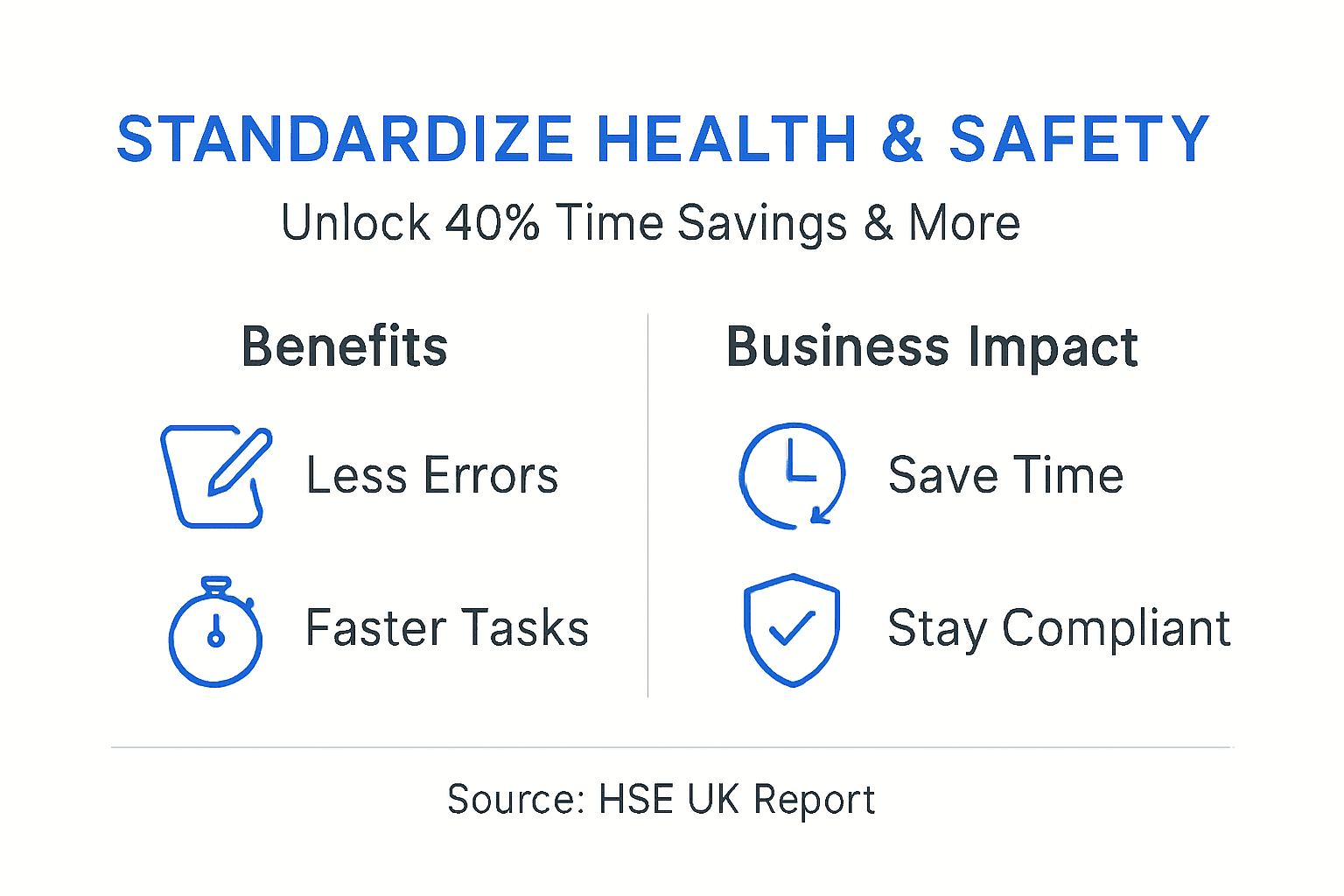
The business case for standardization rests on measurable improvements across multiple compliance areas. Standardized health and safety documents reduce administrative time by up to 40% for SMEs by streamlining data entry, review, and update processes. This dramatic reduction translates directly to cost savings and staff capacity for core business activities.
Beyond time savings, standardization delivers:
-
30% fewer compliance fines due to improved documentation accuracy
-
20% drop in workplace incidents linked to clearer safety protocols
-
Enhanced internal communication through consistent terminology
-
Faster onboarding as new staff quickly understand document structures
-
Reduced legal risk from incomplete or inconsistent records
Up to 40% reduction in administrative time means a business spending 10 hours weekly on health and safety documentation could reclaim 4 hours for revenue-generating activities. Over a year, that’s 208 hours returned to your business.

| Metric | Before Standardization | After Standardization | Improvement |
| Weekly admin hours | 10 hours | 6 hours | 40% reduction |
| Annual compliance fines | £5,000 | £3,500 | 30% reduction |
| Document errors per month | 12 errors | 6 errors | 50% reduction |
| Audit preparation time | 20 hours | 15 hours | 25% reduction |
These improvements compound over time. Consistent documentation builds organizational knowledge, making each subsequent update faster and more accurate. Staff become familiar with document structures, reducing training time and improving compliance understanding across your workforce.
Explore more about health and safety documentation benefits and review the HSE documentation efficiency report for detailed evidence.
Common Misconceptions About Document Standardization
Many UK SME owners hesitate to adopt standardized documentation due to persistent myths about rigidity and complexity. The reality contradicts these concerns.
Myth 1: Standardization means inflexible, generic documents. Standardized templates are fully editable. You customize every relevant field to reflect your specific operations, risks, and procedures. The standardization applies to structure and compliance framework, not the content itself.
Myth 2: Creating bespoke documents is more cost effective. Many small business owners wrongly believe that creating their own bespoke health and safety documents is more cost-effective than using standardized templates; however, bespoke creation often results in longer preparation times and higher risk of compliance errors. Bespoke documents typically require 60% more preparation time and lack professional compliance review.
Myth 3: Digital templates complicate compliance. Digital delivery actually simplifies document management through version control, instant updates, and centralized access. Staff find digital templates easier to complete and update than paper-based systems.
Myth 4: Only large businesses need standardized documentation. SMEs benefit more from standardization because they lack dedicated compliance teams. Efficient documentation systems let small teams manage compliance effectively without specialist resources.
Common false beliefs include:
-
Templates can’t accommodate industry-specific requirements
-
Standardization reduces document quality
-
Digital systems require expensive software investments
-
Templates become outdated quickly and need constant replacement
Pro Tip: Start by standardizing your most frequently updated documents like risk assessments and method statements. You’ll see immediate time savings that build confidence in the approach before expanding to your full documentation suite.
Editable health and safety templates provide the flexibility you need while maintaining professional compliance standards. Review the BSI Group report on document costs for detailed cost comparisons.
Legal and Compliance Advantages of Standardized Documents
Standardizing health and safety documentation supports legal compliance by aligning documents with UK law requirements such as the Health and Safety at Work Act 1974, COSHH, and RIDDOR. This alignment ensures your documentation covers all mandated elements, reducing legal risk and improving regulatory confidence in your systems.
Standardized documents deliver specific compliance advantages:
-
Complete coverage of statutory requirements across all document types
-
Consistent evidence trails for regulatory inspections
-
Clear demonstration of employer duty of care
-
Reduced risk of missing critical compliance elements
-
Faster response to regulatory changes through centralized updates
Audit readiness improves by up to 25% when documentation follows standardized formats. Inspectors can quickly locate required information, and your team spends less time preparing for visits. Clear, consistent documents help both staff and regulators understand your safety protocols without confusion or misinterpretation.
Legal protection extends beyond passing inspections. Should an incident occur, standardized documentation provides robust evidence of your compliance efforts. Courts and insurers view professional, consistent documentation more favourably than ad hoc paperwork, potentially reducing liability and insurance premiums.
Key legal benefits include:
-
Demonstrable compliance with employer legal obligations
-
Clear audit trails showing due diligence
-
Reduced fines and penalties from documentation errors
-
Protection against prosecution for compliance failures
-
Faster resolution of regulatory issues through clear records
Pro Tip: Maintain a document register showing when each template was last reviewed and updated. This simple addition demonstrates ongoing compliance commitment to regulators and provides clear evidence of your systematic approach to health and safety management.
Access health and safety policy templates aligned with current UK legislation. Review the Health and Safety at Work Act guide for detailed legal requirements.
Leveraging Digital Tools for Efficient Standardization
Digital-first delivery of health and safety templates allows instant access and version control, critical for maintaining compliance in dynamic environments like construction and facilities management. Digital templates reduce document errors by 50% compared to manually created documents, eliminating transcription mistakes and ensuring consistent data entry.
Modern digital platforms transform how SMEs manage health and safety documentation:
-
Instant template access from any location with internet connectivity
-
Automatic version control preventing outdated document use
-
Quick, compliant updates when regulations change
-
Centralized document management with clear audit trails
-
Reduced storage costs compared to paper-based systems
Digital templates reduce document errors by 50% because structured fields guide correct data entry and eliminate common manual mistakes. Pre-populated compliance sections ensure you never miss mandatory elements, and built-in formatting maintains professional presentation without design effort.
Version control proves especially valuable when regulations change. Instead of manually updating dozens of documents across different locations, digital systems let you update master templates once and distribute changes instantly. Your entire team accesses the current version automatically, eliminating compliance gaps from outdated paperwork.
Centralized document management creates comprehensive audit trails showing who accessed, edited, and approved each document. This transparency satisfies regulatory requirements while helping you identify documentation bottlenecks and improve internal processes.
Cloud-based access means site managers can complete and update documents in real-time from job sites, eliminating delays from office-based documentation processes. Mobile compatibility lets teams maintain compliance without returning to base, improving both efficiency and documentation accuracy.
Explore digital health and safety templates designed for instant download and immediate use. Review digital health and safety documentation benefits for detailed platform comparisons.
Practical Framework to Implement Document Standardization in SMEs
Successful standardization requires a structured approach that balances efficiency gains with practical implementation challenges. Follow this framework to standardize your health and safety documentation effectively.
-
Select professional, compliant templates. Choose templates from reputable providers that align with current UK regulations. Verify templates cover all statutory requirements for your industry and include editable fields for customization.
-
Customize templates to reflect business-specific risks. Use editable fields to adapt templates to your operations. Document your specific hazards, control measures, and procedures while maintaining the professional structure.
-
Implement a digital document management system. Choose a platform offering version control, access management, and audit trails. Even simple cloud storage with proper folder structures improves document control significantly.
-
Train staff on document use and compliance importance. Ensure everyone understands how to complete, update, and locate standardized documents. Emphasize why consistency matters for legal protection and operational safety.
-
Schedule regular reviews and updates. Set quarterly or biannual review dates to ensure documents remain current. Assign clear responsibility for maintenance to prevent documentation drift over time.
| Implementation Step | Time Investment | Expected Benefit |
| Template selection | 2-4 hours | Foundation for all documentation |
| Initial customization | 8-12 hours | Business-specific compliance |
| Digital system setup | 4-6 hours | Long-term efficiency gains |
| Staff training | 3-5 hours | Improved adoption and consistency |
| Ongoing maintenance | 2 hours/quarter | Sustained compliance and accuracy |
Pro Tip: Pilot standardization with one document type before rolling out across all health and safety paperwork. This approach lets you refine processes and demonstrate benefits before asking teams to change multiple established workflows simultaneously.
Start with high-impact, frequently updated documents like risk assessments or method statements. Success here builds momentum and confidence for broader standardization initiatives.
Access editable RAMS templates to begin your standardization journey with professionally designed, compliant documentation.
Conclusion and Next Steps
Standardizing your health and safety documentation delivers measurable improvements across administrative efficiency, legal compliance, and operational safety. The evidence is clear: up to 40% time savings, 50% fewer document errors, and 25% better audit readiness make standardization a strategic advantage for UK SMEs.
Editable templates strike the perfect balance between consistency and customization. You maintain full control over content while benefiting from professional structure and compliance alignment. Digital platforms enhance these benefits through instant access, version control, and simplified updates.
The path forward is straightforward. Select professional templates aligned with UK regulations, customize them to your specific risks, implement digital management systems, and train your team. Regular reviews keep documentation current as your business and regulations evolve.
Don’t let documentation burdens distract from business growth. Adopt customisable health and safety policy templates and transform compliance from administrative overhead to competitive advantage.
Transform Your Health & Safety Documentation Today
Ready to reclaim hours spent on compliance paperwork? ACI Safety provides customisable health and safety policy templates designed specifically for UK SMEs. Our digital templates deliver instant access, full editability, and professional compliance structure aligned with current regulations.
Every template downloads immediately in Word or PDF formats, letting you customize and implement standardized documentation within hours, not weeks. Browse our complete range of health and safety document templates including RAMS, risk assessments, COSHH assessments, method statements, and toolbox talks.
Visit the ACI Safety website today to explore how our templates help businesses like yours streamline compliance, reduce administrative burden, and focus resources where they matter most.
Why Standardize Health & Safety Documents? FAQ
How long does it take to implement standardized documentation?
Most SMEs complete initial standardization within two to three weeks. Template selection and customization require 10 to 16 hours, while digital system setup and staff training add another 7 to 11 hours. Piloting with one document type before full rollout reduces implementation risk and helps refine processes.
Can standardized templates accommodate industry-specific requirements?
Yes, professional templates include editable fields specifically designed for industry customization. You adapt templates to your sector’s unique hazards, control measures, and procedures while maintaining compliance structure. Construction, facilities management, and general business operations all benefit from this flexible approach.
What happens when health and safety regulations change?
Digital standardized templates simplify regulatory updates significantly. You modify master templates once to reflect new requirements, then distribute updates across your organization instantly. This centralized approach prevents compliance gaps from outdated documents and reduces update time by up to 70% compared to manual revision processes.
Do I need expensive software to manage standardized documents?
No, basic digital document management works with standard cloud storage platforms you likely already use. Proper folder structures, naming conventions, and version control protocols provide substantial benefits without specialized software investments. As your needs grow, you can upgrade to more sophisticated platforms offering enhanced features.
How does standardization improve workplace safety outcomes?
Clearer, more consistent documentation helps staff understand safety protocols better, contributing to a 20% reduction in workplace incidents. Standardized formats make critical information easier to find and follow, improving compliance with safety procedures. Regular reviews built into standardized systems ensure safety measures remain current and effective.
Explore more practical guidance on the health and safety documentation blog for ongoing insights and compliance updates.