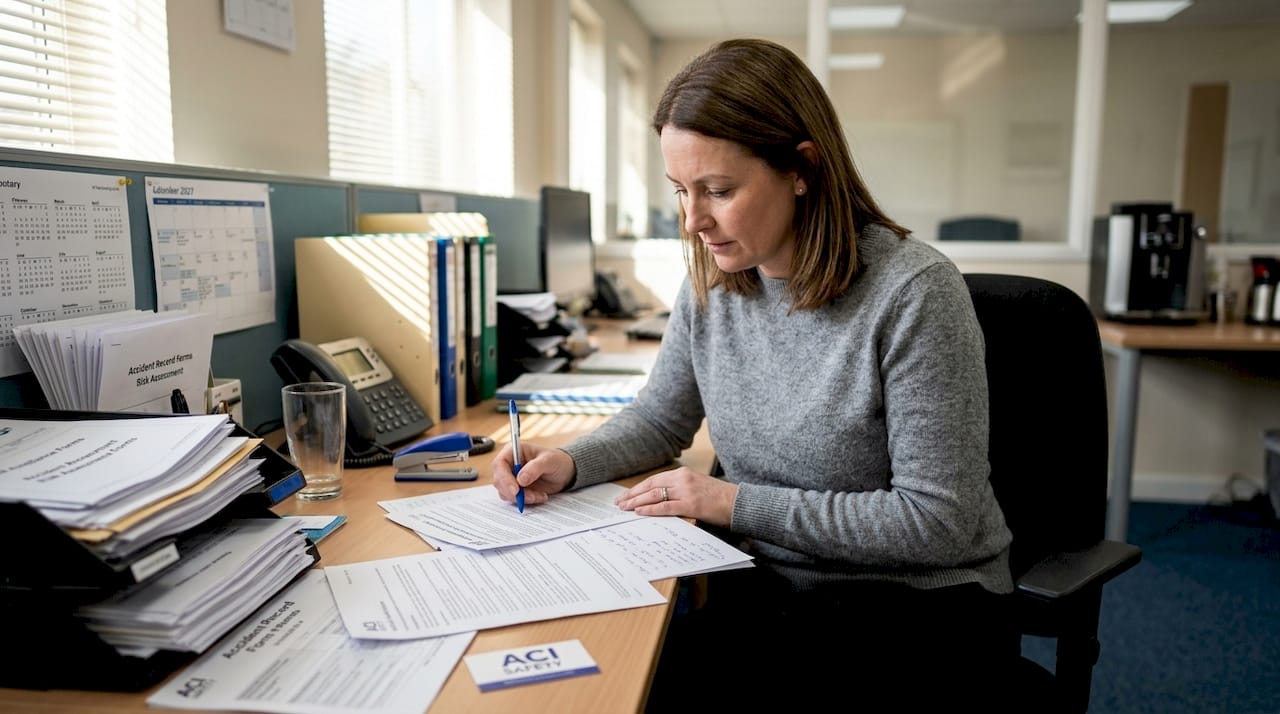
Even experienced health and safety officers occasionally mix up their terms. A ‘hazard’ becomes a ‘risk’, a ‘method statement’ gets confused with a ‘risk assessment’, and suddenly your documentation has gaps that could raise eyebrows during an HSE inspection. It sounds minor, but core HSE terminology is foundational to compliant documentation and robust risk management. Get it wrong and you’re not just being imprecise — you’re potentially leaving your business exposed. This guide cuts through the confusion, defines the terms you actually need, and shows you how to apply them correctly in your day-to-day compliance work.
Table of Contents
- Core health and safety terminology explained
- How risk assessment methodology underpins compliance
- Making sense of ALARP and risk reduction hierarchies
- Applying and advancing terminology: Beyond the basics
- Expert perspective: Why ‘suitable and sufficient’ beats perfection
- Next steps: Templates and tools for SME compliance
- Frequently asked questions
Key Takeaways
| Point | Details |
|---|---|
| Master key terms | Clear understanding of official terminology is essential for compliance and safety management. |
| Align language and process | Using HSE-approved terms in your documentation ensures audits and inspections run smoothly. |
| Apply the hierarchy of risk reduction | Prioritise engineering controls and justify your safety measures with the ALARP principle. |
| Know when to document | Written risk assessments are mandatory for 5+ employees, but always advisable for best practice. |
| Use tools to simplify compliance | Leverage templates and digital guides to save time and avoid costly terminology errors. |
Core health and safety terminology explained
Let’s break down the most critical health and safety language every SME must master. These aren’t just academic definitions — they’re the building blocks of every risk assessment, method statement, and safety policy you’ll ever write.
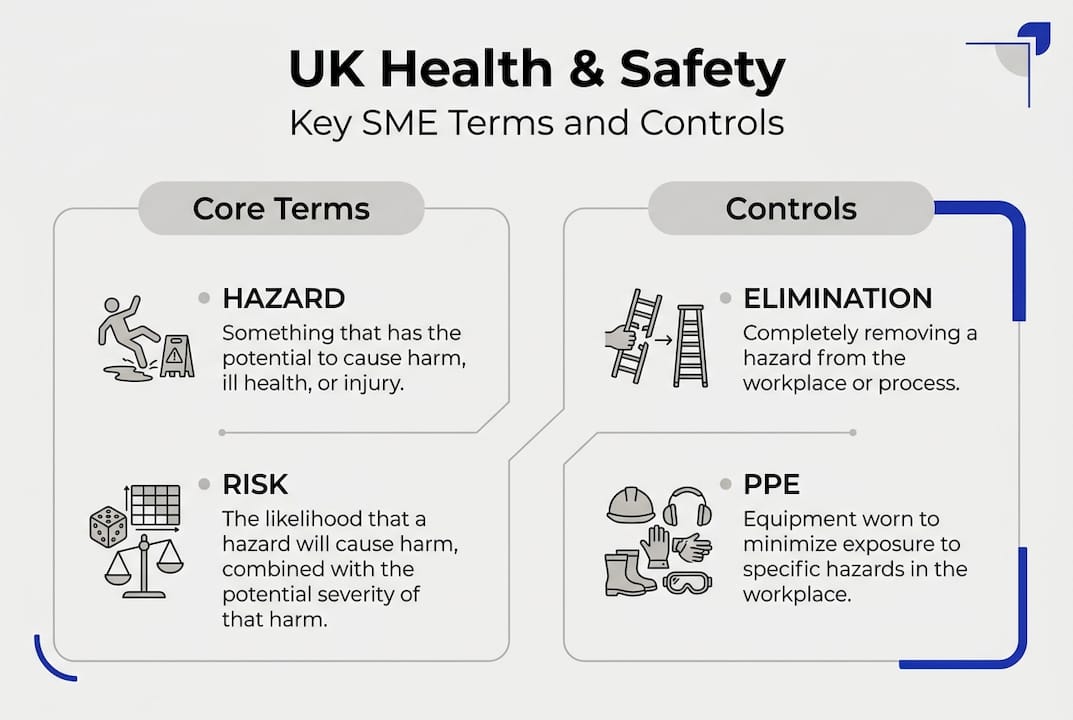
Hazard vs. risk — this is the big one. A hazard is anything with the potential to cause harm. A wet floor, a trailing cable, a chemical substance. A risk is the likelihood that the hazard will actually cause harm, combined with how severe that harm could be. Think of it this way: a lion in a zoo is a hazard. The risk to you personally is very low because there’s a big fence in the way.
Risk assessment is the formal process of identifying hazards, evaluating the associated risks, and deciding on control measures. A method statement (sometimes called a safe system of work) describes how a task will be carried out safely, step by step. They’re related but not the same thing. Mixing them up in documentation is one of the most common SME mistakes we see.
Here are the essential health and safety terms every officer should have locked in:
- Hazard: A source of potential harm or adverse health effect
- Risk: The likelihood and severity of harm occurring
- ALARP: As Low As Reasonably Practicable — the standard you must meet when reducing risk
- Suitable and sufficient: The legal standard your risk assessments must meet (not perfect, just proportionate)
- Competent person: Someone with the knowledge, skills, and experience to manage health and safety tasks correctly
- RAMS: Risk Assessment and Method Statement — a combined document common in construction and trades
| Term | What it means | Common mistake |
|---|---|---|
| Hazard | Potential source of harm | Calling a risk a hazard |
| Risk | Likelihood × severity | Treating all risks as equal |
| ALARP | Reduce risk as far as reasonably practicable | Doing the minimum and stopping |
| Competent person | Qualified and experienced individual | Appointing someone without relevant skills |
| Suitable and sufficient | Proportionate and fit for purpose | Over-engineering or under-documenting |
Pro Tip: When writing documentation, always ask yourself: ‘Am I describing the hazard or the risk here?’ Getting this right keeps your assessments legally sound and logically structured.
How risk assessment methodology underpins compliance
Solid terminology is only truly useful when applied correctly. The backbone of this application is risk assessment methodology.
The HSE’s five-step process is the standard framework for UK SMEs, and it’s genuinely straightforward once you see it laid out:
- Identify the hazards — Walk the workplace, talk to staff, review incident records
- Decide who might be harmed and how — Think employees, contractors, visitors, and members of the public
- Evaluate the risks and decide on precautions — Is the existing control adequate? What else could you do?
- Record your findings and implement them — Document what you found and what you’re doing about it
- Review your assessment and update if necessary — Especially after incidents, changes to process, or new equipment
Now, ‘suitable and sufficient’ comes up in step four. It doesn’t mean your documentation needs to be a masterpiece. It means it should be proportionate to the level of risk involved. A small office with low hazard activity doesn’t need the same depth of assessment as a construction site.
Key legal threshold: Written risk assessments are legally required if you employ five or more people. Below that threshold, written records aren’t mandatory — but they’re still strongly recommended. You’ll thank yourself if something ever goes wrong.
Common pitfalls SMEs fall into include:
- Completing a risk assessment once and never reviewing it
- Copying generic templates without tailoring them to the actual workplace
- Failing to involve workers in the process (they often spot hazards managers miss)
- Confusing ‘recording’ with ‘implementing’ — writing it down isn’t enough
Pro Tip: Set a calendar reminder to review all risk assessments annually, or immediately after any significant change. A stale assessment is almost as problematic as no assessment at all.
Our safety compliance guide and health and safety essentials resources can help you build a review cycle that actually sticks.
Making sense of ALARP and risk reduction hierarchies
Risk assessment is only complete when you can show you’ve chosen the right level of safeguards. Here’s how ALARP and the risk reduction hierarchy help SMEs make defensible decisions.
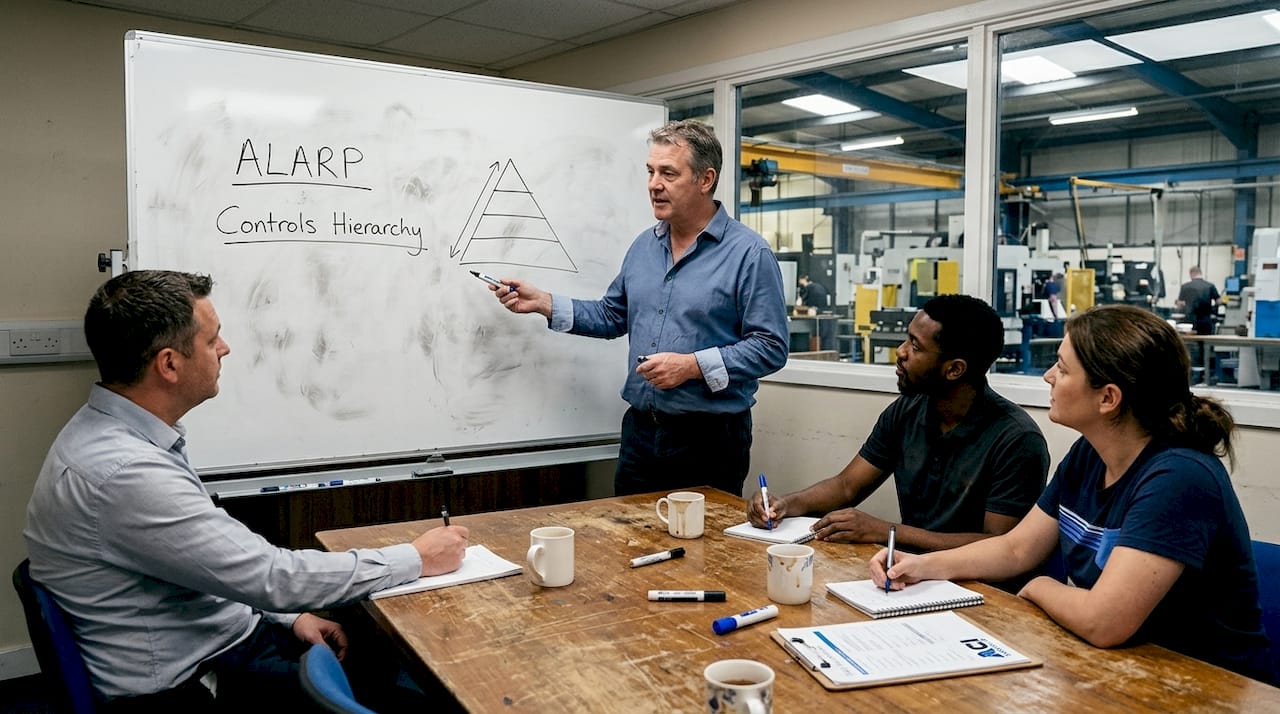
ALARP stands for As Low As Reasonably Practicable. It means you must reduce risk until the cost, effort, or difficulty of doing more would be grossly disproportionate to the benefit gained. In plain English: you don’t have to spend £50,000 to prevent a very minor, unlikely risk. But you do have to do something. Balancing risk reduction against cost and practicality is the standard the HSE expects.
The hierarchy of risk reduction gives you a structured way to decide what to do. It runs from most effective to least effective:
- Elimination: Remove the hazard entirely (best option if possible)
- Substitution: Replace it with something less hazardous
- Engineering controls: Physical barriers, guards, ventilation systems
- Administrative controls: Safe systems of work, training, signage
- PPE: Personal protective equipment (last resort, not first line of defence)
The hierarchy of risk reduction firmly prioritises engineering and safe isolation over PPE. This surprises some SME managers who default to ‘give them gloves and a hard hat’ as their primary control. PPE is important, but it’s the last layer, not the foundation.
| Control level | Example | Effectiveness |
|---|---|---|
| Elimination | Remove the hazardous chemical entirely | Highest |
| Substitution | Use a less harmful cleaning product | High |
| Engineering | Install extraction ventilation | Medium-high |
| Administrative | Introduce a safe working procedure | Medium |
| PPE | Provide gloves and eye protection | Lowest |
When justifying your decisions during an audit or HSE inspection, you need to show you’ve worked down the hierarchy. If you’ve jumped straight to PPE, an inspector will want to know why elimination or engineering controls weren’t considered first. Document your reasoning. It’s that simple.
For a broader look at how the HSE evaluates these decisions, our Role of HSE guide is worth a read.
Applying and advancing terminology: Beyond the basics
Once you’ve mastered the basics, complex operations and higher-risk tasks require a step up in terminology and method. Here’s how SMEs can benefit without overcomplicating things.
For most SMEs, the HSE five-step process and ALARP framework are entirely sufficient. But if your business involves complex processes, hazardous substances, or high-risk activities, you may encounter more advanced methodologies. Knowing what they are (and when to use them) is genuinely useful.
HAZOP (Hazard and Operability Study) is used to identify potential hazards in complex systems, particularly in chemical or process industries. FMEA (Failure Mode and Effects Analysis) examines how individual components can fail and what the knock-on effects might be. Bow-Tie analysis maps the pathway from hazard to harm and identifies barriers at each stage. These advanced assessment techniques are valuable but resource-heavy for most SMEs.
Here’s when you’d actually consider them:
- HAZOP: Large-scale chemical processing, complex plant operations
- FMEA: Manufacturing with critical machinery or multi-stage production
- Bow-Tie: High-consequence events where you need to map both prevention and recovery barriers
A common mistake is using advanced terminology in documentation without actually applying the methodology. Writing ‘HAZOP analysis completed’ on a basic checklist doesn’t make it a HAZOP. It just makes your documentation look inconsistent and potentially misleading during an inspection.
The stakes are real. HSE statistics for 2024/25 highlight the continuing and rising cost of work-related ill health in SMEs, reinforcing why getting your methodology right matters. Poor documentation doesn’t just create legal risk — it means real hazards go unmanaged.
Pro Tip: If you’re unsure whether your activity warrants advanced methodology, ask yourself: ‘Could a failure here cause multiple casualties or catastrophic damage?’ If yes, seek specialist advice. If no, the five-step process done well is almost certainly enough.
Our workplace safety tips and legal compliance guide can help you calibrate which approach fits your risk profile.
Expert perspective: Why ‘suitable and sufficient’ beats perfection
Here’s something we’ve observed time and again: the businesses that tie themselves in knots over compliance are often the ones trying hardest to get it perfect. They spend hours crafting elaborate documentation, layer upon layer of controls, and still feel like it’s not enough.
But reasonably practicable doesn’t mean absolute safety. It means smart balance. The HSE doesn’t expect you to eliminate every conceivable risk — it expects you to understand your risks and manage them proportionately.
The ‘suitable and sufficient’ standard is actually liberating once you get your head around it. A clear, honest, well-reasoned risk assessment that reflects your actual workplace will always outperform a bloated document that nobody reads or understands. Terminology matters because it shows you understand your legal duties, not because it makes your paperwork look impressive.
Our site safety practical guide explores this balance in more depth. The goal isn’t a gold-framed certificate on the wall — it’s a safer workplace and documentation that proves it.
Next steps: Templates and tools for SME compliance
Knowing your terminology is one thing. Having the right documentation structure to put it into practice is another.
At ACI Safety, we’ve built a full range of health and safety templates specifically designed for UK SMEs. Every template uses correct HSE-approved terminology, so you’re not starting from scratch or guessing at the right language. Our digital templates guide walks you through how to choose and adapt the right documents for your business. And if you need a solid foundation for your overall safety framework, our customisable health and safety policy template is an instant download in Word format — ready to edit and use today.
Frequently asked questions
What is the difference between a hazard and a risk?
A hazard is the source of potential harm, while risk is the likelihood and severity of that harm actually occurring. Both terms have distinct roles in compliance documentation and should never be used interchangeably.
When does my UK SME need a written risk assessment?
Written assessments are required if you have five or more employees. Smaller businesses aren’t legally obliged to write them down, but doing so is strongly recommended as good practice and useful evidence.
What does ALARP mean for small businesses?
ALARP means you must reduce risks as far as is reasonably practicable, weighing the benefit of further risk reduction against the cost, time, and effort required to achieve it.
Are there advanced risk assessment methods for higher-risk SME activities?
Yes. HAZOP and FMEA are used for complex or high-consequence processes, but for most routine SME activities, the HSE five-step assessment is entirely appropriate and legally sufficient.
Why is correct terminology important during an HSE inspection?
Using correct HSE terminology demonstrates that you understand your legal obligations and have applied them properly, reducing the risk of enforcement action or penalties due to documentation errors.