
Think health and safety law is only for big corporations with dedicated HR departments and laminated wall charts? Think again. Every UK business, regardless of size, has clear legal duties under the Health and Safety at Work Act 1974, and misunderstanding those duties can lead to fines, prosecutions, and real harm to the people who work for you. The good news? Getting your head around your responsibilities is far simpler than most people assume. This guide cuts through the noise and gives you exactly what you need to know.
Table of Contents
- What are safety responsibilities? Core legal duties under UK law
- Practical safety responsibilities for SMEs: From policy to action
- Health and safety documentation: What, when, and why record it
- How to carry out and document a risk assessment
- Expert guidance: Common pitfalls and how to stay compliant
- Simplify compliance: How ACI Safety supports your responsibilities
- Frequently asked questions
Key Takeaways
| Point | Details |
|---|---|
| Legal duties explained | Employers and employees both have clear safety responsibilities under UK law. |
| Practical steps for SMEs | A simple policy, risk assessments, and training are essential for compliance. |
| Documentation thresholds | Businesses with five or more employees must record policies and assessments, but all should document for best practice. |
| Risk assessment made simple | Use the HSE’s 5-step process and review regularly for effective safety management. |
| Balanced compliance | Prioritise proportionate action over unnecessary paperwork for SME success. |
What are safety responsibilities? Core legal duties under UK law
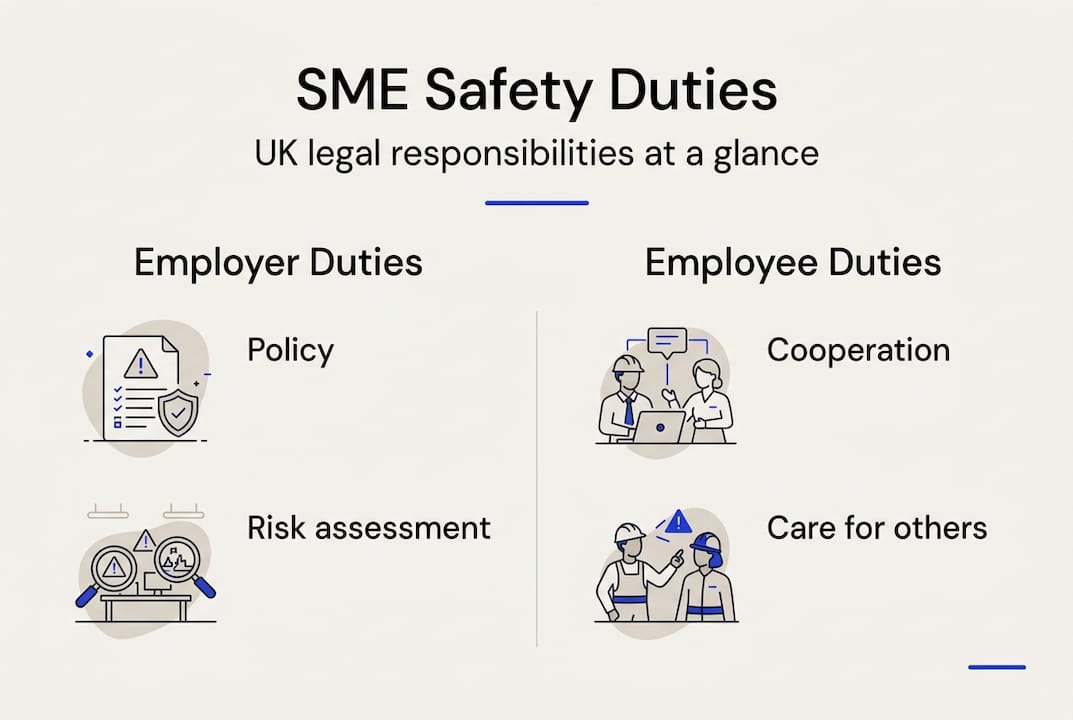
Let’s start with the basics. The importance of health and safety in any workplace comes down to one central idea: everyone goes home in the same condition they arrived. UK law makes this a legal obligation, not just a nice idea.
Under the Health and Safety at Work Act 1974, employers must ensure the health, safety, and welfare of all employees, so far as is reasonably practicable. That phrase, “reasonably practicable,” is important. It does not mean eliminating every conceivable risk. It means balancing the level of risk against the cost, time, and effort required to control it. Zero risk is not the goal. Sensible, proportionate action is.
As an employer, your core legal duties include:
- Providing a safe working environment and safe systems of work
- Ensuring equipment is properly maintained and safe to use
- Providing adequate information, instruction, and training
- Consulting with employees on health and safety matters
- Carrying out risk assessments and acting on the findings
Employees are not off the hook either. Employees must take reasonable care for their own health and safety and that of others, cooperate with their employer, use equipment correctly, and follow safe systems of work. It is a two-way street.
“Health and safety law is not about creating paperwork. It is about making sure people are protected. The legal framework exists to give that protection a backbone.”
Familiarising yourself with key health and safety terms will also help you interpret guidance documents and communicate clearly with inspectors or contractors.
Practical safety responsibilities for SMEs: From policy to action
With the legal foundations in place, let’s translate these duties into something you can actually act on. Here is a logical sequence of core responsibilities for any SME:
- Prepare a health and safety policy that sets out your commitment and arrangements
- Carry out risk assessments for all significant workplace hazards
- Appoint a competent person to help you meet your legal duties (this can be you, with the right training)
- Provide information and training to all employees relevant to their roles
- Consult your workers on health and safety decisions that affect them
- Ensure adequate welfare facilities (toilets, washing facilities, rest areas)
- Arrange first aid provision appropriate to your workplace
- Display the HSE law poster or provide the equivalent leaflet to all staff
- Report certain incidents under RIDDOR (Reporting of Injuries, Diseases and Dangerous Occurrences Regulations)
The HSE simple health and safety guide confirms these as the key responsibilities for SMEs, and they apply whether you run a two-person plumbing firm or a 40-strong facilities management team.
The competent person role is worth a mention. You do not need a consultant in a sharp suit to fulfil this. Many small business owners take on this role themselves after completing a basic health and safety course. If your risks are more complex, external support is a sensible investment, but do not assume you need it from day one.
Knowing which essential health and safety documents to have in place will help you build a system that works without burying you in paperwork. And if you have ever wondered why enforce safety procedures at all, the answer is simple: it protects your people, your business, and your reputation.
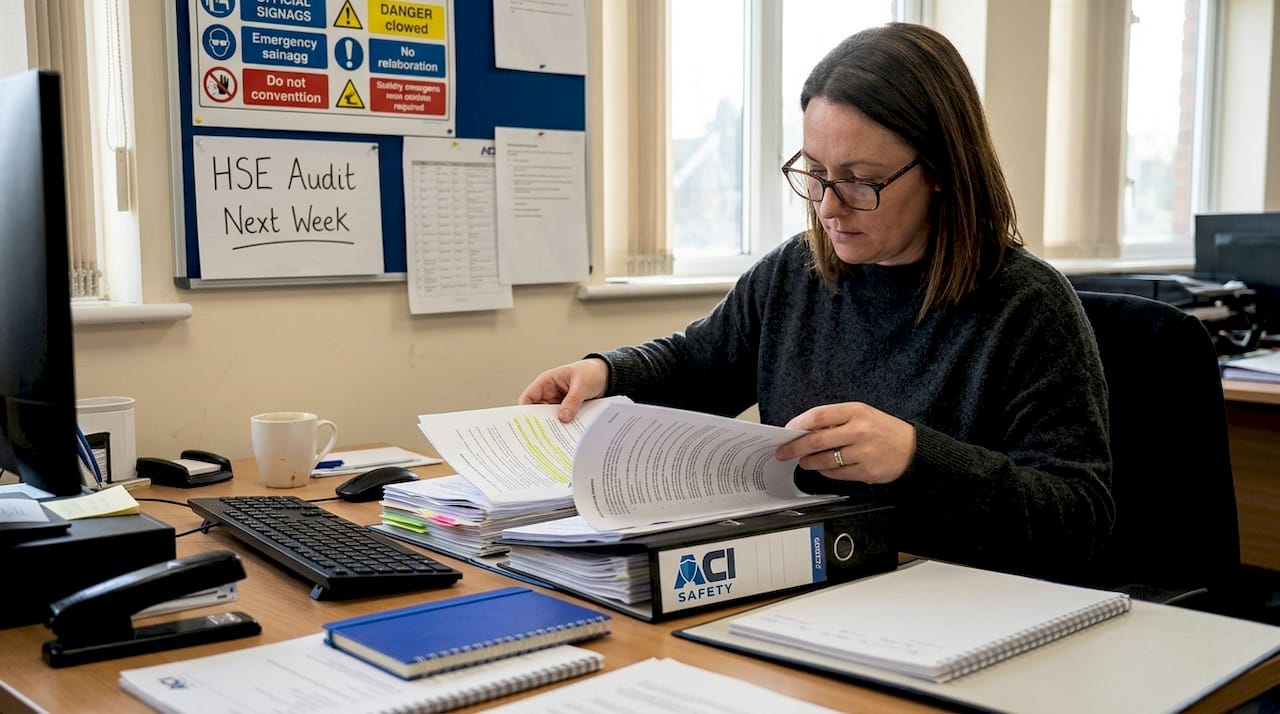
Pro Tip: Keep your documentation proportionate. A sole trader doing low-risk office work does not need the same level of paperwork as a construction firm. Match your records to your actual risks.
Health and safety documentation: What, when, and why record it
Having outlined day-to-day responsibilities, the next step is understanding when and how you must formalise your health and safety efforts in writing.
The most commonly misunderstood rule is the five-employee threshold. Businesses with fewer than five employees are exempt from having a written health and safety policy and written risk assessment records. But here is the critical bit: your protection duties are identical regardless of size. You still need to assess risks and act on them. You just have more flexibility in how you record it.
For businesses with five or more employees, written records become mandatory. The table below summarises the key differences:
| Obligation | Fewer than 5 employees | 5 or more employees |
|---|---|---|
| Written health and safety policy | Not required (recommended) | Mandatory |
| Written risk assessment records | Not required (recommended) | Mandatory |
| Duty to assess risks | Yes | Yes |
| Duty to protect non-employees | Yes | Yes |
| Consult workers | Yes | Yes |
| Display HSE law poster | Yes | Yes |
As the documentation threshold guidance makes clear, the five-employee rule is purely administrative. Your duty to protect people does not shrink because your team is small.
One thing many SMEs overlook: your responsibilities extend beyond your own employees. Contractors, visitors, members of the public, and anyone else who might be affected by your work are also covered. If a delivery driver slips on your wet floor, that is your problem too.
For a clear breakdown of what legal compliance for SMEs looks like in practice, it is worth reviewing the full scope of your obligations under the HSE compliance guidance.
How to carry out and document a risk assessment
Once you understand documentation needs, the most practical starting point is mastering risk assessment. It is the foundation of everything else.
The HSE recommends a five-step risk assessment process:
- Identify the hazards in your workplace
- Decide who might be harmed and how
- Evaluate the risks and decide on precautions
- Record your findings and implement them
- Review your assessment and update if necessary
Here is a quick reference table of common hazards and typical control measures for SMEs:
| Hazard | Who is at risk | Control measure |
|---|---|---|
| Slips and trips | All staff, visitors | Non-slip flooring, clear walkways, good lighting |
| Manual handling | Warehouse, trades staff | Training, mechanical aids, task redesign |
| Hazardous substances | Cleaning, maintenance staff | COSHH assessment, PPE, ventilation |
| Working at height | Construction, maintenance | Scaffolding, harnesses, edge protection |
| Electrical equipment | Office and site workers | PAT testing, visual checks, isolation procedures |
Risk assessments are not a one-and-done exercise. Review them at least annually, and also after any significant change to your workplace, processes, or workforce, and following any accident or near miss.
Pro Tip: Focus on significant risks, not every tiny possibility. The HSE does not expect you to document that someone might stub their toe. Prioritise the hazards that could genuinely cause serious harm.
For sector-specific guidance, SME safety best practices and a solid site safety guide are useful starting points if you work in construction or trades.
Expert guidance: Common pitfalls and how to stay compliant
With the core processes covered, let’s talk about the mistakes that trip SMEs up most often. Because there are two extremes, and both cause problems.
Doing too little is the obvious one. No written policy, no risk assessments, no training records. If something goes wrong, you have no evidence that you took your duties seriously. That is a very uncomfortable place to be during an HSE inspection.
Doing too much is less obvious but equally wasteful. Some consultants encourage excessive documentation and audits that go far beyond what the law requires. The HSE emphasises a proportionate approach for low-risk SMEs. Spending three days writing a 40-page safety manual for a small office is not compliance. It is theatre.
Here is what to prioritise if an HSE inspector visits:
- A clear, up-to-date health and safety policy (if you have five or more staff)
- Written risk assessments covering your main hazards
- Evidence of employee training and induction records
- Accident book and any RIDDOR reports
- Records of equipment checks and maintenance
- Evidence of worker consultation
“The HSE is not looking for perfection. They are looking for evidence that you have thought about the risks and taken sensible steps to manage them.”
The key word throughout is proportionate. A small landscaping firm and a large manufacturing plant have very different risk profiles. Your documentation should reflect your actual workplace, not a generic template copied from a company ten times your size. For a practical overview of SME essentials for health and safety, it is worth reviewing what genuinely matters for businesses like yours.
Simplify compliance: How ACI Safety supports your responsibilities
If reading through all of this has made you realise your documentation needs a bit of work, you are not alone. Most SMEs we speak to know they should have things in place but are not sure where to start or what good looks like.
That is exactly why we built ACI Safety. Our ready-made templates cover everything from risk assessments and COSHH assessments to method statements, toolbox talks, and full health and safety policy documents. They are editable, professionally structured, and available as instant digital downloads in Word and PDF formats. No starting from scratch. No guessing whether you have covered the right points. Just open, edit, and you are done. Browse our full documentation list for 2026 or explore our range of health and safety documents for small business to find exactly what your business needs.
Frequently asked questions
Do all UK businesses need a written health and safety policy?
Only businesses with five or more employees are legally required to have a written policy, but it is best practice for all businesses regardless of size.
Who is responsible for health and safety in a small UK business?
The employer holds the primary duty, but employees must also take reasonable care for themselves and others and cooperate with safety arrangements.
How often should risk assessments be reviewed?
Risk assessments should be reviewed at least annually or whenever there are significant changes to the workplace, processes, or following an accident.
Are self-employed people covered by health and safety law?
Yes, if their work poses risks to others. Low-risk self-employed individuals working alone and not endangering others are exempt from certain duties.
What does ‘reasonably practicable’ mean in health and safety law?
It means balancing risk severity against the cost, time, and effort required to put controls in place. It is not about eliminating all risk.