
TL;DR:
- Effective health and safety KPIs help SMEs ensure compliance and prevent incidents.
- Both lagging (outcome-based) and leading (preventative) KPIs are crucial for safety management.
- Focusing on a few relevant, well-tracked KPIs and acting on data improves safety culture.
If you think health and safety KPIs are just another box-ticking exercise, you’re not alone. Most managers we speak to treat them like a formality, something to dust off before an audit and then forget about. But here’s the thing: the right KPIs are one of the most powerful tools you have for staying compliant, preventing costly incidents, and proving due diligence to your insurer or the HSE. This article will walk you through what health and safety KPIs actually are, how to pick the right ones for your business, and how to avoid the common traps that catch SMEs out.
Table of Contents
- What are health and safety KPIs and why do they matter?
- Types of health and safety KPIs: lagging vs. leading indicators
- How to select and track KPIs for UK SME compliance
- Common pitfalls and expert tips for KPI management
- Why traditional KPI thinking risks compliance for small UK businesses
- Boost your compliance with expert health and safety resources
- Frequently asked questions
Key Takeaways
| Point | Details |
|---|---|
| KPIs drive real compliance | Carefully chosen health and safety KPIs help prove compliance and prevent costly incidents. |
| Lagging vs. leading matters | Balancing incident and prevention KPIs provides both regulatory evidence and safer workplaces. |
| SME needs differ | Small businesses must focus on practical, risk-relevant KPIs rather than excessive documentation. |
| Near-miss tracking pays | Encouraging early reporting supports a proactive safety culture, provided data accuracy is maintained. |
| Expert resources help | UK businesses can streamline compliance and KPI management using specialist guides and templates. |
What are health and safety KPIs and why do they matter?
KPI stands for Key Performance Indicator. In health and safety, a KPI is a measurable value that tells you how well your business is managing risk and meeting its legal obligations. Simple enough, right? But here’s where most people go wrong: they confuse KPIs with general workplace metrics.
A generic metric might be “number of incidents this month.” A KPI ties that number to a target, a trend, and an action. It tells you not just what happened, but whether you’re moving in the right direction and what to do next.
Understanding the importance of health and safety in UK workplaces means recognising that KPIs sit at the heart of any credible compliance framework. The HSE expects businesses to monitor and review their safety performance. ISO 45001, the international standard for occupational health and safety management, specifically requires performance evaluation under Clause 9. KPIs are how you do that.
There are two broad families of health and safety KPIs:
- Lagging KPIs measure what has already happened. Think injury rates, lost time, and absence figures.
- Leading KPIs measure what you’re doing to prevent things from happening. Think safety inspections completed, toolbox talks delivered, and near-misses reported.
Both matter. Neither alone is enough.
Here’s a quick list of the most commonly tracked lagging KPIs for UK businesses:
- TRIR (Total Recordable Incident Rate): the number of recordable incidents per 100 workers
- LTIFR (Lost Time Injury Frequency Rate): injuries causing at least one day off, per million hours worked
- Absence rate: days lost to work-related ill health
As HSE injury data confirms, these are the standard measures used to benchmark safety performance across UK industries.
“KPIs are not just about counting what went wrong. They’re about understanding why, and what you’re doing to stop it happening again.”
For SMEs especially, getting your head around this distinction is genuinely useful. You don’t need a sophisticated system. You need the right measures, tracked consistently.
Types of health and safety KPIs: lagging vs. leading indicators
Now that we’ve defined KPIs, let’s get into the two main types and why you genuinely need both.
Lagging indicators look backwards. They record outcomes: injuries, illnesses, near-misses that resulted in harm. They’re useful for spotting patterns and reporting to the HSE or your insurer. The problem? By the time a lagging KPI moves, someone has already been hurt.
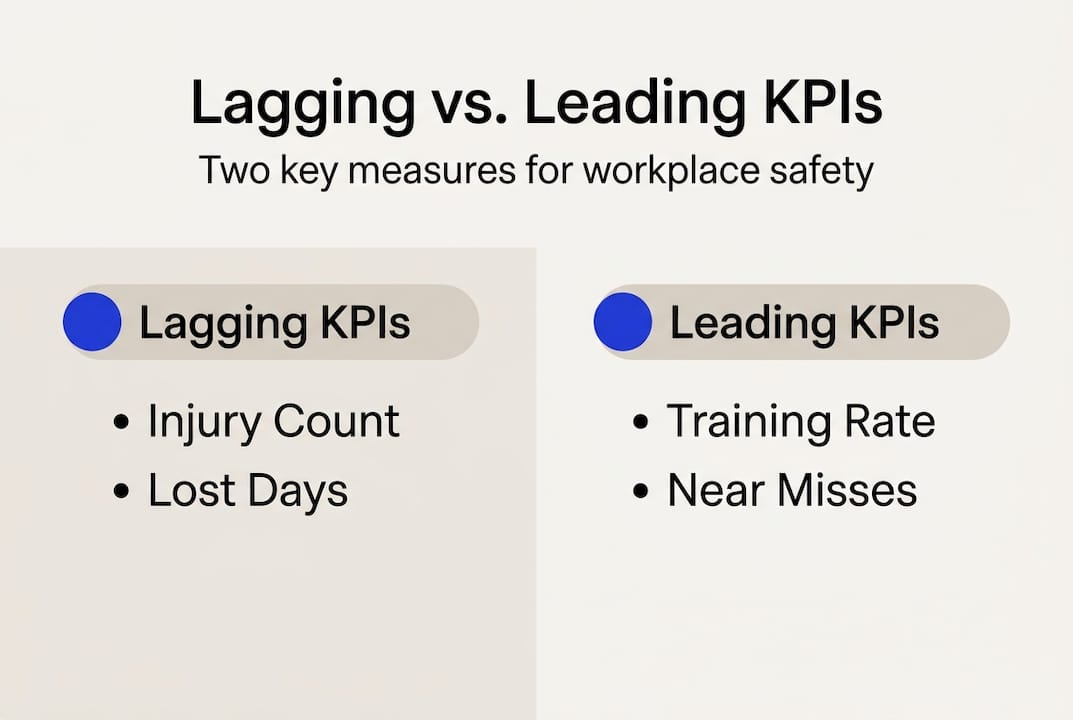
Leading indicators look forwards. They measure the actions and conditions that predict future safety performance. EHS KPI methodologies confirm that leading metrics include safety observations, PPE compliance rates, and corrective action closure rates. These give you something to act on before an incident occurs.
Here’s a comparison to make this concrete:
| KPI type | Example | What it tells you | When it’s useful |
|---|---|---|---|
| Lagging | LTIFR | Injuries already occurred | Reporting, benchmarking |
| Lagging | Absence rate | Work-related ill health | Trend analysis |
| Leading | Safety inspections completed | Proactive activity level | Prevention, culture |
| Leading | Corrective action closure rate | How fast issues are fixed | Continuous improvement |
| Leading | Near-miss reports submitted | Hazard awareness | Early warning system |
To put the stakes in perspective: UK safety statistics show 680,000 non-fatal injuries, a £22.9bn economic cost, and 1.9 million work-related ill health cases in 2024 to 2025. Those are lagging numbers at a national scale. Leading KPIs are how individual businesses avoid contributing to them.

For HSE regulatory benchmarks and understanding common terminology for KPIs, it helps to see these measures in context.
Here’s a simple numbered framework for building your KPI mix:
- Start with two or three lagging KPIs relevant to your industry.
- Add two or three leading KPIs that reflect your most significant risks.
- Set realistic targets for each, based on your own history or sector benchmarks.
- Review monthly, not just at audit time.
- Act on what the data tells you, every single time.
The balance between lagging and leading is what separates a reactive safety culture from a proactive one.
How to select and track KPIs for UK SME compliance
Choosing KPIs can feel overwhelming, especially when you’re running a small team and compliance is just one of many priorities. The good news is that proportionality is built into UK law. “Reasonably practicable” is the standard, which means your KPI framework should match the scale and nature of your risks.
Here’s a practical table to help you match KPIs to common SME sectors:
| Sector | Key risks | Suggested KPIs |
|---|---|---|
| Construction | Falls, manual handling | LTIFR, toolbox talk completion, near-miss reports |
| Hospitality | Slips, stress, burns | Absence rate, incident reports, staff training records |
| Facilities management | Lone working, COSHH | Safety inspections, COSHH assessment reviews, PPE compliance |
| Office-based | DSE, stress | DSE assessment completion, stress survey scores |
For best practices for SMEs, the key is to focus on what actually drives risk in your business, not what looks impressive on paper.
Tracking doesn’t have to be complicated. A simple spreadsheet updated monthly is perfectly adequate for most SMEs. If you want something more visual, a basic dashboard works well. The important thing is consistency.
Pro Tip: Don’t track ten KPIs badly. Track four or five really well. Quality of data beats quantity every time.
The HSE KPI report is clear that over-reliance on lagging KPIs is like driving using only your rear-view mirror. You can see where you’ve been, but you can’t avoid what’s coming. Corrective action closure rates, for example, tell you how quickly hazards are being resolved. That’s a leading KPI with real teeth.
For essentials for SME compliance and guidance on how to resolve safety issues efficiently, having clear KPI targets makes the whole process faster and more defensible. Insurers and the HSE both respond well to businesses that can show a documented, consistent approach to monitoring.
For further KPI selection advice, the EHS Watch resource is a solid starting point.
Common pitfalls and expert tips for KPI management
Even with the right KPIs in place, things can go sideways. Here are the most common mistakes SMEs make, and how to sidestep them.
- Tracking too many KPIs. More is not better. A long list of metrics that nobody reviews is worse than useless. It creates a false sense of security.
- Only tracking lagging KPIs. If your entire safety dashboard is built on incident counts, you’re only ever reacting. Add at least two leading indicators.
- Ignoring near-miss data. Near-misses are gold. They tell you where the next incident is likely to come from. Near-miss reporting builds a no-blame culture, but it needs careful oversight to prevent people from gaming the numbers.
- Not acting on what you find. A KPI that triggers no action is a waste of time. Every review should end with at least one clear next step.
- Over-documenting to compensate. Some managers produce mountains of paperwork to demonstrate compliance. The HSE doesn’t want volume. It wants evidence of genuine, proportionate effort.
Pro Tip: When reviewing KPIs with your team, ask “what did we do differently this month?” rather than just “what do the numbers say?” It shifts the conversation from reporting to learning.
For practical SME compliance tips and a clearer picture of your SME safety responsibilities, it helps to frame KPI management as an ongoing conversation rather than a periodic chore.
The near-miss point deserves a bit more attention. Encouraging staff to report near-misses is genuinely one of the most effective things you can do for safety culture. But you need to monitor the data for patterns, and make sure people aren’t under-reporting because they fear blame, or over-reporting to hit a target. Proportionate documentation is what keeps this honest.
Why traditional KPI thinking risks compliance for small UK businesses
Here’s something we see all the time, and it frustrates us no end. A business sets up a KPI dashboard, fills it with incident counts and absence rates, reviews it once a quarter, and calls it a compliance programme. Then something goes wrong, and they’re genuinely baffled.
The problem isn’t that they were tracking KPIs. The problem is that they were only tracking outcomes, not activity. As the HSE KPI report puts it, relying solely on lagging KPIs is rearview mirror driving. You only see the crash after it happens.
For small UK businesses, the real risk isn’t complexity. It’s complacency dressed up as compliance. A tidy spreadsheet of incident rates doesn’t prove you’re managing risk. It proves you’re counting what went wrong.
The businesses that genuinely stay compliant, and stay safe, are the ones tracking leading indicators consistently. Are toolbox talks happening? Are inspections being completed and closed out? Are staff raising near-misses without fear? Those questions matter more than any incident count.
Simplicity and proportionality beat complexity every time. For guidance on simplifying SME compliance, the focus should always be on practical action, not impressive paperwork.
Boost your compliance with expert health and safety resources
Understanding KPIs is one thing. Having the documentation to support them is another. If your KPI framework is pointing to gaps in your risk assessments, method statements, or toolbox talks, you need to fill those gaps quickly and without a mountain of admin.
At ACI Safety, we provide ready-made SME health and safety documents that slot straight into your compliance processes. From RAMS templates to COSHH assessments, everything is editable, instant to download, and built around UK legal requirements. Check out our health and safety documentation list to see what fits your business, or visit our guide to simplify compliance and get your documentation working as hard as your KPIs do.
Frequently asked questions
Which health and safety KPIs are mandatory for UK SMEs?
There are no universally mandatory KPIs, but SMEs should track incident rates, lost time injuries, and leading indicators as expected by the HSE and insurers. Core lagging KPIs such as TRIR and LTIFR are the standard starting point.
How do I calculate Total Recordable Incident Rate (TRIR)?
TRIR is calculated as recordable incidents multiplied by 200,000, divided by total hours worked. This standardises incident rates so you can compare your performance against industry benchmarks fairly.
What’s the benefit of tracking leading KPIs as an SME?
Leading KPIs help you prevent incidents before they happen and demonstrate proactive compliance to the HSE and insurers. They also support ISO 45001 Clause 9 requirements for performance evaluation and trend analysis.
How do I avoid excessive paperwork when managing KPIs?
Select only the KPIs most relevant to your specific business risks and keep documentation proportionate. Reasonably practicable effort is the legal standard, so you don’t need to document everything, just what genuinely demonstrates due diligence.
How can near-miss reporting improve compliance?
Reporting near-misses identifies hazards early and builds a healthier safety culture across your team. It works best when there’s no blame attached, but near-miss data needs regular monitoring to stay accurate and useful.