Running a construction or trades business in the UK means juggling a lot. Deadlines, subcontractors, materials, clients who change their minds at 4pm on a Friday. The last thing you need is a health and safety issue spiralling into an HSE visit, a stop notice, or worse. Yet construction fatalities run at four times the all-industry average, with 45% of deaths linked to falls from height. That’s not a statistic to gloss over. This guide walks you through the practical, step-by-step approach to preventing and resolving safety compliance issues in your business, without drowning you in legal jargon or burying you in paperwork.
Table of Contents
- Core steps for resolving health and safety issues
- What SMEs need: Compliance tools and requirements overview
- Common mistakes and edge cases in construction safety
- Responding to HSE notices and enforcement steps
- Best practices for method statements and RAMS in SMEs
- Why paperwork alone won’t keep your people safe (and what actually works)
- Take the next step with proven SME safety solutions
- Frequently asked questions
Key Takeaways
| Point | Details |
|---|---|
| Follow a clear process | Carry out risk assessments, prepare method statements, and implement controls for all construction work. |
| Know your SME obligations | Small businesses with fewer than five staff can use practical controls, but records help with compliance and inspections. |
| Act fast on HSE enforcement | Responding quickly to HSE notices and correcting issues can avoid prosecution and business disruption. |
| Avoid repeat mistakes | Falls from height and temporary works failures remain top causes of penalties in construction SMEs, so address these proactively. |
Core steps for resolving health and safety issues
Now that you understand what’s at risk, let’s break down exactly which steps SMEs must take to address safety gaps. The good news? The process is more straightforward than most people expect.
Here’s the core sequence:
- Identify the hazard. Walk the site. Talk to your workers. Look for anything that could cause harm.
- Carry out a risk assessment. Evaluate who could be harmed and how. Understanding risk assessment basics is the foundation of everything else.
- Write a method statement. This explains, step by step, how the work will be done safely.
- Create a CDM plan if required. Under the Construction (Design and Management) Regulations 2015, most construction projects need a Construction Phase Plan.
- Implement controls. Put the measures in place. Don’t just write it down and forget about it.
- Review regularly. Conditions change. Your documents need to keep up.
Risk assessments, method statements, and CDM plans are all required under current HSE and CDM 2015 regulations. These aren’t optional extras.
| Document | When required | Who needs it |
|---|---|---|
| Risk assessment | All construction work | All employers |
| Method statement | High-risk or complex tasks | All employers |
| Construction Phase Plan | Notifiable and non-notifiable projects | Principal contractor |
| COSHH assessment | Where hazardous substances are used | All employers |
For a clearer picture of how to build efficient workflows for SMEs, it’s worth reviewing how your current process stacks up against HSE guidance.
Pro Tip: Don’t treat these documents as a one-off job. Set a calendar reminder to review your risk assessments every time a new task, location, or team member is introduced.
What SMEs need: Compliance tools and requirements overview
Understanding the process is one side. Knowing exactly what’s required for your business size ensures you stay on track.
There’s a common misconception that all businesses need the same level of documentation. They don’t. Your obligations depend partly on how many people you employ.
“SMEs with fewer than five staff are not legally required to have written risk assessments, but keeping basic controls documented is strongly recommended.”
Here’s a side-by-side breakdown:
| Requirement | 1 to 4 employees | 5 or more employees |
|---|---|---|
| Written risk assessment | Not legally required | Legally required |
| Health and safety policy | Not legally required | Legally required |
| COSHH records | Best practice | Required where applicable |
| Accident book | Required | Required |
| CDM Construction Phase Plan | Required for construction work | Required for construction work |
| Method statements | Best practice | Required for high-risk tasks |
Even if you sit in the “1 to 4” bracket, don’t skip the paperwork. Insurers, principal contractors, and HSE inspectors will all want to see evidence of controls. No documentation means no defence.
Key documents every construction SME should have in place:
- Risk assessments (written, even if not legally mandated)
- COSHH assessments for any hazardous substances on site
- Method statements for complex or high-risk activities
- Toolbox talk records to show worker engagement
- Accident and near-miss logs
For a full breakdown of key SME documents, the detailed SME guide from Safety Clarity is also worth a read.
Common mistakes and edge cases in construction safety
Once you’re clear on requirements, it’s crucial to know where others get tripped up and how to avoid their mistakes.
Most HSE enforcement actions in construction don’t happen because businesses were reckless. They happen because someone assumed a risk was obvious enough not to document, or that a task was too short to bother with a method statement. That assumption is expensive.
The biggest culprits:
- Falls from height. Falls account for 45% of construction fatalities, and recent prosecutions have involved five-figure fines for businesses that skipped basic controls like edge protection or scaffold inspection records.
- Fragile surfaces. Roofers and maintenance teams regularly underestimate the risk of fragile roofing materials. A single misstep without a risk assessment in place can mean prosecution.
- Temporary works errors. Excavations, falsework, and propping systems that aren’t properly designed or inspected are a recurring cause of serious incidents.
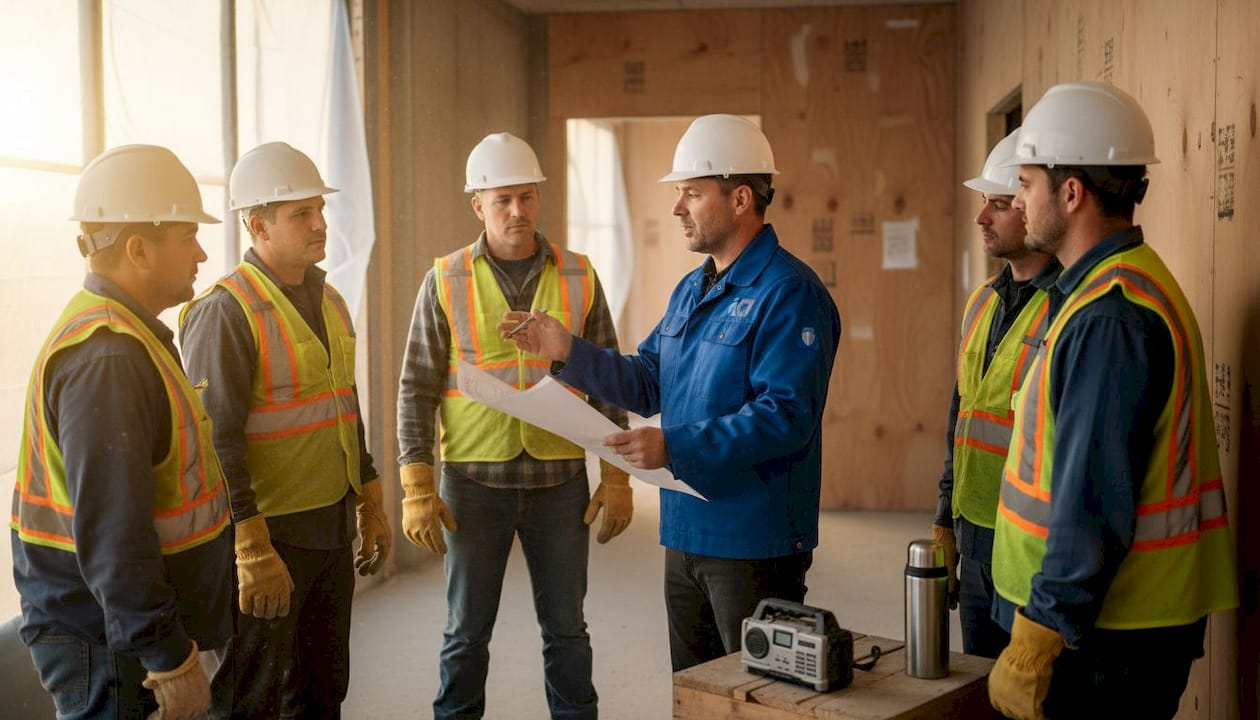
- Inadequate supervision. Sending a worker to carry out a high-risk task without a briefing or method statement is a compliance failure, full stop.
The pattern in recent HSE prosecutions is consistent. Simple controls, properly documented and communicated, would have prevented most of them.
Pro Tip: Before any high-risk task starts, run a two-minute verbal briefing with your team. It doesn’t need to be formal. It just needs to happen and be noted down.
For practical guidance on day-to-day controls, our site safety guide and hazard management resources cover the most common scenarios in plain English.
Responding to HSE notices and enforcement steps
Even with solid controls, things can go wrong. Here’s exactly what to do if you hear from the HSE.
Receiving a notice from the HSE is stressful. But it’s not the end of the world if you respond correctly and quickly.
The HSE enforcement process follows a clear escalation path:
- Verbal or written advice. An inspector flags a concern. This is your chance to act before things get formal.
- Improvement Notice. You’re given a deadline (usually 21 days minimum) to fix a specific issue. Ignore it and you’re heading for prosecution.
- Prohibition Notice. Work stops immediately. This is issued when there’s a risk of serious personal injury. You cannot restart until the notice is lifted.
- Prosecution. The HSE takes legal action. Fines can run into hundreds of thousands of pounds for serious breaches.
If you receive a notice:
- Read it carefully and note the deadline.
- Contact the issuing inspector to clarify exactly what’s required.
- Document every action you take in response.
- Update your risk assessments and method statements to reflect the changes.
- Keep copies of everything.
“The HSE’s Enforcement Management Model guides inspectors on proportionate responses. Demonstrating genuine, documented remediation significantly reduces the risk of escalation.”
For more on how the HSE operates and what to expect during an inspection, our guide on the role of the HSE is a useful starting point. The HSE Enforcement Policy itself is also publicly available and worth reading.
Best practices for method statements and RAMS in SMEs
With enforcement risks clear, get your documentation right for smooth, stress-free inspections.
RAMS stands for Risk Assessment and Method Statement. Together, they form the backbone of safe working documentation for most construction and trades activities. Getting them right isn’t complicated, but it does require a bit of thought.
Method statements must be site-specific, kept up to date, and written in a logical sequence. For demolition and dismantling work, written RAMS are a legal requirement, not just best practice.
Here’s a checklist for producing solid RAMS:
- Describe the task clearly. What are you doing, where, and when?
- List the hazards. Be specific. “Working at height” is better than “general risk.”
- Identify who’s at risk. Workers, visitors, members of the public nearby.
- Set out the controls. What equipment, procedures, and supervision will be in place?
- Assign responsibilities. Who is in charge of each control measure?
- Include emergency procedures. What happens if something goes wrong?
- Get sign-off from workers. They should read and acknowledge the document before work starts.
For more on safety best practices in construction, and to see a practical electrical RAMS example, our site has task-specific resources ready to go. The method statement essentials guide from CPD Online is also a solid reference.
Pro Tip: Keep your RAMS readable. If a site operative can’t understand it in five minutes, it won’t be used. Plain language and a clear layout beat a 20-page document nobody reads. Browse our RAMS templates to see how this looks in practice.
Why paperwork alone won’t keep your people safe (and what actually works)
Here’s an uncomfortable truth. You can have a filing cabinet full of perfectly formatted risk assessments and still have a serious incident on site. Paperwork is necessary. It’s not sufficient.
CDM 2015 focuses on practical risk management rather than paperwork. That’s the point most businesses miss. The regulations aren’t asking you to produce documents for their own sake. They’re asking you to actually manage risk.
What genuinely changes outcomes in construction safety?
- Leadership visibility. When a site manager or business owner is seen actively checking controls, workers take safety seriously. When they’re not, corners get cut.
- Worker involvement. The people doing the job usually know the risks better than anyone. Ask them. Include their input in your risk assessments.
- Simple, visible controls. A laminated checklist on the back of a van door gets used. A 15-page PDF buried in a shared drive does not.
- Honest near-miss reporting. Near misses are free lessons. Create a culture where reporting them is encouraged, not punished.
Documents are tools, not trophies. Use them to drive real conversations and real actions on site. Our safety essentials guide covers the practical side of building a genuine safety culture without making it feel like a bureaucratic nightmare.
Take the next step with proven SME safety solutions
If you want simple, compliant documentation that works, here’s where to start.
Sorting your health and safety documentation doesn’t have to take weeks or cost a fortune. At ACI Safety, we’ve built a full range of ready-made templates specifically for UK construction and trades SMEs.
Whether you need a RAMS template for a specific task, guidance on how to choose a RAMS template that fits your work, or a full 2026 safety documentation list to make sure nothing’s missing, we’ve got you covered. All templates are instant downloads in Word and PDF formats, editable, and designed to meet current UK compliance requirements. No fluff, no filler, just practical documents that do the job.
Frequently asked questions
What is the first step if I find a safety issue on site?
Carry out a risk assessment immediately, document the issue clearly, and put practical controls in place before work continues. Acting fast and recording your actions is essential.
Do I need a written risk assessment if I have fewer than five employees?
No, but written records are strongly recommended for inspections and insurance purposes, even if they’re not a strict legal requirement for businesses under five staff.
What should I do if I receive an HSE Improvement or Prohibition Notice?
Respond promptly, follow the required actions to the letter, and keep detailed records of everything you do. Documented remediation significantly reduces the risk of escalation to prosecution.
Are method statements needed for all construction activities?
Not for every task, but they are a legal requirement for demolition and dismantling work. For any complex or high-risk activity, a method statement is best practice regardless.
What is the biggest cause of serious injury in construction SMEs?
Falls from height cause 45% of construction fatalities, making it the single most important hazard to control and document on any construction or trades site.