
Risk evaluation. Two words that make plenty of small business owners reach for a strong cup of tea and quietly hope the subject goes away. It won’t, though. Risk evaluation is a core legal requirement for all UK employers, and getting it wrong can mean fines, enforcement notices, or worse, a serious workplace injury that could have been prevented. The good news? It doesn’t have to be complicated. This guide breaks down exactly what risk evaluation involves, how to do it properly, and how to make it work for your business without drowning in paperwork.
Table of Contents
- What is risk evaluation and why it matters
- Step-by-step risk evaluation process for SMEs
- Understanding risk ratings: qualitative vs quantitative methods
- The hierarchy of controls: effective risk management
- Who and what to include: covering all bases in your risk evaluation
- Making risk evaluation part of your business culture
- Get compliant with time-saving risk templates and expert support
- Frequently asked questions
Key Takeaways
| Point | Details |
|---|---|
| Central to compliance | Risk evaluation is essential for meeting UK legal obligations and avoiding fines. |
| HSE 5-step approach | Follow the standard HSE process for efficient and effective risk control. |
| Tailored to SMEs | Simple, proportionate risk methods usually suffice for smaller enterprises. |
| Dynamic and inclusive | Include all relevant risks and groups, and regularly update evaluations. |
| Support available | Template solutions make risk evaluation easier and help SMEs stay compliant. |
What is risk evaluation and why it matters
Let’s clear something up straight away. Risk evaluation and risk assessment are not the same thing, even though people use them interchangeably all the time. A risk assessment is the overall process of identifying hazards and figuring out what to do about them. Risk evaluation is a specific part of that process. It’s where you decide how significant each risk actually is and what level of action is needed.
Think of it like this. Risk assessment is the whole meal. Risk evaluation is deciding which dish needs the most attention before it goes cold.
Risk evaluation is central to health and safety compliance in the UK. Under the Management of Health and Safety at Work Regulations 1999 and the Health and Safety at Work Act 1974, every employer must assess the risks their workers face and act on the findings. That’s not optional.
For SMEs, getting this right matters for several reasons:
- It demonstrates legal compliance to inspectors and insurers
- It reduces the likelihood of accidents and costly downtime
- It supports staff retention by showing you take their safety seriously
- It protects your business reputation
“A suitable and sufficient risk assessment isn’t just a legal box to tick. It’s the foundation of a safe and well-run business.”
If you’re new to this area, our risk assessment guide is a solid starting point, and our health and safety legal guide covers the broader legal landscape in plain English.
Step-by-step risk evaluation process for SMEs
With the importance clear, here’s how SMEs can put risk evaluation into practice step by step. The HSE recommends a 5-step method that works well for businesses of all sizes.
- Identify the hazards — Walk around your workplace. Talk to your team. What could cause harm? Think physical, chemical, ergonomic, and psychological hazards.
- Decide who might be harmed and how — Consider employees, contractors, visitors, and any vulnerable groups such as new starters or young workers.
- Evaluate the risks and decide on precautions — This is the evaluation step. How likely is harm, and how severe could it be? What controls are already in place?
- Record your findings and implement them — If you have five or more employees, you must record your findings in writing. Even if you have fewer, it’s good practice.
- Review your assessment and update if necessary — Risks change. Your evaluation should too.
Here’s a quick summary table to keep things clear:
| Step | Action | Why it matters |
|---|---|---|
| 1 | Identify hazards | You can’t manage what you haven’t spotted |
| 2 | Who might be harmed | Ensures no one is overlooked |
| 3 | Evaluate and decide | The core of risk evaluation |
| 4 | Record and implement | Legal requirement for 5+ employees |
| 5 | Review and update | Keeps your evaluation current |
For a broader look at how to streamline your risk process, we’ve got a dedicated guide. You can also find a useful risk assessment overview from Simply Business that covers the basics well.
Pro Tip: Keep your evaluation proportionate. A small café doesn’t need the same level of documentation as a construction site. Match the depth of your evaluation to the actual level of risk in your workplace.
Understanding risk ratings: qualitative vs quantitative methods
Once you know the process, you need to decide how to rate the risks faced by your business. There are two main approaches.
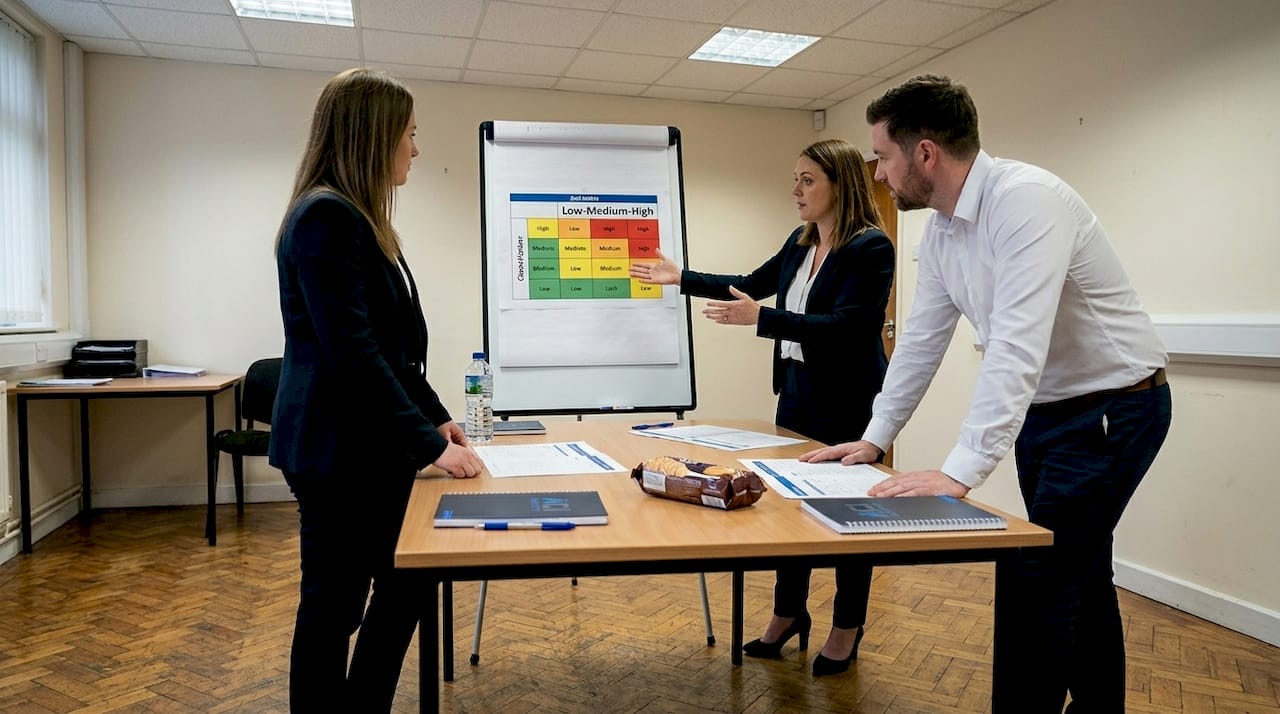
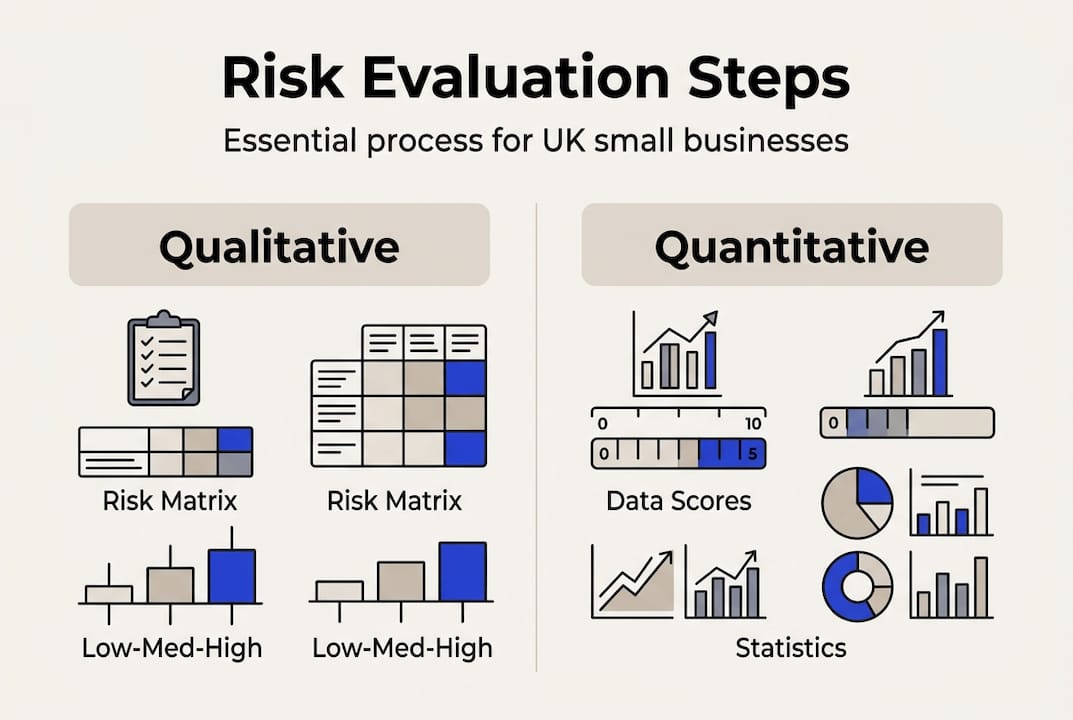
Qualitative methods use descriptive categories. Think: low, medium, high. Or a simple 3×3 or 5×5 risk matrix where you score likelihood and severity. No complex formulas needed.
Quantitative methods use numerical data and statistical analysis. These are more common in high-hazard industries like oil and gas or nuclear. For most SMEs, they’re overkill.
SMEs tend to benefit from qualitative or hybrid approaches that are practical, proportionate, and easy to maintain without a dedicated safety team.
| Method | Best for | Complexity | Cost |
|---|---|---|---|
| Qualitative | Most SMEs | Low | Low |
| Quantitative | High-hazard industries | High | High |
| Hybrid | Growing SMEs with varied risks | Medium | Medium |
Common mistakes SMEs make with risk ratings:
- Over-complicating the scoring system until no one uses it
- Rating everything as “high” to be safe (which defeats the purpose)
- Ignoring likelihood and only focusing on severity
- Failing to reassess ratings after implementing controls
For a plain English breakdown of risk and safety terms that often trip people up, we’ve got you covered. The British Safety Council also has a helpful overview of risk mitigation approaches worth bookmarking.
The hierarchy of controls: effective risk management
After evaluating risks, the next challenge is choosing the right controls to ensure meaningful reduction in risk. This is where the hierarchy of controls comes in. It’s a ranked list of control measures, from most to least effective.
Control hierarchy is best practice for selecting precautions, and it works like this:
- Eliminate — Remove the hazard entirely. Can you stop using that chemical? Can you redesign the task?
- Substitute — Replace the hazard with something safer. Swap a harsh solvent for a water-based alternative.
- Engineering controls — Physical changes that reduce exposure. Guards on machinery, local exhaust ventilation.
- Administrative controls — Change how work is done. Safe systems of work, training, shift rotation.
- PPE (Personal Protective Equipment) — The last resort. Gloves, goggles, hard hats.
Here’s the bit people often get wrong. PPE is not your first line of defence. It’s your last. If your risk evaluation concludes that gloves are the only control in place for a chemical hazard, that’s a red flag.
Practical examples for SMEs:
- Slippery floors — Fix the drainage issue (engineering) before handing out non-slip footwear (PPE)
- Hazardous substances — Check out the COSHH control basics from the HSE before reaching for a face mask
- Repetitive strain — Rotate tasks and adjust workstations before issuing wrist supports
Pro Tip: If you work in construction or trades, our construction safety best practices guide covers sector-specific controls in detail.
Who and what to include: covering all bases in your risk evaluation
Even the best frameworks can miss key people or risks. Here’s how to ensure your evaluation is broad enough to be genuinely useful.
The law requires that risk assessments are “suitable and sufficient”, which means they must consider all relevant hazards and all people who might be affected, including vulnerable groups.
Groups you must consider:
- New and young workers (less experience, more risk)
- Pregnant workers
- Lone workers (especially relevant for trades and field-based roles)
- Temporary or agency staff
- Contractors and visitors
Don’t forget psychosocial hazards either. Stress, excessive workload, and poor mental health are legitimate workplace risks. They’re often overlooked in SME evaluations, but they’re just as real as a wet floor.
“A risk evaluation that ignores mental health and stress is only doing half the job.”
You should also know when to review and update your evaluation. Trigger points include:
- A significant change in working practices or equipment
- A near miss or accident
- New legislation or guidance
- At least annually as standard practice
For more on staying on the right side of the law, our legal compliance in safety guide is worth a read. The HSE also has specific guidance on workplace transport risks if vehicles are part of your operations.
Making risk evaluation part of your business culture
The most effective risk evaluation isn’t a one-off document. It’s an ongoing part of how your business operates. Businesses that treat it as a living process rather than a filing exercise tend to have fewer incidents, better staff morale, and stronger compliance records.
Ongoing, dynamic risk evaluation is central to both compliance and commercial success. Here’s how to make it stick:
- Involve your team — The people doing the work often spot hazards that managers miss. Ask them. They’ll appreciate being included.
- Make it a regular agenda item — Add risk review to your team meetings. Even five minutes counts.
- Communicate changes clearly — When controls change, tell everyone affected. Don’t assume people will notice.
- Keep records accessible — Your documentation should be easy to find and update, not buried in a filing cabinet from 2019.
- Celebrate near-miss reporting — If someone flags a potential hazard before it causes harm, that’s a win. Treat it like one.
Pro Tip: Culture change doesn’t happen overnight. Start small. Pick one area of your business, get the evaluation right there, and build from that success. Our SME safety essentials guide has practical steps to help you build momentum.
Get compliant with time-saving risk templates and expert support
If you want to put robust risk evaluation into action quickly, here’s how to get started without reinventing the wheel. Pulling together compliant documentation from scratch takes time most SMEs simply don’t have.
At ACI Safety, we’ve done the heavy lifting for you. Our ready-made templates cover everything from risk assessments to COSHH evaluations, all structured to meet UK legal requirements and available as instant digital downloads. Start by checking our list of essential health and safety documents to see what your business actually needs. If you’re a smaller operation, our range of small business H&S documents is built specifically for you. And if you want to understand how digital safety templates can simplify your whole compliance process, we’ve got a guide for that too.
Frequently asked questions
What is the difference between risk evaluation and risk assessment?
Risk evaluation is a core component of risk assessment under UK law. Risk assessment is the overall process, while risk evaluation specifically determines how likely and severe the risks are, and what action is needed.
How often should SMEs review their risk evaluation?
SMEs should review their risk evaluations at least annually or after any significant change or incident. The HSE advises regular reviews to ensure evaluations remain current and effective.
Are qualitative methods enough for small businesses?
For most SMEs, qualitative risk assessment is suitable and sufficient for compliance. Simple scoring methods like a risk matrix are practical, proportionate, and widely accepted by regulators.
Who should be involved in the risk evaluation process?
Involve employees who are familiar with daily operations, as they often identify hazards that aren’t obvious from a management perspective. A broader team input leads to a more thorough and reliable evaluation.