
Many UK health and safety managers treat risk assessment as simple hazard spotting. That misconception creates compliance gaps and weakens safety management. Understanding precise terminology transforms risk assessment from a tick-box exercise into an effective legal defence and practical tool. This guide clarifies essential risk assessment terms, UK legal requirements, and how accurate language protects your business and workers.
Table of Contents
- Introduction To Risk Assessment Terminology
- Understanding Key Risk Assessment Terms
- Key Principles Behind Risk Assessment Terminology
- Legal And Compliance Requirements For Risk Assessment In UK SMEs
- Common Misconceptions About Risk Assessment Terminology
- Importance Of Accurate Terminology In Risk Documentation
- Bridging Understanding To Practical Application: Templates And Best Practices
- Conceptual Framework For Organising Risk Assessment Terminology
- Discover Compliant Templates And Tools To Simplify Your Risk Assessments
- Frequently Asked Questions About Risk Assessment Terminology
Key takeaways
| Point | Details |
|---|---|
| Clear hazard, risk, and control definitions improve compliance | Precise terminology ensures legal protection and effective safety documentation for UK SMEs. |
| ALARP guides balanced risk control decisions | As Low As Reasonably Practicable principle balances safety benefits against cost and effort. |
| UK law mandates written assessments for 5+ workers | Businesses with five or more employees must document risk assessments and review them regularly. |
| Accurate documentation provides legal evidence | Clear language in risk assessments demonstrates employer due diligence during incidents or audits. |
| Simplified templates aid practical application | Ready-made forms with plain language help SME managers apply terminology correctly and save time. |
Introduction to risk assessment terminology
The HSE defines risk assessment as a careful examination of workplace hazards to determine if precautions are sufficient or need improvement. This definition highlights a systematic process, not just hazard listing. UK law requires this examination to follow five key steps: identify hazards, decide who might be harmed, evaluate risks and controls, record findings, and review assessments regularly.
Consistent terminology matters because ambiguous language creates legal vulnerabilities. When incidents occur, inspectors and courts scrutinise risk assessment documents. Vague phrases like “be careful” or “take care” fail to demonstrate adequate control measures. Clear terms like “mandatory eye protection” or “two-person lift” show specific, actionable controls.
For UK SMEs, understanding these basics ensures compliance with Health and Safety at Work Act duties. Terminology clarity helps managers communicate controls effectively to workers, maintain audit-ready records, and demonstrate legal due diligence. Whether you run a construction firm, trade business, or office, precise language in your risk assessment overview protects both people and business interests.
The five-step process provides structure:
- Identify what could cause harm in your workplace
- Determine which workers or visitors face those hazards
- Evaluate if existing controls are adequate or need strengthening
- Document your findings in written assessments
- Review assessments when conditions change or annually at minimum
This framework ensures nothing gets overlooked and terminology remains consistent across all documentation.
Understanding key risk assessment terms
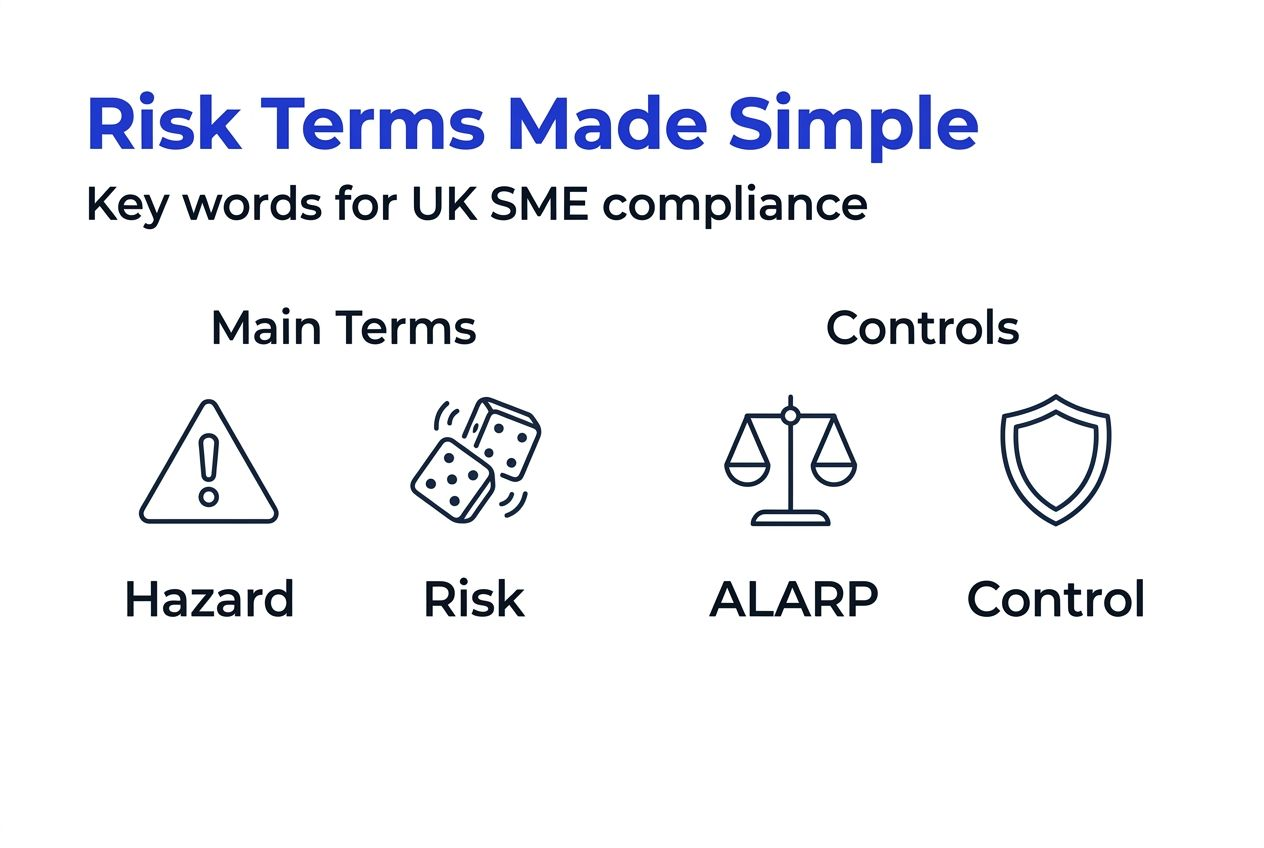
Three fundamental terms form the foundation of risk assessment: hazard, risk, and control. A hazard has potential to cause harm whilst risk measures the likelihood and severity of that harm occurring. Controls are measures that eliminate or reduce risk to acceptable levels. These key phrases including residual risk must be understood for compliant assessments.
Consider a factory floor with oil spills. The slippery surface is the hazard. The risk is workers might slip, fall, and break bones. Controls include immediate cleanup procedures, non-slip footwear requirements, and warning signs. After implementing controls, some residual risk remains because no control eliminates hazards completely. Acceptable risk means residual risk is low enough that further controls would be disproportionately costly.

In office settings, poor workstation setup creates musculoskeletal hazards. The risk is workers developing repetitive strain injuries over time. Controls include adjustable chairs, monitor stands, and regular breaks. Understanding these distinctions helps you complete editable risk assessment examples accurately.
| Term | Definition | Example |
|---|---|---|
| Hazard | Something with potential to cause harm | Exposed electrical wiring, heavy lifting, chemical substances |
| Risk | Likelihood and severity of harm from hazard | High risk of electric shock, medium risk of back strain |
| Control | Measure to eliminate or reduce risk | Insulate wiring, use lifting equipment, provide PPE |
| Residual risk | Risk remaining after controls applied | Low shock risk with insulation, minimal strain with equipment |
| Acceptable risk | Residual risk low enough to be tolerated | Risk reduced to ALARP, further controls disproportionate |
Pro Tip: When documenting, always state the hazard first, then quantify the risk, and finally specify controls. This sequence matches how inspectors read assessments and ensures logical flow.
Key principles behind risk assessment terminology
ALARP, meaning As Low As Reasonably Practicable, governs UK risk control decisions. This principle requires reducing risks until further reduction would be grossly disproportionate to safety benefits gained. It balances worker protection against business practicality, acknowledging that eliminating every conceivable risk is neither possible nor required.
Risk levels determine control priorities. High risks demand immediate action regardless of cost. Medium risks need planned controls with timelines. Low risks may only require monitoring. This hierarchy guides resource allocation and ensures critical hazards receive attention first.
Balancing safety benefits versus control costs requires judgement. Installing guard rails on a flat warehouse floor would be disproportionate because trip risk is low. However, identical rails at a loading bay edge are essential because fall risk is severe. The ALARP principle provides this decision framework.
In practical SME contexts, consider noise hazards in a small workshop. Eliminating noisy machinery might be prohibitively expensive or operationally impossible. Instead, you provide hearing protection, limit exposure duration, and maintain equipment to minimise noise. These controls reduce risk to ALARP without destroying business viability. Understanding this balance prevents both over-engineering controls and dangerous under-protection.
“The ALARP principle recognises that absolute safety is unattainable. Instead, it demands employers demonstrate they have reduced risks as far as reasonably practicable, considering both the degree of risk and the sacrifice needed to avert it.”
For UK SMEs, ALARP means documenting why you chose specific controls and rejected others. This evidence shows inspectors your decisions were reasonable, not arbitrary. It bridges SME safety compliance tips with practical risk management.
Key ALARP considerations include:
- Severity of potential harm if risk materialises
- Likelihood of harm occurring without controls
- Cost and feasibility of available control measures
- Industry standards and good practice benchmarks
- Whether sacrifice required is grossly disproportionate to risk reduction achieved
Legal and compliance requirements for risk assessment in UK SMEs
UK law requires written assessments for businesses employing five or more workers. Even smaller employers benefit from documenting assessments to ensure clarity and provide evidence of compliance. This threshold reflects legislative intent to formalise safety management whilst recognising micro-businesses face different resource constraints.
However, verbal assessments for businesses under five employees still require rigour. Inspectors expect you to demonstrate systematic hazard identification and control implementation, even without written records. Most legal advisers recommend documentation regardless of size because memory fades and staff turnover erases institutional knowledge.
Compliant risk assessments must include:
- Identification of significant hazards in your workplace
- Assessment of who might be harmed and how
- Evaluation of existing controls and whether they are adequate
- Recording of findings including control measures and residual risks
- Plans for review and update when circumstances change
Record-keeping standards require assessments to be accessible, understandable, and current. Store them where managers and workers can reference them during daily operations. Written documents should be reviewed regularly, particularly when workplace changes or new risks emerge. Annual reviews are common practice, but significant incidents or process changes trigger immediate updates.
Non-compliance consequences for SMEs include improvement notices, prohibition notices stopping work, and prosecution. Fines can reach tens of thousands of pounds, and serious breaches may result in director liability. Beyond legal penalties, poor risk assessment increases accident likelihood, raises insurance premiums, and damages business reputation. Using risk assessment templates ensures you meet documentation standards without excessive administrative burden.
Common misconceptions about risk assessment terminology
Many managers believe risk assessment only involves identifying hazards rather than evaluating probability, severity, and implementing controls. This misconception produces incomplete assessments that fail legal and practical tests. Listing hazards without quantifying risks or specifying controls provides no safety benefit and no compliance evidence.
Another confusion surrounds ALARP, with some managers thinking it means eliminating all possible risks. This impossibly high standard would shut down virtually every business activity. ALARP actually balances risk reduction against proportionate effort, allowing residual risks when further controls become disproportionately burdensome.
Small firms often assume businesses under five employees need no documentation whatsoever. Whilst written assessments are not legally mandated below this threshold, undocumented risk management creates evidential gaps. If an incident occurs, proving you conducted adequate assessment becomes nearly impossible without records.
These misconceptions undermine both compliance and safety outcomes:
- Incomplete assessments leave hazards uncontrolled and workers unprotected
- Misunderstanding ALARP leads to either excessive controls or dangerous under-protection
- Lack of documentation prevents effective communication and legal defence
- Terminology confusion creates inconsistent safety management across the organisation
Pro Tip: Review existing risk assessments against HSE guidance to identify terminology gaps. Replace vague phrases with precise terms. For example, change “take care” to “wear safety goggles” or “avoid injury” to “use two-person lifting technique”. This specificity transforms documents from liability into assets. Explore health and safety common errors for additional guidance.
Importance of accurate terminology in risk documentation
Properly documenting risk assessments with clear terminology ensures evidence of employer due diligence if workplace incidents occur, reducing legal risks substantially. Courts and inspectors judge whether you met your legal duties based on written records. Ambiguous language raises doubts about whether you genuinely understood and controlled hazards.
Clear terminology demonstrates competence and care. Documented assessments show you identified specific hazards, evaluated risks systematically, and implemented appropriate controls. This evidence often determines whether incidents result in prosecutions or whether enforcement action proceeds to formal notices.
Vague or incorrect language creates multiple risks. Terms like “possible danger” fail to quantify risk severity or likelihood. Phrases like “be safe” do not specify control measures. If incidents occur, such documentation suggests inadequate assessment and exposes businesses to liability. Inspectors interpret ambiguity as evidence of insufficient consideration.
Tips for writing clear, compliant risk assessments include:
- Use precise hazard descriptions: “rotating machinery parts” not “dangerous equipment”
- Quantify risks with severity and likelihood ratings: “high risk of amputation” not “might hurt”
- Specify exact control measures: “mandatory lockout-tagout procedure” not “take precautions”
- Avoid jargon unless defined; prefer plain language for accessibility
- Structure assessments consistently using templates to ensure completeness
Accurate terminology also improves communication with workers. When risk assessments specify controls clearly, workers understand exactly what safety measures to follow. This clarity reduces accidents more effectively than vague warnings. Using editable risk assessment documentation ensures consistent, professional language across all safety records.
Bridging understanding to practical application: templates and best practices
Health and safety terminology appears complex, but simplifying language and using practical examples improves comprehension and application by small business managers significantly. Templates with built-in glossaries help users apply terms correctly without extensive training. This accessibility democratises safety management for resource-constrained SMEs.
Compliant risk assessment forms for SMEs should include:
- Hazard identification section with common workplace hazards listed
- Risk evaluation matrix showing severity and likelihood ratings
- Control measures section with examples of hierarchy of controls
- Residual risk assessment after controls implemented
- Review schedule and responsible persons identified
Stepwise documentation processes align terminology to each element. Start by listing all workplace hazards using simple, specific descriptions. Next, rate each hazard’s risk level considering who might be harmed. Then document existing controls and evaluate their adequacy. Record any additional controls needed and assign implementation responsibility. Finally, calculate residual risk and confirm it meets ALARP standards.
Practical examples improve usability. Templates might include:
- Sample hazards: “wet floors”, “manual handling”, “electrical equipment”
- Example risk ratings: “high (severe injury likely)”, “medium (minor injury possible)”
- Common controls: “PPE”, “training”, “engineering guards”, “procedural safeguards”
Pro Tip: Customise templates with your industry-specific hazards and terminology. Construction templates should include scaffold hazards; office templates focus on workstation ergonomics. This customisation makes forms immediately relevant and reduces completion time. Access risk assessment templates and forms or try a customisable risk assessment template to streamline your process.
Conceptual framework for organising risk assessment terminology
Clear stepwise risk assessment processes including hazard identification, risk evaluation, control implementation, recording, and review provide a mental model to structure terminology use and practical application effectively. This five-step framework maps directly to essential terms and ensures systematic safety management.
The five steps with associated terminology:
- Identify hazards: Use precise hazard descriptions recognising anything with potential to cause harm
- Evaluate risks: Apply risk ratings considering likelihood and severity for each hazard identified
- Implement controls: Select control measures following hierarchy from elimination to PPE
- Record findings: Document assessments using clear terminology showing hazards, risks, and controls
- Review assessments: Schedule regular reviews updating documentation when circumstances change
This framework organises terminology into logical workflow stages. During identification, focus on hazard vocabulary. During evaluation, emphasise risk quantification terms. During control selection, apply ALARP principle and hierarchy of controls. During recording, ensure precise documentation language. During review, update terminology to reflect workplace changes.
| Risk assessment step | Key terminology | Practical action |
|---|---|---|
| Identify | Hazard, source of harm, potential danger | List all workplace hazards by area and activity |
| Evaluate | Risk, likelihood, severity, who is harmed | Rate each hazard’s risk level and affected persons |
| Control | Control measure, hierarchy, ALARP, residual risk | Select and implement proportionate controls |
| Record | Documentation, evidence, written assessment | Create clear written records of process and decisions |
| Review | Update, revision, monitoring, continuous improvement | Schedule reviews and update after incidents or changes |
Benefits of this framework include consistency across assessments, easier training for new managers, and improved audit readiness. By mapping terminology to process steps, you ensure nothing gets overlooked and documentation remains comprehensive. This structure transforms abstract terms into concrete actions aligned with your risk assessment process guide.
Discover compliant templates and tools to simplify your risk assessments
Mastering risk assessment terminology is essential, but applying it efficiently requires practical tools. ACI Safety provides ready-made, editable risk assessment templates and health and safety documents specifically designed for UK SMEs. These templates incorporate correct terminology, comply with current regulations, and save hours of administrative work.
Our digital templates come in Word and PDF formats for immediate download and customisation. Whether you need comprehensive risk assessments, COSHH forms, or method statements, our structured documents ensure you use precise language whilst focusing on your actual workplace hazards. Standardise health and safety documents to save up to 40% of documentation time.
Explore our customisable health and safety policy template and complete range of risk assessment templates to enhance compliance, improve safety outcomes, and protect your business legally.
Frequently asked questions about risk assessment terminology
What terms are most important to understand in UK risk assessments?
The critical terms are hazard, risk, control, residual risk, and ALARP. Hazard identifies potential sources of harm. Risk quantifies likelihood and severity. Control specifies measures to reduce risk. Residual risk is what remains after controls. ALARP ensures controls are proportionate.
When must UK SMEs have a written risk assessment?
Businesses with five or more employees must document risk assessments in writing under UK law. Smaller businesses are not legally required to write assessments but should document them for clarity and legal protection. Written records provide essential evidence of due diligence.
How often should risk assessments be reviewed?
Review assessments annually at minimum, or whenever workplace conditions change significantly. Trigger reviews after incidents, process modifications, new equipment installation, or regulatory updates. Regular reviews ensure controls remain adequate and documentation stays current.
What is the difference between hazard and risk?
A hazard is anything with potential to cause harm, like a wet floor or electrical wire. Risk measures the likelihood and severity of harm from that hazard actually occurring. Controls reduce risk by lowering likelihood, severity, or both.
How can SMEs make risk assessment documents clearer?
Use simple, specific language avoiding jargon. Replace vague terms like “be careful” with precise controls like “wear safety goggles”. Employ templates with built-in examples and glossaries. Structure assessments consistently using the five-step process for logical flow and completeness.
What does ALARP mean in practical risk management?
ALARP requires reducing risks as low as reasonably practicable, balancing safety benefits against control costs and feasibility. It does not demand eliminating all risks, only those where further reduction is proportionate to the risk level and industry standards.