
Selecting compliant health and safety checklists remains a persistent challenge for UK small and medium-sized business managers. You need documentation that satisfies legal requirements, integrates seamlessly with daily operations, and adapts to your industry’s specific risks. This article provides a structured evaluation framework to identify optimal checklist solutions that balance regulatory compliance, usability, and cost effectiveness in 2026.
Table of Contents
- Understanding UK Compliance Requirements For Health And Safety Checklists
- Health And Safety Checklist Selection Criteria For UK SMBs
- Industry-Specific Checklist Features
- Digital Vs. Paper Health And Safety Checklists
- Overview Of Checklists By Leading Providers
- Pricing And Accessibility Of Health And Safety Checklists
- Checklist Selection Summary And Situational Recommendations
- Explore Tailored Health And Safety Checklist Solutions
Key takeaways
| Point | Details |
|---|---|
| Regulatory compliance is essential | Checklists must address UK legislation and COSHH requirements to demonstrate legal adherence |
| Digital formats improve efficiency | Editable templates enable faster updates and reduce administrative burden compared to paper |
| Industry specificity matters | Construction, trades, and facilities management require tailored control points and risk assessments |
| Balance cost with features | Pricing varies widely; prioritise compliance coverage and customisation over lowest price |
| Situational selection guides decisions | Match checklist features to your business size, industry sector, and operational needs |
Understanding UK compliance requirements for health and safety checklists
Every UK business carries a legal obligation to conduct suitable risk assessments and maintain documentation that demonstrates compliance with health and safety legislation. Checklists serve as operational tools that translate these statutory requirements into actionable, daily practices.
Your checklist documentation must integrate COSHH elements when hazardous substances feature in your operations. This integration ensures you capture substance identification, exposure risks, and control measures within a single workflow rather than maintaining separate systems.
Effective checklists provide legal defence during inspections and audits. They create evidence trails showing you identified hazards, implemented controls, and monitored effectiveness over time. This documentation proves particularly valuable when enforcement officers review your compliance history.
Core legal requirements remain consistent across sectors:
- Systematic hazard identification processes
- Risk evaluation methodologies appropriate to operations
- Control measure documentation with implementation dates
- Review schedules aligned with operational changes
- Records demonstrating worker consultation and training
Whilst industry-specific nuances exist, all UK businesses share these foundational obligations. Understanding this legal context helps you evaluate whether potential checklist solutions address mandatory elements or merely provide generic templates lacking compliance depth. For broader compliance strategies, explore workplace safety tips UK SMEs 2026 to identify common gaps.
Health and safety checklist selection criteria for UK SMBs
Selecting the right checklist demands evaluation across five critical dimensions that directly impact your compliance outcomes and operational efficiency.
Usability determines whether your team will consistently apply the checklist. Complex layouts and unclear instructions lead to incomplete assessments and compliance gaps. Look for templates with logical flow, plain language instructions, and visual clarity that supports quick comprehension during busy workdays.
Regulatory coverage separates compliant tools from generic lists. Your checklist must address all relevant UK health and safety legislation, including specific COSHH requirements if you handle hazardous substances. Incomplete coverage creates vulnerability during audits and fails to protect workers adequately.

Customisation capability allows you to tailor generic frameworks to your specific operations. Industry-specific hazards, unique processes, and particular control measures all require documentation flexibility. Rigid checklists that resist modification become obsolete quickly as your business evolves.
Format accessibility influences update speed and record management efficiency. Digital, editable formats enable rapid regulatory updates and simplified storage compared to paper systems. Consider whether you need offline access, mobile compatibility, or integration with existing documentation systems.
Cost effectiveness requires balancing initial investment against long-term value:
- Template comprehensiveness versus piecemeal purchases
- Update frequency and ongoing support availability
- Time savings from pre-structured formats
- Reduced compliance risk through professional design
Pro Tip: Evaluate checklist samples across multiple typical work scenarios before purchasing. A template that works for routine operations but fails during complex tasks wastes money and creates compliance gaps.
The customisable health and safety policy template demonstrates how editable formats support tailored compliance approaches that grow with your business needs.
Industry-specific checklist features
Construction, trades, and facilities management each demand distinct checklist features that address sector-specific hazards and regulatory focus areas.
Construction operations require embedded RAMS integration that connects method statements with daily activity checklists. Your checklist should prompt verification of equipment inspections, permit-to-work systems, and temporary works approvals specific to construction phases. Height work controls, excavation safety, and lifting operations demand dedicated checklist sections reflecting sequential risk management.
Trades businesses need COSHH integration within routine task checklists. Painters, electricians, and plumbers encounter hazardous substances during standard work, so checklists must capture substance handling at the point of use rather than through separate documentation. Equipment maintenance schedules, portable appliance testing, and client premises risk assessments require specific control points.
Facilities management checklists span diverse operational areas from cleaning to building maintenance. You need modular templates covering fire safety checks, ventilation system maintenance, contractor management, and occupant safety communications. Multi-site operations benefit from standardised checklists that enable consistent application across locations.
Critical industry-specific elements include:
- Pre-use equipment verification appropriate to tools and machinery
- Substance-specific controls aligned with safety data sheets
- Environmental condition checks matching operational risks
- Documentation triggers for permit systems and notifications
- Competency verification aligned with task complexity
Customisation supports audit readiness by demonstrating you understand your sector’s particular risks rather than applying generic safety approaches. Learn more about substance handling documentation through COSHH assessment essentials and access ready-made solutions via COSHH templates. Research confirms checklist importance in construction projects for maintaining systematic safety controls.
Digital vs. paper health and safety checklists
Format choice significantly impacts compliance efficiency, update speed, and long-term record management capabilities for UK SMBs.
Digital checklists streamline administrative tasks through automated date stamping, version control, and searchable records. You can update templates organisation-wide within minutes when regulations change, ensuring consistent compliance across all sites and teams. This responsiveness proves critical when new hazards emerge or enforcement guidance evolves.
Paper systems create update challenges requiring physical distribution, manual version tracking, and uncertain implementation timelines. Regulatory changes may take weeks to reach all workers, creating compliance gaps and inconsistent risk management during transition periods.
Remote audit facilitation becomes straightforward with digital records. Inspectors can review documentation electronically without site visits, and you can demonstrate compliance history through organised digital archives. Paper records require physical access, manual organisation, and time-consuming retrieval during inspections.
Key digital advantages include:
- Real-time regulatory updates across all templates
- Centralised storage with backup redundancy
- Quick retrieval for audits and incident investigations
- Integration with training records and competency systems
- Reduced physical storage requirements and costs
Digital checklists with structured templates score 18% higher in usability and compliance support than generic non-tailored checklists. Users report faster completion times, fewer omissions, and greater confidence in regulatory coverage.
Paper retains value for operations without reliable digital access or where workers prefer physical documentation. Some teams find paper checklists easier during hands-on tasks where devices create impracticality. Hybrid approaches combining digital templates printed for field use offer compromise solutions balancing accessibility with update efficiency.
Overview of checklists by leading providers
UK SMBs can access health and safety checklists through several provider types, each offering distinct formats, features, and pricing approaches.
ACI Safety specialises in editable Word and PDF templates designed specifically for UK compliance requirements. Templates integrate COSHH assessments, RAMS documentation, and industry-specific control points within unified formats. Instant digital downloads enable immediate implementation, and editable formats support ongoing customisation as operations evolve. Pricing reflects comprehensive coverage with sector-specific features.
Generic paper checklist providers offer basic templates at lower price points but sacrifice customisation capability and update efficiency. These solutions suit businesses with simple, unchanging operations but create limitations when regulatory requirements shift or operational complexity increases.
Digital platform providers deliver cloud-based checklist systems with mobile access and reporting features. Pricing typically follows subscription models with ongoing costs. Feature richness varies significantly, and some platforms lack deep COSHH integration or industry-specific templates tailored to UK regulations.
| Provider Type | Format | COSHH Integration | Industry Specificity | Price Range | Update Method |
|---|---|---|---|---|---|
| ACI Safety | Editable Word/PDF | Full integration | Construction, trades, facilities | £15-£45 per template | Instant digital |
| Generic paper | Static PDF/print | Limited or separate | General only | £5-£20 per template | Manual reprint |
| Digital platforms | Cloud/mobile app | Varies by platform | Some sectors covered | £200-£800 annually | Automatic cloud |
| HSE free resources | PDF download | Basic guidance only | General principles | Free | Manual download |
Comprehensive digital templates featuring industry-specific layouts and COSHH integration are preferred by UK SMBs for compliance and ease. The choice impacts not only immediate usability but long-term compliance sustainability as regulations evolve. Access professionally designed options through customisable health and safety templates that balance compliance depth with practical application.
Pricing and accessibility of health and safety checklists
Health and safety checklist pricing spans a wide range reflecting feature comprehensiveness, customisation depth, and ongoing support availability.
Digital template packages typically cost £15 to £45 per individual checklist for professionally designed, sector-specific formats. Comprehensive bundles covering multiple operational areas may range from £100 to £300, offering better value than piecemeal purchases. These one-time investments provide perpetual access with no recurring fees.
Subscription platforms charge £200 to £800 annually depending on user numbers and feature access. Monthly costs appear lower initially but accumulate significantly over multi-year periods. Evaluate whether ongoing platform features justify recurring expenses versus one-time template purchases.
Instant digital downloads revolutionise accessibility for SMBs needing immediate implementation. You can purchase, download, and deploy compliant checklists within minutes rather than waiting for physical delivery or onboarding processes. This speed proves critical when starting new projects or responding to audit findings.
Accessibility considerations include:
- Immediate availability without procurement delays
- No minimum order quantities or bulk requirements
- Compatibility with standard software like Microsoft Word
- No specialised training required for basic use
- Perpetual access without subscription dependencies
Pro Tip: Calculate total cost of ownership over three years when comparing options. Subscription costs exceeding £600 over this period may not justify features compared to comprehensive template packages costing £200 to £300 with unlimited use.
Budget constraints must not compromise essential compliance coverage. Inadequate checklists create regulatory vulnerability exceeding any initial cost savings. Prioritise templates addressing your specific industry risks and full COSHH requirements over generic low-cost alternatives lacking compliance depth.
Checklist selection summary and situational recommendations
Matching checklist solutions to your specific business context ensures optimal compliance outcomes and operational efficiency.
| Business Type | Primary Need | Recommended Solution | Key Features | Approximate Cost |
|---|---|---|---|---|
| Construction SME | RAMS integration | Industry-specific digital templates | Method statements, COSHH, equipment checks | £30-£45 per template |
| Trades (electrical, plumbing) | COSHH compliance | Substance-specific editable checklists | Safety data sheet links, PPE verification | £25-£40 per template |
| Facilities management | Multi-site consistency | Standardised template packages | Fire safety, maintenance, contractor control | £150-£250 bundle |
| Start-up on budget | Basic compliance | Free HSE resources plus targeted templates | Core risk assessment, basic COSHH | £0-£50 initial |
| Growing business | Scalable system | Comprehensive digital library | All operational areas, unlimited editing | £200-£300 package |
Construction and trades businesses benefit most from templates embedding RAMS and COSHH within daily task checklists. This integration prevents documentation silos and ensures substance controls feature prominently during high-risk activities.
Budget-conscious start-ups should combine free HSE guidance resources with targeted commercial templates addressing their highest-risk activities. This hybrid approach maintains compliance while controlling initial costs.
Businesses requiring flexible, long-term solutions gain greatest value from comprehensive digital template libraries offering unlimited customisation. The ability to modify templates as operations evolve prevents recurring purchases and maintains compliance continuity.
Actionable next steps include:
- Audit current checklist coverage against UK legal requirements
- Identify industry-specific risks requiring specialised templates
- Evaluate format preferences based on team digital literacy
- Compare total ownership costs across provider options
- Pilot selected templates across representative work scenarios
For operations extending beyond health and safety into facilities hygiene, review commercial cleaning best practices to understand complementary documentation needs.
Explore tailored health and safety checklist solutions
Finding compliant, practical checklists that match your specific operational needs no longer requires extensive research or custom development. ACI Safety provides ready-made, professionally designed templates addressing the exact compliance challenges UK SMBs face daily.
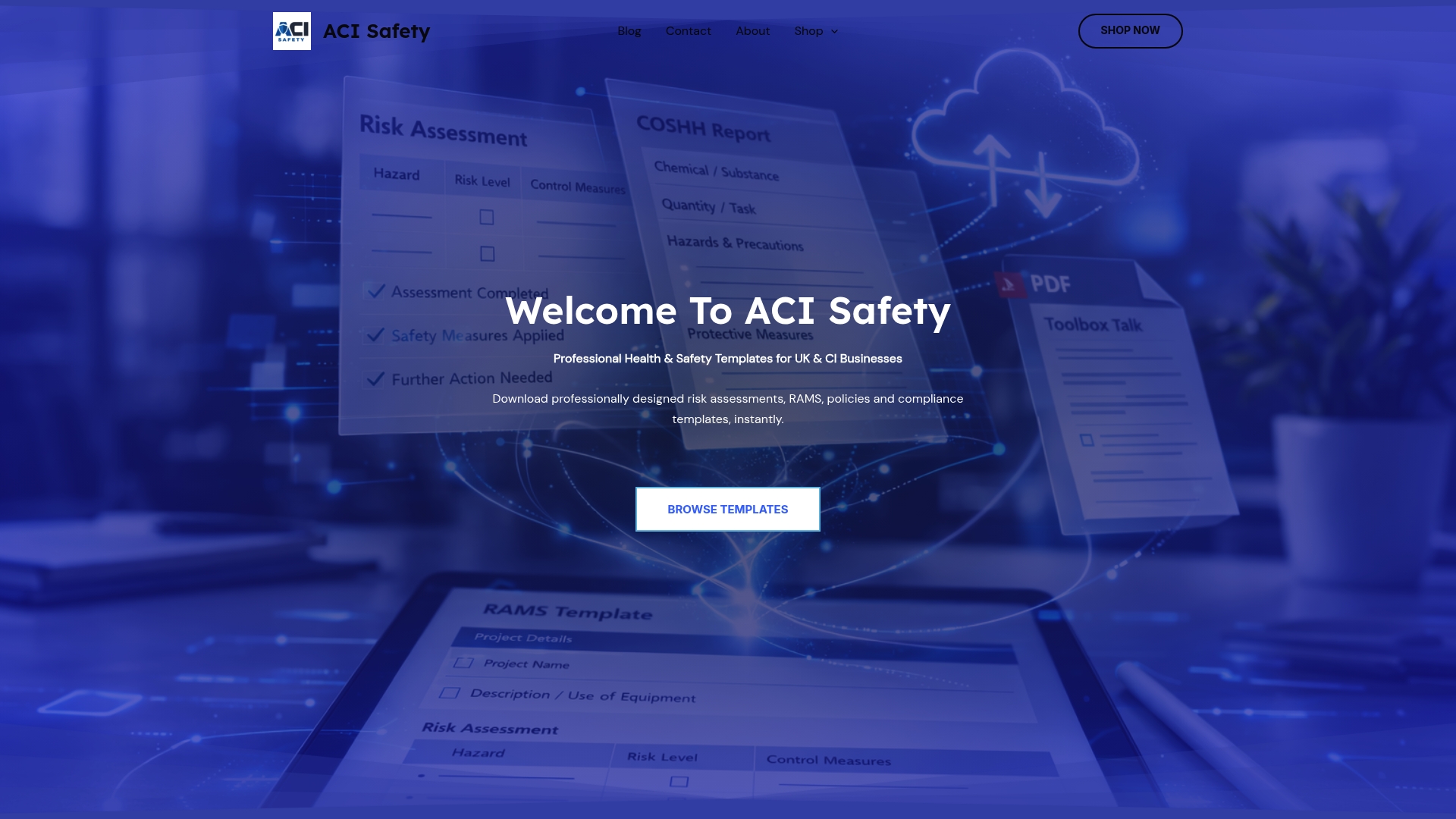
Our editable Word document templates integrate COSHH requirements, RAMS frameworks, and industry-specific control points within formats you can customise immediately. Research shows standardising health and safety documents can reduce compliance management time by 40%, freeing resources for core business activities.
Whether you need construction-specific method statements, trades-focused substance handling checklists, or facilities management inspection templates, our instant digital downloads enable same-day implementation. Access the customisable health and safety policy template to see how editable formats support your unique operational requirements, or explore sector-specific COSHH templates designed for immediate deployment.
Frequently asked questions
What is a health and safety checklist?
A health and safety checklist is a structured document guiding systematic identification of workplace hazards and verification of control measures. It translates legal compliance requirements into practical, repeatable workflows ensuring consistent risk management across operations. Effective checklists integrate regulatory elements like COSHH assessments within daily activity verification, creating unified documentation rather than fragmented systems.
How often should health and safety checklists be reviewed?
Review checklists at least annually or whenever operational changes occur, such as new equipment introduction, process modifications, or regulatory updates. Regular reviews ensure templates reflect current risks and legal requirements rather than becoming outdated documents failing to address evolving hazards. Learn more about COSHH assessment review frequency for substance-specific documentation cycles.
What are the key components of a COSHH checklist?
COSHH checklists must identify all hazardous substances used in operations and document associated health risks and exposure routes. They detail specific control measures including ventilation, PPE requirements, and safe handling procedures aligned with safety data sheets. Discover full requirements through COSHH assessment components guidance.
Are digital health and safety checklists better than paper ones?
Digital formats enable real-time regulatory updates and simplified record management compared to paper systems requiring manual distribution and version control. Research demonstrates digital checklists score 18% higher in usability and compliance support than non-tailored alternatives. Users report faster completion times and greater confidence in regulatory coverage when using structured digital templates.
Can I customise pre-made health and safety checklists?
Editable digital templates in Word format support extensive customisation to match your specific operational hazards, processes, and control measures. This flexibility allows you to maintain professional compliance structure whilst tailoring content to unique business requirements, creating documentation that grows with operational changes rather than requiring complete replacement.
What is the typical cost of professional health and safety checklists?
Professional digital templates range from £15 to £45 per individual checklist depending on comprehensiveness and industry specificity. Comprehensive bundles covering multiple operational areas typically cost £150 to £300, offering better value than piecemeal purchases whilst providing perpetual access without recurring subscription fees.
Recommended
- Workplace safety tips UK SMEs 2026: 45% compliance gaps – ACI Safety
- Customisable Health & Safety Policy Template – Easy-to-Edit Word Document for UK Businesses – ACI Safety
- Blog – ACI Safety
- Customisable UK Sole Trader Health and Safety Policy Template – Compliant and Easy-to-Use – ACI Safety
- 7 Key Sustainable Building Practices 2026 for Managers
- Importance of Checklists in Residential Construction