
Many small business managers wrongly believe PPE is the primary safety control, yet it ranks as the least effective in the risk hierarchy. Understanding the risk assessment hierarchy helps UK SMEs prioritise controls by effectiveness, ensuring compliance with health and safety regulations whilst reducing workplace incidents. This guide reveals how to apply the hierarchy correctly, avoid common pitfalls, and implement practical solutions that protect workers and meet legal obligations.
Table of Contents
- Understanding Risk Assessment Hierarchy
- The Legal Framework Supporting Risk Assessment Hierarchy In The UK
- Deep Dive Into The Hierarchy Levels And Their Priority
- Common Misconceptions About Risk Assessment Hierarchy
- Implementing The Risk Assessment Hierarchy In SMEs: Practical Steps And Tools
- Real-World Examples And Impact Of Risk Assessment Hierarchy In SMEs
- Enhance Your Health And Safety Management With ACI Safety
- Frequently Asked Questions About The Role Of Risk Assessment Hierarchy
Key takeaways
| Point | Details |
|---|---|
| Risk assessment hierarchy prioritises controls from elimination to PPE | Higher levels deliver more effective, permanent hazard reduction compared to relying on personal protective equipment alone. |
| UK law requires using the hierarchy, especially in construction and SME sectors | CDM Regulations 2015 and Health and Safety at Work Act mandate this approach for compliance and enforcement. |
| Common pitfalls include overreliance on PPE and poor documentation | Many SMEs skip elimination or substitution steps, undermining safety effectiveness and audit readiness. |
| Templates and practical tools support easier implementation | Standardised documents save time, integrate hierarchy steps, and help SMEs balance cost with safety improvements. |
Understanding risk assessment hierarchy
The risk assessment hierarchy is an ordered system that prioritises controls based on their effectiveness in reducing workplace hazards. Rather than treating all safety measures equally, this framework guides health and safety managers to focus resources on the most reliable solutions first.
The hierarchy recognises five control levels, arranged from most to least effective:
- Elimination: Permanently removing the hazard from the workplace
- Substitution: Replacing the hazard with a less harmful alternative
- Engineering controls: Isolating workers from hazards through physical barriers or ventilation
- Administrative controls: Changing work procedures, training, or scheduling to minimise exposure
- Personal protective equipment (PPE): Providing workers with protective gear as the last line of defence
For SMEs with limited budgets and personnel, understanding this priority helps target investments where they deliver maximum safety impact. A small manufacturing firm, for example, gains more lasting protection by redesigning a process to eliminate a chemical hazard than by issuing respirators and hoping workers use them correctly every shift.
The hierarchy serves as the foundation for UK health and safety management, shaping how you assess risks, select controls, and demonstrate due diligence. Applying it systematically transforms safety from reactive firefighting into proactive hazard management. This clear guide to risk assessment explains core concepts, whilst understanding responsibilities in COSHH assessments shows how hierarchy principles apply to chemical risks specifically.
The legal framework supporting risk assessment hierarchy in the UK
UK law does not treat the risk assessment hierarchy as optional guidance. It mandates this approach across multiple regulations, making compliance a legal duty rather than best practice.
The Health and Safety at Work Act 1974 requires employers to ensure worker safety “so far as is reasonably practicable.” Courts and regulators interpret this standard by examining whether you applied the hierarchy correctly. Skipping elimination or substitution without justification exposes you to enforcement action, even if you provided PPE.
For construction and related sectors, the CDM Regulations 2015 require hierarchy in construction risk controls, explicitly stating that designers and contractors must prioritise controls from elimination downward. Regulation 8 specifies this sequence, leaving no ambiguity about legal expectations.
Key legal requirements include:
- Demonstrating systematic consideration of higher-level controls before accepting lower ones
- Documenting why elimination or substitution proved impracticable if you rely on engineering or administrative controls
- Reviewing control hierarchies regularly as part of ongoing risk assessments
- Training workers on why the hierarchy matters and how controls protect them
Enforcement consequences can be severe. HSE inspectors issue improvement notices when hierarchy application is inadequate, and prosecutions follow serious breaches. A Midlands SME faced a £50,000 fine in 2025 after an injury occurred because the firm relied solely on PPE when feasible engineering controls existed.
“The law does not permit employers to default to the cheapest or easiest option. You must work down the hierarchy methodically, choosing the highest practicable level for each hazard.”
This health and safety checklist for SMEs helps ensure you meet legal obligations across all areas. Understanding the broader CDM Regulations 2015 and reviewing UK health and safety legal guides provides essential context for compliance.
Deep dive into the hierarchy levels and their priority
Each hierarchy level operates differently, offering distinct advantages and limitations that affect safety outcomes and implementation costs.
1. Elimination removes the hazard entirely, making it impossible for harm to occur. A warehouse redesign that eliminates manual handling of heavy items by automating storage achieves permanent protection. Upfront costs may be significant, but ongoing expenses disappear alongside the risk.
2. Substitution replaces a hazard with a safer alternative. Switching from a solvent-based paint to a water-based version reduces inhalation risks whilst maintaining functionality. This level preserves the activity but reduces severity of potential harm.
3. Engineering controls isolate workers from hazards through physical means. Machine guarding, local exhaust ventilation, and acoustic enclosures create barriers that do not rely on worker behaviour. These controls function continuously once installed, providing reliable protection.
4. Administrative controls modify how work occurs through procedures, training, rotation, or scheduling. A permit-to-work system for confined spaces reduces exposure by controlling access. However, effectiveness depends entirely on consistent human compliance, making these controls inherently less reliable than physical barriers.
5. Personal protective equipment provides the last line of defence when higher controls prove insufficient. Hard hats, safety glasses, and respirators protect individual workers but require proper selection, fitting, maintenance, and use. Failure at any point compromises protection.
| Control Level | Reliability | Implementation Cost | Ongoing Burden | Best For |
|---|---|---|---|---|
| Elimination | Very high | Variable | None | Permanent solutions |
| Substitution | High | Moderate | Low | Process changes |
| Engineering | High | Moderate to high | Low | Physical barriers |
| Administrative | Moderate | Low to moderate | High | Behaviour-dependent |
| PPE | Low | Low | High | Last resort |
Applying the risk control hierarchy reduces workplace incidents by focusing on root hazards over relying on PPE alone. A study tracking manufacturing sites found 40% fewer injuries when firms prioritised elimination and engineering controls compared to those defaulting to administrative measures and PPE.
Pro Tip: Start risk assessments by asking “Can we eliminate this hazard completely?” before considering any other option. This simple question shifts thinking from managing risks to removing them, often revealing solutions you might otherwise overlook.
For detailed terminology supporting hierarchy discussions, review risk assessment terminology explained. The study on hierarchy effectiveness provides evidence-based insights into control performance across industries.
Common misconceptions about risk assessment hierarchy
Several widespread misunderstandings undermine effective hierarchy implementation in SMEs, leading to weaker controls and compliance gaps.
Misconception 1: PPE is a primary control solution. Many managers view issuing safety glasses or gloves as fulfilling their duty. In reality, PPE ranks lowest because it fails frequently. Workers forget equipment, use it incorrectly, or equipment degrades unnoticed. Relying primarily on PPE leaves hazards fully present, hoping human behaviour stays perfect.
Misconception 2: Administrative controls are highly effective. Procedures and training feel comprehensive, but they demand constant vigilance. A worker rushing to meet a deadline may skip a safety step. Fatigue, distraction, or simple forgetfulness compromises administrative controls regularly, making them far less reliable than engineering solutions.
Misconception 3: Elimination and substitution are too complex or expensive. Whilst these levels may require upfront analysis and investment, they often prove more cost-effective over time. Eliminating a hazard ends all associated costs: no PPE purchases, no training refreshers, no injury claims. The initial barrier is psychological, not necessarily financial.
Misconception 4: Documentation does not affect control effectiveness. Poor records create legal and practical problems. Without documented hierarchy consideration, you cannot prove compliance during inspections. Inadequate documentation also prevents learning from past assessments, forcing you to restart analysis repeatedly.
Misconception 5: The hierarchy is rigid and inflexible. Some managers believe they must achieve elimination or nothing. The hierarchy guides priority, not absolute requirements. When higher levels prove genuinely impracticable, you can justify lower controls, provided you document the reasoning and apply the highest feasible option.
Pro Tip: Use a stepwise template that prompts you to consider and document each hierarchy level systematically. This structured approach prevents accidental skipping of higher controls and creates audit-ready evidence of your decision process.
Exploring common health and safety misconceptions helps identify other areas where assumptions may undermine your safety programme.
Implementing the risk assessment hierarchy in SMEs: practical steps and tools
Applying the hierarchy effectively requires a structured approach that balances thoroughness with SME resource constraints.
Step 1: Identify all hazards in your workplace through walkthrough inspections, incident reviews, and worker consultations. Create a comprehensive list before evaluating controls.
Step 2: For each hazard, ask elimination questions. Can you remove the task entirely? Can you redesign the process to avoid creating the hazard? Document your answers, even when elimination proves impossible.
Step 3: Explore substitution options. Research safer materials, equipment, or methods that achieve the same outcome with reduced risk. Contact suppliers for alternatives and compare hazard profiles.
Step 4: Design engineering controls when elimination and substitution are not viable. Consider guards, ventilation, enclosures, or automation that physically separates workers from remaining hazards.
Step 5: Develop administrative controls to supplement engineering measures. Create procedures, training programmes, and supervision systems that reinforce safe practices without relying on them as primary protection.
Step 6: Specify PPE requirements only after exhausting higher options. Select equipment based on specific hazard characteristics, ensure proper fitting, and establish maintenance schedules.
Step 7: Document your hierarchy analysis for every significant hazard, recording why you chose each control level and why higher levels were not practicable.
Key implementation tips:
- Use risk assessment templates that incorporate hierarchy prompts, ensuring you consider each level systematically
- Access editable risk assessments allowing customisation to your specific hazards whilst maintaining hierarchy structure
- Balance cost against risk severity, investing more in controls for high-consequence hazards
- Involve workers in hierarchy discussions, as they often identify practical elimination or substitution options managers miss
- Review hierarchy decisions annually or when processes change, as new technology may enable higher-level controls
A West Midlands metal fabrication SME reduced hand injuries by 60% after applying this approach. Instead of relying on cut-resistant gloves alone, they redesigned material handling to eliminate manual cutting where feasible, substituted safer blade types, installed engineering guards on equipment, and only then specified appropriate PPE for remaining exposures.

This clear guide to risk assessment provides foundational context, whilst principles extend to specialised areas like event risk assessment overview for businesses managing temporary venues or gatherings.
Real-world examples and impact of risk assessment hierarchy in SMEs
Concrete case studies demonstrate measurable benefits when SMEs adopt hierarchy principles systematically.
A Lancashire construction SME specialising in residential refurbishment tracked safety outcomes before and after implementing structured hierarchy assessments. Previously, the firm defaulted to PPE and safe work procedures for most risks. After training managers on the hierarchy and adopting templates that enforced level-by-level consideration, the business achieved notable improvements.
| Metric | Before Hierarchy | After Hierarchy | Change |
|---|---|---|---|
| Reportable injuries (per year) | 7 | 5 | 29% reduction |
| Minor incidents (per year) | 23 | 16 | 30% reduction |
| Time spent on risk assessments | 8 hours/project | 5 hours/project | 38% decrease |
| Compliance audit score | 72% | 94% | 22 points improvement |
| Worker safety confidence (survey) | 68% | 89% | 21 points improvement |
The firm eliminated several hazards entirely by redesigning work sequences. For example, prefabricating roof trusses at ground level removed working at height risks during assembly. Substituting safer cleaning chemicals reduced respiratory complaints. Engineering controls like mobile edge protection replaced reliance on harness use.
Key benefits realised:
- Reduced injury rates: Targeting root hazards rather than managing exposures cut incident frequency substantially
- Improved compliance confidence: Structured hierarchy documentation made HSE inspections straightforward, with clear evidence of due diligence
- Enhanced efficiency: Templates streamlined assessment processes, freeing management time for other priorities
- Better worker engagement: Visible commitment to hierarchy principles built trust and encouraged hazard reporting
- Lower insurance premiums: Improved safety record and documentation quality qualified the firm for reduced rates
A similar pattern emerged at a Devon facilities management SME serving schools and public buildings. After adopting hierarchy-based assessments, the company achieved audit readiness in half the previous preparation time, with assessors noting the clarity of control justifications.
These outcomes show that hierarchy application delivers tangible returns beyond regulatory compliance. Understanding risk assessment terminology explained supports clearer documentation, whilst reviewing workplace safety tips for SMEs helps address common implementation gaps.
Enhance your health and safety management with ACI Safety
Mastering the risk assessment hierarchy becomes significantly easier with structured tools designed specifically for SME needs. ACI Safety provides editable templates that incorporate hierarchy principles directly into assessment workflows, prompting you to consider and document each control level systematically.
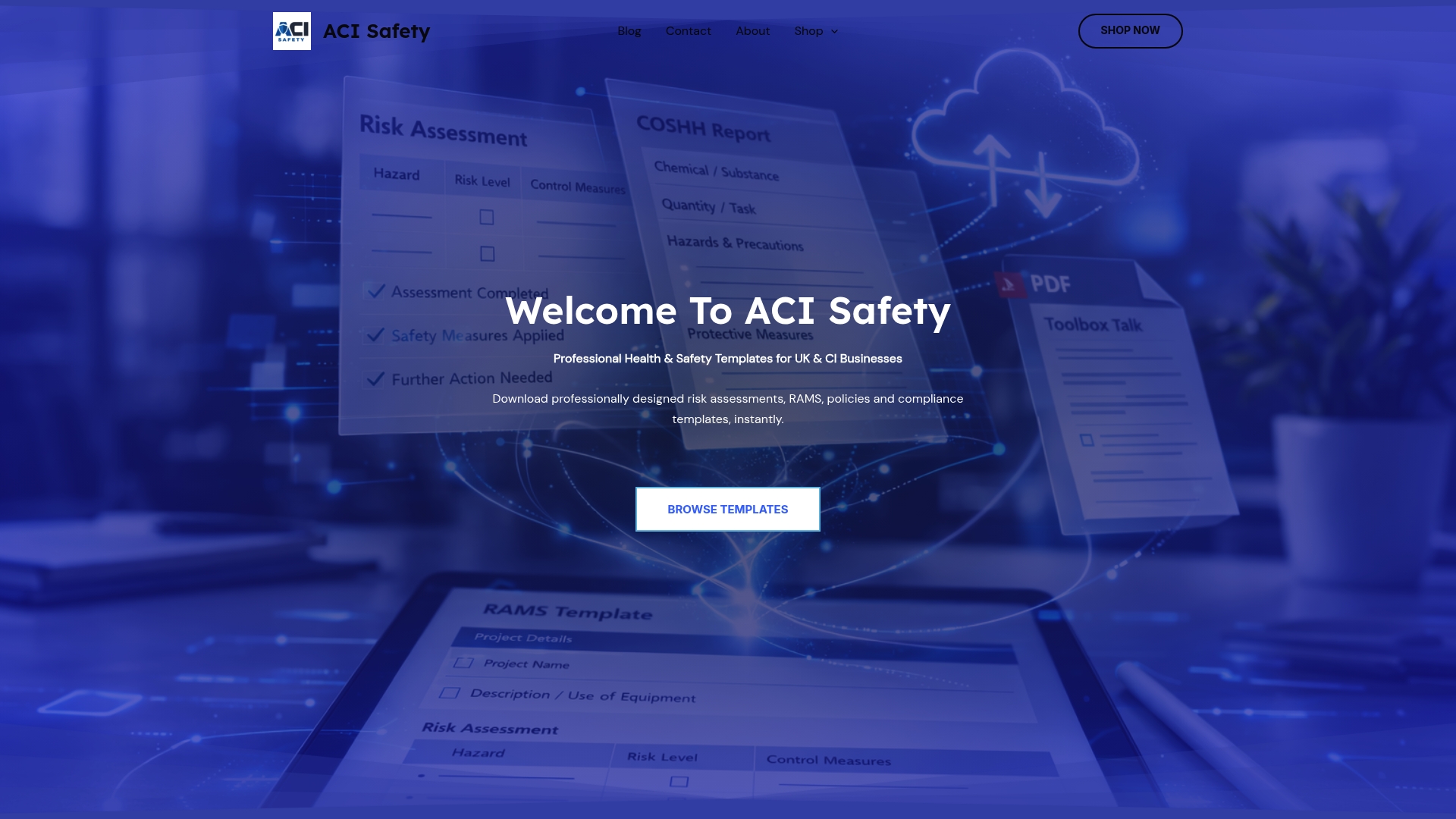
Our templates help you standardise health and safety documents across your business, reducing assessment time by up to 40% whilst improving consistency and compliance. Each risk assessment template includes hierarchy-specific sections that guide you through elimination, substitution, engineering, administrative, and PPE considerations for every hazard you identify.
Available in instantly downloadable Word and PDF formats, these templates adapt to your specific operations whilst maintaining the rigorous structure inspectors expect. Whether you manage construction sites, facilities, or general business premises, professionally designed documentation supports audit readiness and demonstrates due diligence clearly.
Pro Tip: Pair risk assessment templates with our customisable health and safety policy template to create a cohesive compliance framework that reflects hierarchy principles throughout your safety management system.
Frequently asked questions about the role of risk assessment hierarchy
What is the risk assessment hierarchy?
The risk assessment hierarchy is a legally required framework that prioritises workplace safety controls from most to least effective: elimination, substitution, engineering controls, administrative controls, and PPE. It ensures you focus resources on solutions that provide the most reliable, permanent protection.
Why does PPE rank last in the hierarchy?
PPE ranks lowest because it leaves hazards fully present whilst relying entirely on correct, consistent human behaviour for protection. Equipment can fail, workers may forget or misuse it, and maintenance often lapses, making PPE the least reliable control option.
How can SMEs balance cost and safety using the hierarchy?
Start by thoroughly exploring elimination and substitution, which often prove more cost-effective long-term by removing ongoing control expenses. When higher levels require significant investment, apply them to your highest-risk hazards first, using this risk assessment guide to prioritise effectively.
How should I document risk assessments to show hierarchy application?
For each significant hazard, record your consideration of all five levels in order, noting why you selected specific controls and why higher options proved impracticable. Use structured risk assessment templates that include hierarchy-specific sections to ensure consistent, audit-ready documentation.
Is applying the hierarchy legally required for all UK businesses?
Yes, UK health and safety law requires you to apply the hierarchy when selecting risk controls. The Health and Safety at Work Act and specific regulations like CDM 2015 mandate this approach, making it a legal duty rather than optional guidance for all employers.