
Over 14,200 HSE inspections in 2024 resulted in nearly a third leading to enforcement actions, highlighting why UK businesses must understand safety audits. Many small and medium businesses misunderstand what safety audits entail, yet these systematic reviews reduce risks and safeguard operations. This guide covers the what, why, and how of safety audits to help you enhance compliance and workplace safety.
Table of Contents
- Definition And Purpose Of Safety Audits
- Legal Context And Compliance
- Audits Vs Inspections: Key Differences
- Types Of Safety Audits And Who Conducts Them
- How To Conduct A Safety Audit: Step-By-Step Guide
- Common Misconceptions About Safety Audits
- Benefits Of Regular Safety Audits
- Leveraging Digital Documentation For Audits
- Explore Our Health And Safety Templates And Tools
Key takeaways
| Point | Details |
|---|---|
| Definition and purpose | Safety audits systematically review policies, procedures, and controls to identify hazards and improve compliance with UK health and safety laws. |
| Legal framework | Governed by Health and Safety at Work Act 1974 and Management Regulations 1999, audits are best practice but not legally mandatory. |
| Audits vs inspections | Audits assess entire safety management systems whilst inspections focus on immediate hazards and compliance checks. |
| Audit process | Define scope, gather documentation, inspect workplaces, interview employees, analyse findings, and produce actionable reports. |
| Regular benefits | Lower accident risk, demonstrate due diligence, improve employee morale, and build proactive safety culture. |
Definition and purpose of safety audits
A safety audit is a comprehensive review of workplace safety policies and procedures aimed at identifying potential hazards and assessing the effectiveness of safety measures. This systematic examination evaluates whether your business complies with UK legislation and whether your controls actually work in practice.
Safety audits serve multiple crucial purposes for UK businesses:
- Identify hazards that daily operations might overlook, from physical dangers to procedural gaps
- Assess how effectively your existing controls mitigate risks and protect employees
- Support compliance with the Health and Safety at Work etc. Act 1974 and related regulations
- Enhance overall safety culture by demonstrating management commitment to continuous improvement
- Inform strategic improvements through actionable recommendations based on evidence
Unlike reactive measures that respond to incidents, audits proactively examine your entire health and safety audit guide framework. They review documentation including risk assessments, training records, incident reports, and RAMS templates. This holistic approach reveals patterns and systemic weaknesses that isolated checks might miss, enabling you to strengthen your safety management before problems escalate.
Now that we know what a safety audit is, it’s important to understand the legal framework that influences them.
Legal context and compliance
UK safety audits operate within a robust legal framework designed to protect workers and hold employers accountable. The Health and Safety at Work Act 1974 establishes foundational duties for employers to ensure employee health, safety, and welfare so far as reasonably practicable. This legislation applies to virtually all work activities across the UK.
The Management of Health and Safety at Work Regulations 1999 build on this foundation by detailing specific requirements. These regulations mandate risk assessments, implementation of preventive measures, provision of information and training, and appointment of competent persons to assist with health and safety duties. Together, these laws create the compliance landscape that safety audits help navigate.
Key legal considerations for UK businesses include:
- The HSE enforces legal standards through inspections and enforcement actions, but responsibility for risk management rests with organisations
- Safety audits are not legally required but considered best practice to demonstrate due diligence
- Regular audits help prove you’ve taken reasonable steps to identify and control risks
- Audit evidence can support your defence if enforcement action or legal claims arise
- Following the best health and safety checklist demonstrates systematic compliance efforts
Whilst audits aren’t mandatory, they provide tangible proof of your commitment to legal compliance. Courts and regulators view documented audit processes favourably when assessing whether a business has fulfilled its duty of care. This makes audits a strategic investment in legal protection alongside their safety benefits.
Understanding the legal framework helps distinguish audits from simpler checks, so next we explore how audits differ from inspections.
Audits vs inspections: key differences
Many business owners confuse safety audits with safety inspections, yet these serve distinct complementary roles. Safety audits provide a systemic evaluation of the entire health and safety management system rather than focusing on immediate hazards. Inspections, by contrast, are focused checks examining specific areas, equipment, or compliance with particular rules at a single point in time.

| Feature | Safety Audit | Safety Inspection |
|---|---|---|
| Scope | Entire safety management system | Specific areas, equipment, or hazards |
| Focus | Policies, procedures, effectiveness, culture | Immediate hazards, rule compliance |
| Frequency | Typically annual or semi-annual | Weekly, monthly, or as needed |
| Depth | Comprehensive, strategic review | Focused, operational check |
| Outcome | System improvements, policy changes | Corrective actions for identified hazards |
The fundamental differences include:
- Audits assess whether your overall health and safety management system achieves its objectives over time
- Inspections verify compliance with specific standards and identify immediate safety concerns
- Audits promote continuous improvement through strategic recommendations and gap analysis
- Inspections are more frequent, providing ongoing operational oversight and hazard spotting
- Both are essential: inspections catch daily issues whilst audits evaluate whether your processes prevent issues systematically
Think of inspections as routine health checks and audits as comprehensive medical examinations. Inspections keep daily operations safe, whilst audits ensure your entire safety framework functions effectively. Together, they create a robust safety management approach that addresses both immediate and systemic risks.
With these distinctions clear, let’s examine the main types of safety audits and who typically conducts them in UK businesses.
Types of safety audits and who conducts them
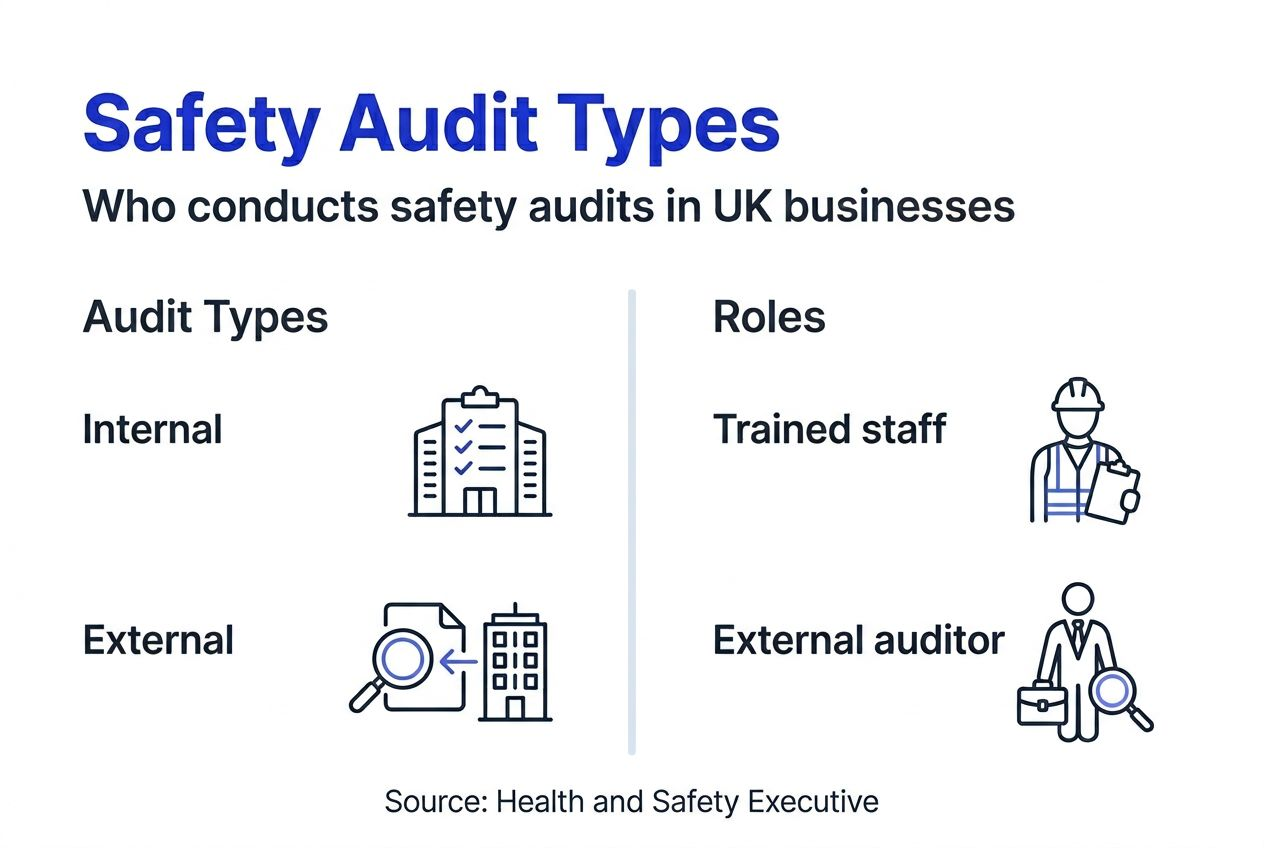
UK businesses typically employ two main audit types, each offering distinct advantages. Internal HSE audits are conducted by trained staff for ongoing monitoring, providing continuous improvement insights and day-to-day compliance support. External audits, performed by third parties, deliver objective assessments and help prepare for regulatory inspections or certifications like ISO 45001.
Internal audits offer several benefits:
- Conducted by employees familiar with operations, culture, and specific risks
- Cost-effective for regular monitoring and continuous improvement cycles
- Flexible scheduling to match business needs and operational changes
- Build internal competence and safety awareness throughout the organisation
- Typically occur monthly, quarterly, or following significant workplace changes
External audits provide complementary value:
- Independent, objective perspective free from internal biases or blind spots
- Specialist expertise in specific industries, regulations, or international standards
- Credibility with regulators, insurers, clients, and certification bodies
- Benchmarking against industry best practices and regulatory expectations
- Usually conducted annually or when seeking formal certifications
For comprehensive guide to HSE audits, consider combining both approaches. Many successful UK SMBs use internal audits for routine monitoring and external audits for annual validation and strategic review. The choice depends on your business size, risk profile, compliance goals, and available resources.
Selecting qualified auditors is crucial. Internal auditors need proper training in audit techniques, relevant regulations, and your industry’s specific hazards. External auditors should hold recognised qualifications and demonstrate experience in your sector. Either way, auditor competence directly influences audit quality and the value you extract from the process.
Knowing audit types prepares us for a practical guide on how to carry out a safety audit effectively.
How to conduct a safety audit: step-by-step guide
Conducting an effective safety audit requires systematic planning and execution tailored to your business needs. Follow this practical process designed for UK small and medium businesses:
-
Define scope and objectives. Determine which areas, processes, or systems you’ll audit and what you aim to achieve. Planning includes defining the scope to focus resources effectively and set clear success criteria.
-
Gather and review documentation. Collect risk assessments, RAMS templates, health and safety policies, training records, incident logs, and previous audit reports. This baseline review identifies obvious gaps before the physical inspection.
-
Prepare audit team and checklists. Assign qualified auditors and create customised checklists covering regulations, industry standards, and your specific operations. Tailored checklists ensure consistency and thoroughness.
-
Conduct workplace inspections. Walk through facilities systematically, observing work practices, equipment conditions, housekeeping, and visible hazards. Audits use reviews, inspections, and interviews to collect comprehensive evidence.
-
Interview employees and managers. Speak with workers at all levels to understand how safety procedures work in practice, identify concerns, and gauge safety culture. Frontline insights often reveal gaps that documentation misses.
-
Analyse evidence and identify gaps. Compare findings against legal requirements, your policies, and best practices. Categorise issues by severity and root causes to prioritise corrective actions effectively.
-
Produce detailed audit report. Document findings, prioritised recommendations, responsible parties, and timelines. Reports should be clear, actionable, and linked to specific compliance requirements or risk reductions.
Pro Tip: Before starting your audit, review your small business safety compliance guide to ensure you understand baseline requirements. This preparation makes audits more efficient and helps you ask better questions during employee interviews.
Integrate your audit process with existing documentation systems. Reference your COSHH assessment guide when auditing chemical handling, consult your risk assessment guide to verify assessment quality, and check your health and safety policy template for policy compliance. This holistic approach ensures audits strengthen your entire safety framework.
With a clear audit process outlined, let’s dispel some common misconceptions that may hinder effective safety auditing.
Common misconceptions about safety audits
Several persistent myths discourage UK businesses from conducting effective safety audits. Misconceptions include that audits are merely box-ticking exercises, yet properly conducted audits drive genuine cultural and operational improvements rather than superficial compliance theatre.
Common misconceptions to address:
- Audits are just paperwork exercises. Reality: audits combine documentation review with physical inspections, employee interviews, and behavioural observations to assess real-world safety performance.
- Safety audits are legally mandatory. Truth: whilst not required by law, audits represent best practice and help demonstrate due diligence if enforcement actions arise.
- Audits replace risk assessments. Clarification: audits review whether your risk assessment process works effectively but don’t substitute for identifying and controlling specific hazards.
- Only large businesses need audits. Fact: small and medium businesses benefit equally from systematic safety reviews, often gaining proportionally greater value from identifying gaps early.
- Audits find blame, not solutions. Reality: effective audits focus on systemic improvements and learning opportunities rather than punishing individuals for shortcomings.
Understanding these distinctions improves audit effectiveness and stakeholder buy-in. When employees and managers view audits as constructive improvement tools rather than punitive exercises, they engage more openly and provide honest feedback. This transparency reveals genuine risks and opportunities that defensive responses would hide.
Audits contribute meaningfully to safety culture by demonstrating management commitment to continuous improvement. They signal that safety matters beyond regulatory compliance, fostering employee trust and participation. This cultural shift often delivers greater long-term value than the specific corrective actions audits identify.
Clearing these misconceptions shows how safety audits benefit businesses, so next we explore these advantages in depth.
Benefits of regular safety audits
Regular safety audits deliver substantial practical, compliance, and cultural benefits that justify their investment. Regular audits reduce accidents and legal penalties by proactively identifying hazards and verifying controls before incidents occur, protecting both people and business interests.
Key advantages for UK SMBs include:
- Lower accident risk. Early hazard identification and control verification prevent injuries, ill health, and associated costs including lost productivity, compensation claims, and reputational damage.
- Demonstrate due diligence. Documented audit programmes show regulators you’ve taken reasonable steps to manage risks, reducing fines and enforcement action likelihood.
- Improve employee morale. Visible commitment to safety through regular audits increases worker confidence, engagement, and willingness to report concerns.
- Support continuous improvement. Audits create feedback loops that refine policies, procedures, and controls based on evidence rather than assumptions.
- Build proactive safety culture. Regular systematic reviews normalise safety as an ongoing priority rather than a reactive response to incidents.
- Prioritise corrective actions. Audit reports categorise findings by severity, enabling resource allocation to highest-risk issues first for maximum impact.
Regular safety audits transform compliance from a burden into a competitive advantage by reducing costs, improving efficiency, and attracting quality employees who value workplace safety.
Beyond regulatory compliance, audits often reveal operational inefficiencies, wasteful practices, and process improvements that enhance productivity. Many businesses discover that safer work methods are also faster, cheaper, and higher quality. This alignment of safety and business objectives makes audits valuable strategic tools, not just compliance exercises.
The cultural benefits compound over time. As audits become routine, employees increasingly view safety as integral to work rather than an external imposition. This mindset shift drives voluntary compliance, peer accountability, and innovative safety solutions from frontline workers who understand operations best.
Regular audits bring many benefits, which can be further maximised by leveraging modern tools like digital documentation.
Leveraging digital documentation for audits
Modern digital tools streamline audit preparation, execution, and follow-up for UK businesses. Digital tools and editable templates streamline audit documentation, reduce administrative burden, and support compliance evidence with structured, consistent formats that meet regulatory expectations.
Digital documentation advantages include:
- Consistent, compliant templates. Editable RAMS and risk assessment templates ensure standardised formats that align with UK regulations and industry best practices.
- Instant accessibility. Downloadable formats in Word and PDF allow immediate use and easy sharing with auditors, regulators, or certification bodies.
- Reduced errors and workload. Pre-structured templates guide users through required information, minimising omissions and reducing time spent creating documents from scratch.
- Centralised records. Digital systems organise documentation for quick retrieval during audits, inspections, or enforcement actions, demonstrating systematic compliance.
- Credible evidence. Professional templates provide audit trails showing when documents were created, reviewed, and updated, supporting due diligence claims.
Pro Tip: Maintain a dedicated digital folder for audit-ready documentation including current risk assessments, RAMS templates, training records, and incident logs. Update this folder quarterly so you’re always prepared for internal audits or unexpected HSE visits without last-minute scrambling.
Integrating digital documentation with your audit process creates efficiency gains beyond individual time savings. Templates standardise information collection, making comparisons across sites, departments, or time periods straightforward. This consistency enables trend analysis and benchmarking that manual systems struggle to support.
For comprehensive health and safety audit support, consider platforms offering integrated audit checklists, reporting tools, and compliance tracking. These systems automate routine tasks, freeing your team to focus on analysis, improvement planning, and cultural engagement rather than administrative paperwork.
Now that you understand how digital tools assist audits, let’s see how you can take the next steps to secure your business with the right safety support.
Explore our health and safety templates and tools
Strengthening your safety audit process starts with proper documentation that meets UK compliance standards. ACI Safety provides instantly downloadable templates designed specifically for small and medium businesses seeking efficient, professional health and safety management.
Our customisable health safety policy template offers an easy-to-edit Word document that establishes your compliance framework quickly. Pair this with our extensive RAMS template collection covering construction, trades, and facilities management to document safe working methods effectively. Browse our complete range of health and safety templates including risk assessments, COSHH assessments, method statements, and toolbox talks. Each template is professionally structured, instantly downloadable, and designed to support your audit preparation whilst reducing administrative burden.
FAQ
What is the difference between a safety audit and a risk assessment?
Safety audits review the overall health and safety management system to evaluate whether policies, procedures, and controls function effectively. Risk assessments focus on identifying specific hazards in particular tasks or areas and determining appropriate control measures. Audits assess whether your risk assessment process works systematically.
Are safety audits legally required for UK small businesses?
Safety audits are not legally mandatory under UK health and safety law. However, they are widely regarded as best practice and help demonstrate due diligence in fulfilling your duty of care. Regular audits provide evidence that you’ve taken reasonable steps to identify and manage workplace risks.
How often should a safety audit be conducted?
Internal audits commonly occur monthly to quarterly for ongoing monitoring and continuous improvement. External audits typically happen annually or before pursuing certifications like ISO 45001. Frequency depends on your business size, risk levels, operational complexity, and compliance objectives. High-risk industries often audit more frequently.
What role do employees play in safety audits?
Employees provide essential feedback during audits through interviews and consultations that reveal how safety procedures work in practice. Their involvement helps identify hazards that managers might overlook and fosters ownership of safety outcomes. Engaging workers in audits builds proactive safety attitudes and improves overall workplace culture.