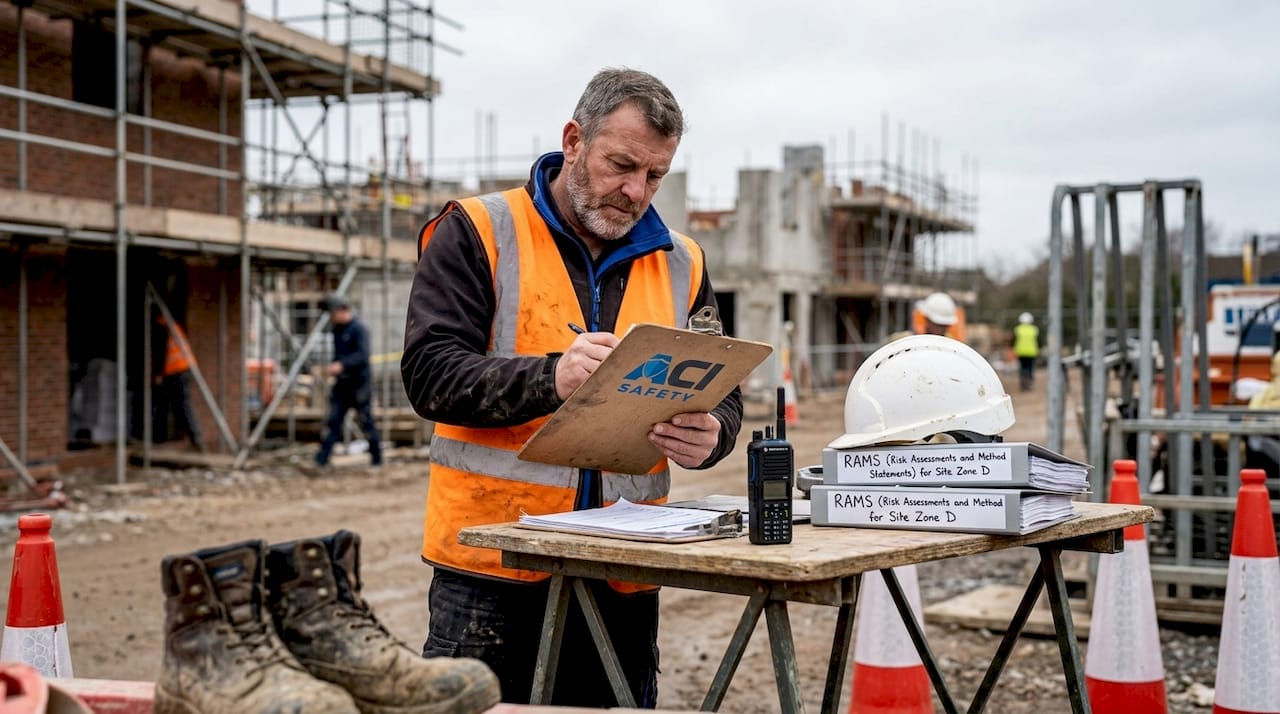
Running a small construction or trades business in the UK means juggling tools, timelines, clients, and a mountain of paperwork that never seems to shrink. Sound familiar? UK tradespeople lose 8 hours every week to admin tasks alone, which adds up to ten full working weeks a year. That’s time you could spend on the tools, winning new contracts, or simply knocking off at a reasonable hour. The good news is that health and safety compliance doesn’t have to bury you in paperwork. With the right approach and the right documents, you can stay fully compliant, protect your team, and reclaim your evenings.
Table of Contents
- Core health and safety requirements for construction SMEs
- Using HSG150: The essential construction safety guide
- Smart risk assessments: Less paper, more protection
- Selecting and managing safe contractors
- Best practice controls: The hierarchy of risk management
- Free and official templates: Where to access ready-made documentation
- Get compliant without the headache
- Frequently asked questions
Key Takeaways
| Point | Details |
|---|---|
| Prioritise core documentation | Focusing on the required essentials cuts admin and ensures legal coverage for construction SMEs. |
| Leverage HSE and industry templates | Free, pre-vetted templates save time and help keep your documents compliant. |
| Use proportionate risk assessments | Assess risks relevant to your actual site work rather than overloading on paperwork. |
| Check contractor competence | Always confirm skills and insurance before any contractor starts on site. |
| Adopt digital tools | Digital forms and automation can save your business up to 10 weeks per year in admin. |
Core health and safety requirements for construction SMEs
Let’s start with the basics. Every UK construction and trades business has legal obligations under health and safety law, and getting your head around them is the first step to making compliance feel manageable rather than terrifying.
Here’s what the law actually requires:
- Written health and safety policy if you employ five or more people
- Risk assessments for all significant workplace hazards
- Employers’ liability insurance with a minimum cover of £5 million
- First aid provision appropriate to your workplace
- Fire safety measures and a fire risk assessment
- Construction-specific requirements including CSCS cards, working at height training, and asbestos awareness
These are the essential compliance documents every SME in construction needs to have in order. Miss one and you’re not just risking a fine; you’re leaving your workers exposed.
“Health and safety law applies to all businesses, regardless of size. The key is proportionate action: focus on real risks, not generating paperwork for its own sake.” — HSE simple health and safety guide
The HSE’s simple health and safety guidance covers everything from policy preparation and accident reporting to worker consultation and appointing a competent person. It’s a solid starting point and it’s free. The difference between law and best practice matters here too. The law sets the floor; best practice raises the ceiling. Aim higher and you’ll find compliance becomes a natural part of how you work, not a last-minute scramble.
Using HSG150: The essential construction safety guide
With the fundamentals in place, SMEs need a reliable reference. That’s where HSG150 comes in. Published by the HSE, Health and Safety in Construction (HSG150) is the go-to guide for UK construction businesses of all sizes. It covers risk management, CDM 2015 duties (the Construction Design and Management Regulations), hazard controls, and practical site safety.
Construction is a genuinely hazardous industry. It has a 4x higher fatality rate than most other sectors and accounts for around 30% of all workplace deaths in the UK. Those aren’t numbers to gloss over.
Here’s what HSG150 covers that’s most useful for SMEs:
- Risk assessment frameworks tailored to construction activities
- CDM 2015 duties explained in plain English for smaller projects
- Hazard-specific controls for working at height, excavations, and manual handling
- Practical checklists you can use as operational tools on site
- Guidance on competence and what it actually means in practice
Pro Tip: The HSG150 PDF is available as a free download from the HSE construction resources page. Print the summary sections and keep them in your site folder. Use it as a checklist, not just a reference document.
Understanding HSE’s role in UK construction helps you see HSG150 not as a threat but as a tool. It’s there to help you manage real risks, not to generate bureaucracy. Pair it with a practical site safety approach and you’ve got a solid operational framework.
Smart risk assessments: Less paper, more protection
A key compliance document is the risk assessment. But here’s the thing most people get wrong: more paper does not equal more safety. A ten-page risk assessment full of generic hazards nobody reads is worth less than a focused one-pager your team actually uses.
Here’s how to run a proportionate risk assessment in five steps:
- Identify the hazards specific to the task or site, not a generic list
- Decide who might be harmed and how, including subcontractors and visitors
- Evaluate the risks and decide on control measures
- Record your findings clearly and concisely
- Review and update whenever the job, site, or team changes
Where do most SMEs waste time? Over-documentation. Writing lengthy assessments for low-risk tasks nobody will read is a classic trap. The HSE’s risk assessment basics are clear: the record should be simple, practical, and focused on significant risks.
Digital tools and editable templates are a genuine game-changer here. Automating your RAMS can save over 21 hours a month in admin time. That’s not a small number. And worker involvement matters too: the people doing the job often spot hazards that managers miss. Ask them. It improves safety and it’s good practice under HSE guidance.
Pro Tip: Use editable RAMS templates to build a library of task-specific assessments. Adapt them for each job rather than starting from scratch every time. You’ll save hours and your documents will actually be relevant to the work being done. Check out our guide on streamlining your risk assessment workflow for more practical steps.
Selecting and managing safe contractors
Once you’ve managed your own health and safety, ensure any contractors on site are up to standard. This is an area where many SMEs fall short, not because they don’t care, but because they’re not sure what to check.
When you bring a contractor onto your site, you take on a degree of responsibility for their safety and the safety of others around them. Here’s what to verify before they start:
- Relevant experience and qualifications for the specific task
- CSCS cards or equivalent trade certification
- Safety records and any previous enforcement notices
- Method statements and risk assessments for their scope of work
- Public liability and employers’ liability insurance certificates
- Health and safety management procedures relevant to your site
“When using contractors, verify competence through experience, certificates, and safety records. Exchange information before work begins and monitor the site throughout.” — HSE contractors guidance
Monitoring matters more than box-ticking. Collecting documents and filing them away isn’t enough. Walk the site. Talk to the contractors. Check that what’s written in their method statement is what’s actually happening on the ground. For more on managing this across your business, our SME construction essentials guide covers the full picture.
Best practice controls: The hierarchy of risk management
Effective control measures go beyond compliance. There’s a proven system for tackling site risks called the hierarchy of control, and it tells you which measures are most effective and in what order to apply them.
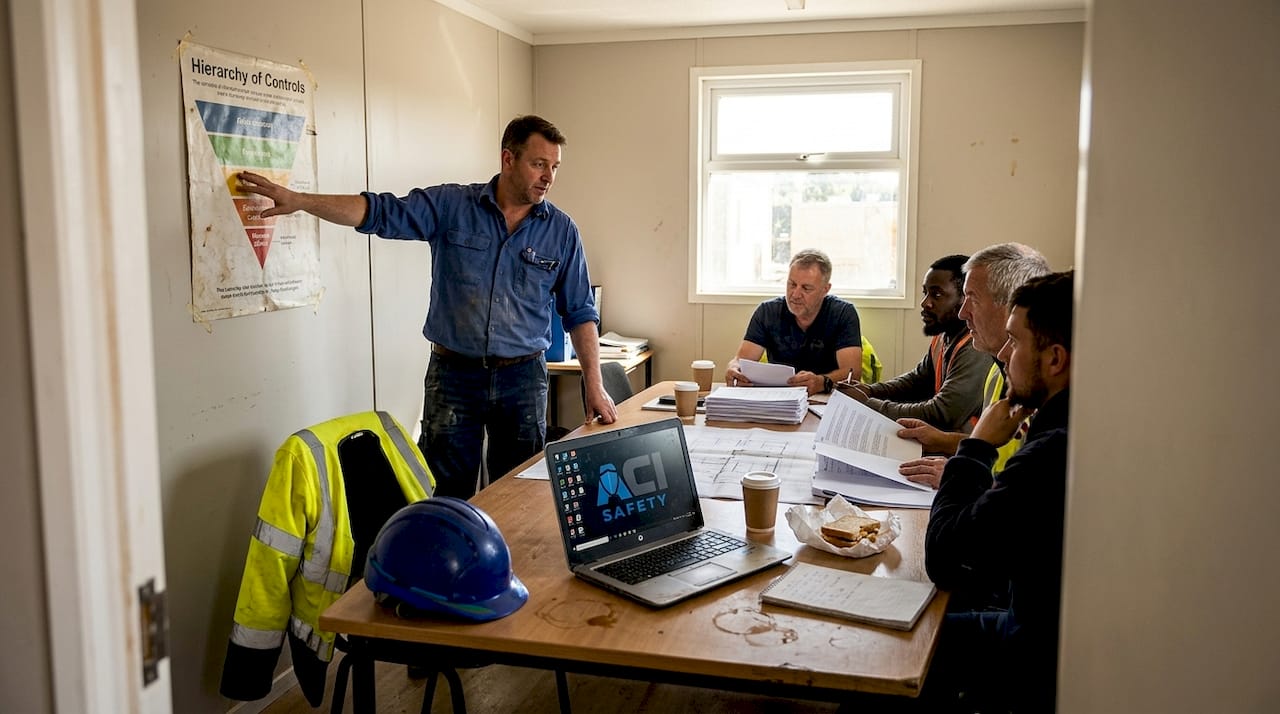
Let’s use hand-arm vibration syndrome (HAVS) as a real example. HAVS is caused by prolonged use of vibrating tools and can cause permanent nerve and circulation damage. It’s a significant risk in construction. The HSE HAV campaign sets out a clear approach:
| Control level | Example for HAVS | Effectiveness |
|---|---|---|
| Elimination | Remove the vibrating task entirely | Highest |
| Substitution | Use a less vibrating tool or process | Very high |
| Engineering controls | Anti-vibration tool mounts, job rotation | High |
| Administrative controls | Exposure time limits, training | Moderate |
| PPE | Anti-vibration gloves | Lowest |
The hierarchy applies to every hazard on site, not just vibration. Here’s how to apply it practically:
- Always ask: can we eliminate this hazard entirely?
- If not, can we substitute a safer method or material?
- Then look at engineering solutions before relying on PPE
- PPE is the last line of defence, not the first
- Document your reasoning when you choose a control measure
When you’re putting together your RAMS, the hierarchy of control should shape every section. Our guide on choosing the right RAMS template walks you through how to structure this properly.
Free and official templates: Where to access ready-made documentation
Documentation doesn’t have to be a burden, especially with ready-made and official templates available. The HSE publishes a range of free construction leaflets covering specific topics:
- CIS52 covering dumper safety
- CIS65 on avoiding underground services
- CIS66 for basement construction
- CIS69 on dust extraction
- INDG344 a practical toolkit for small contractors
These are useful starting points. But they’re not editable, and they won’t have your company name, your specific site details, or your team’s names on them. That’s where editable templates come in.
| Document type | HSE free leaflets | Editable Word templates |
|---|---|---|
| Customisable with your details | No | Yes |
| Ready to use immediately | Yes | Yes |
| Covers your specific tasks | Partial | Yes |
| Legally structured | Yes | Yes |
| Saves admin time | Moderate | High |
For businesses that want to save time with ready-made templates, the combination of official HSE guidance and editable documents is the sweet spot. You get the legal rigour of HSE-aligned content with the flexibility to make it your own. A customisable health and safety policy template is a great place to start if you don’t already have one in place.
Get compliant without the headache
If reading this has made you realise your health and safety documentation needs a bit of attention, you’re not alone. Most small construction businesses are in the same boat.
At ACI Safety, we’ve built a full library of professionally designed, editable health and safety templates specifically for UK construction and trades businesses. From RAMS and risk assessments to COSHH assessments, method statements, toolbox talks, and health and safety policies, everything is available as an instant digital download in Word or PDF format. No starting from scratch. No legal jargon to wade through. Just clear, structured documents you can adapt and use straight away. Browse our full range and take the admin pain out of compliance today.
Frequently asked questions
What basic health and safety documents are legally required for UK construction SMEs?
You need a written health and safety policy (if you have five or more employees), risk assessments, employers’ liability insurance of at least £5 million, and evidence of relevant training such as CSCS cards and asbestos awareness. Construction businesses also need specific controls for working at height.
How can small construction businesses cut admin time when managing health and safety?
Using digital tools and editable templates is the fastest win. Automating admin tasks can save up to ten working weeks a year and potentially £17,000 to £25,000 per business annually.
What is the benefit of using official HSE templates over creating documents from scratch?
HSE templates are legally structured and regularly updated, covering all the essentials from policy preparation to accident reporting. They save hours of admin and reduce the risk of missing a legal requirement.
What is the most common health and safety pitfall for small contractors?
Focusing on generating paperwork rather than managing real, practical risks is the most common mistake. Failing to properly check contractor competence before they start work is a close second.