
Managing risk assessments efficiently while ensuring legal compliance remains one of the most pressing challenges for health and safety managers in UK small to medium-sized businesses. The Health and Safety at Work etc. Act 1974 mandates that all employers systematically identify workplace hazards and implement effective controls to protect their workforce. This guide provides a practical, step-by-step workflow designed specifically for UK SMEs, helping you streamline risk assessment processes, maintain compliance, and create safer working environments without unnecessary complexity or administrative burden.
Table of Contents
- Understanding The Legal Requirements And Importance Of Risk Assessments
- Preparing For Your Risk Assessment: Tools, Requirements, And Team Roles
- Following A Step-By-Step Risk Assessment Workflow For Effective Hazard Control
- Reviewing And Verifying Risk Assessments To Maintain Safety Compliance
- How ACI Safety Can Simplify Your Risk Assessment Workflow
- Frequently Asked Questions
Key takeaways
| Point | Details |
|---|---|
| Legal obligation | UK employers must conduct risk assessments under the Health and Safety at Work etc. Act 1974 and document findings when employing five or more staff. |
| Structured approach | An effective workflow includes hazard identification, risk evaluation, control implementation, and scheduled reviews to maintain compliance. |
| Tailored assessments | Generic templates fail to address business-specific hazards, requiring customisation to ensure legal compliance and practical effectiveness. |
| Regular reviews | Annual reviews or updates following workplace changes keep assessments relevant and effective in protecting employees. |
| Documentation matters | Written records demonstrate compliance, guide employee safety practices, and provide evidence during inspections or incidents. |
Understanding the legal requirements and importance of risk assessments
Compliance with the Health and Safety at Work etc. Act 1974 and Management of Health and Safety at Work Regulations 1999 is mandatory for all UK businesses, regardless of size or sector. These regulations establish clear employer duties to identify workplace hazards, assess associated risks, and implement appropriate control measures to protect employees, contractors, and visitors. The law requires businesses with five or more employees to maintain written records of significant findings, creating an auditable trail of safety management.
Your responsibilities extend beyond simple paperwork completion. Employers must identify hazards, assess risks, and implement control measures that genuinely reduce the likelihood of harm occurring in your specific workplace context. This means understanding the unique hazards present in your operations, from manual handling risks in warehousing to chemical exposures in manufacturing or slips and trips in office environments.
Neglecting these legal duties carries serious consequences. The Health and Safety Executive can issue improvement or prohibition notices, impose substantial fines, or pursue criminal prosecution in cases of serious breaches. Beyond legal penalties, inadequate risk assessments directly contribute to increased workplace injuries, lost productivity, higher insurance premiums, and potential civil litigation from injured employees.
The good news is that the law requires ‘suitable and sufficient’ assessments rather than perfection. You need practical documentation that identifies real hazards, evaluates genuine risks, and implements effective controls without creating unnecessarily complex systems that overwhelm small business resources. Understanding legal compliance in safety helps you focus efforts where they matter most, protecting your workforce whilst meeting regulatory obligations efficiently.
Key legal requirements include:
- Identifying all reasonably foreseeable hazards in your workplace
- Evaluating who might be harmed and how
- Implementing control measures following the hierarchy of controls
- Recording significant findings in writing when employing five or more staff
- Reviewing assessments regularly and after significant workplace changes
- Consulting employees or their representatives throughout the process
- Providing appropriate training and information based on assessment findings
Preparing for your risk assessment: tools, requirements, and team roles
Effective preparation sets the foundation for streamlined risk assessment workflows. Before starting your assessment, gather the essential tools, documentation, and personnel needed to conduct thorough evaluations efficiently. The HSE guidance on risk assessment process emphasises that systematic preparation prevents delays, ensures comprehensive coverage, and improves assessment quality.
Start by assembling your assessment toolkit. You need workplace inspection checklists tailored to your industry, hazard identification sheets covering physical, chemical, biological, and ergonomic hazards, and proper documentation templates that capture findings systematically. Review previous assessments, incident reports, and near-miss records to identify recurring issues or emerging hazards requiring attention. Collect relevant information including equipment manuals, safety data sheets for chemicals, workplace layouts, and employee feedback about safety concerns.

Define clear roles and responsibilities within your assessment team. Designate a competent assessor with appropriate knowledge, training, and authority to lead the process. Involve department supervisors who understand day-to-day operations and can identify practical hazards. Include employee representatives to capture frontline perspectives often missed by management. Assign someone to document findings accurately and maintain records systematically. This collaborative approach ensures comprehensive hazard identification whilst building workforce engagement with safety management.
Pro Tip: Schedule brief pre-assessment meetings with each department to gather insights about operational challenges, recent changes, and employee concerns before conducting formal inspections, saving time and improving hazard identification accuracy.
Utilising health and safety templates that save time provides structured frameworks that guide your assessment process without starting from scratch. Templates ensure consistency across different workplace areas, prompt consideration of common hazards, and create standardised documentation that simplifies reviews and updates. However, templates must be customised to reflect your specific operations rather than used as generic tick-box exercises.
| Tool/Material | Purpose | Frequency of Use |
|---|---|---|
| Inspection checklists | Guide systematic workplace walkthroughs | Each assessment cycle |
| Hazard identification sheets | Record potential sources of harm | Initial assessment and reviews |
| Risk rating matrices | Evaluate likelihood and severity | During risk evaluation phase |
| Control measure templates | Document implemented safeguards | Ongoing as controls are added |
| Review schedules | Track assessment currency | Monthly monitoring |
For businesses handling hazardous substances, understanding COSHH assessment components ensures you capture chemical-specific risks systematically. COSHH assessments require additional detail about substance properties, exposure routes, health effects, and specialised control measures beyond general risk assessment requirements.
Establish clear communication channels between stakeholders throughout the preparation phase. Health and safety managers need regular input from operational staff who encounter hazards daily, whilst senior management must understand resource requirements for implementing recommended controls. Transparent communication prevents assessments becoming isolated paperwork exercises disconnected from workplace realities.
Following a step-by-step risk assessment workflow for effective hazard control
A structured approach involves identifying hazards, evaluating risks, and implementing control measures through a systematic workflow that ensures comprehensive coverage whilst remaining practical for SME implementation. This step-by-step process transforms legal obligations into manageable tasks that genuinely improve workplace safety.
-
Identify hazards systematically by conducting thorough workplace inspections, reviewing incident records, consulting employees about safety concerns, and examining work processes from start to finish. Look beyond obvious hazards to identify less visible risks such as ergonomic issues, psychological stressors, or cumulative exposures that develop over time.
-
Determine who might be harmed and how by considering employees, contractors, visitors, and vulnerable groups including young workers, pregnant employees, or those with disabilities. Different people face different risk levels from the same hazard based on exposure duration, experience, and physical capabilities.
-
Evaluate risk levels by assessing both the likelihood of harm occurring and the potential severity of consequences. Use simple risk rating matrices that categorise risks as low, medium, or high priority, helping you focus resources on the most significant hazards first.
-
Record your findings in writing, documenting identified hazards, affected persons, current control measures, risk ratings, and additional actions required. Written records demonstrate compliance, guide implementation of improvements, and provide reference points for future reviews.
-
Implement control measures following the hierarchy of controls, prioritising elimination of hazards where possible, then substitution with safer alternatives, engineering controls, administrative procedures, and finally personal protective equipment as a last resort. COSHH risk assessments require hazard identification, risk evaluation, and control measures tailored to specific business hazards, particularly when managing chemical exposures.
-
Plan regular reviews to verify that controls remain effective, identify new hazards, and adapt to workplace changes. Schedule annual reviews as a minimum, with additional reviews triggered by incidents, near misses, or operational changes.
Pro Tip: Balance thoroughness with simplicity by focusing assessment detail on high-risk activities whilst using streamlined approaches for routine, low-risk tasks, preventing assessment processes from becoming overwhelming for small business resources.
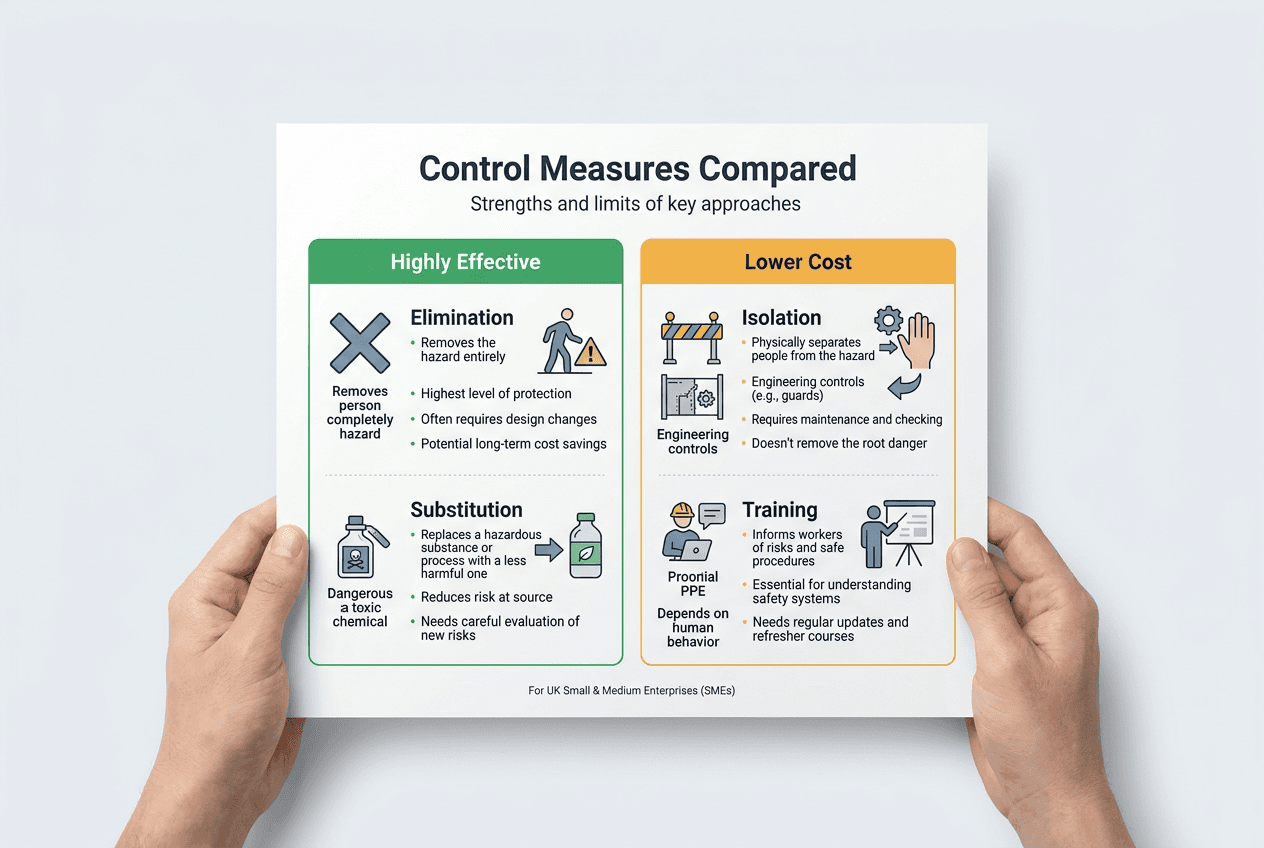
Common control measures vary in effectiveness, cost, and ease of implementation. Understanding their relative strengths and limitations helps you select appropriate solutions for your specific circumstances.
| Control Approach | Advantages | Limitations |
|---|---|---|
| Elimination | Completely removes hazard and risk | Often impractical for core business activities |
| Substitution | Reduces risk whilst maintaining functionality | May introduce new, unforeseen hazards |
| Engineering controls | Provides reliable, passive protection | Requires capital investment and maintenance |
| Administrative controls | Flexible and relatively inexpensive | Depends on consistent human compliance |
| Personal protective equipment | Quick to implement for residual risks | Least effective, requires ongoing management |
Utilising COSHH templates and COSHH assessments provides specialised frameworks for managing chemical hazards that require more detailed evaluation than general workplace risks. These templates guide you through substance-specific considerations including exposure limits, health surveillance requirements, and emergency procedures.
Effective implementation requires clear communication of findings to all affected employees. Share assessment outcomes through toolbox talks, safety briefings, and accessible documentation that explains both identified hazards and required control measures in plain language. Employees cannot follow safety procedures they do not understand or were never informed about.
Monitor control measure effectiveness through regular workplace inspections, employee feedback, and incident analysis. Controls that look effective on paper may prove impractical in real-world operations, requiring adjustment to achieve genuine risk reduction rather than just compliance documentation.
Reviewing and verifying risk assessments to maintain safety compliance
Conducting initial risk assessments represents just the beginning of effective safety management. Regular review and verification ensure assessments remain current, controls stay effective, and your business adapts to changing workplace conditions whilst maintaining legal compliance. HSE recommends annual risk assessment reviews to ensure effectiveness and relevance, with additional reviews triggered by specific circumstances.
Reviewing risk assessments regularly helps adapt to changing workplace conditions and hazards that emerge as operations evolve. Schedule comprehensive reviews at least once yearly, examining all documented assessments to verify they accurately reflect current workplace realities. However, annual reviews alone prove insufficient when significant changes occur between scheduled evaluations.
Trigger immediate reviews when specific circumstances arise that may introduce new hazards or alter existing risk levels. Understanding these review triggers prevents assessments from becoming outdated documents that fail to protect your workforce effectively.
Key review triggers include:
- Introduction of new equipment, machinery, or technology
- Changes to work processes, procedures, or operational methods
- Workplace accidents, incidents, or near misses indicating control failures
- Employee reports of new hazards or safety concerns
- Changes in workforce composition affecting vulnerability to hazards
- Introduction of new substances or materials
- Regulatory updates changing legal requirements or guidance
Verification involves more than reviewing paperwork. Conduct workplace inspections to observe whether implemented controls function as intended in practice. Interview employees to gather feedback about control measure effectiveness and practicality. Analyse incident data to identify patterns suggesting assessment gaps or control failures. Compare your assessments against current industry guidance and regulatory expectations to ensure they meet evolving standards.
Common pitfalls undermine assessment effectiveness even when documentation appears comprehensive. Many businesses treat risk assessments as tick-box exercises completed to satisfy inspectors rather than practical tools guiding daily safety management. This approach creates impressive filing cabinets full of assessments that bear little relationship to actual workplace practices, leaving employees unprotected despite apparent compliance.
Risk assessments must bridge the gap between planned paperwork and real-world safety actions. Documentation that sits in filing cabinets without influencing daily operations fails to protect your workforce, regardless of how comprehensive it appears on paper.
Another frequent mistake involves conducting reviews superficially, simply updating dates without genuinely evaluating whether circumstances have changed or controls remain effective. This creates false assurance that safety management stays current when assessments may have become dangerously outdated.
Document all review activities systematically, recording review dates, findings, changes made, and reasons for updates. This creates an auditable trail demonstrating ongoing compliance whilst providing valuable historical context for future assessments. When inspectors or insurers request evidence of safety management, comprehensive review records prove far more convincing than isolated assessment documents with uncertain currency.
Engage employees throughout the review process by soliciting feedback about control measure effectiveness, gathering reports of new hazards, and communicating assessment updates that affect their work. Employee involvement improves assessment accuracy whilst building safety culture where workforce members actively participate in hazard management rather than passively receiving instructions.
Understanding the small business safety compliance guide helps you integrate risk assessment reviews into broader compliance management systems, ensuring all safety obligations receive appropriate attention within resource constraints typical of SME operations.
How ACI Safety can simplify your risk assessment workflow
Implementing the systematic workflow outlined above becomes significantly easier when you have access to professionally designed documentation templates that guide your assessment process efficiently. ACI Safety specialises in providing UK SMEs with practical, ready-to-use health and safety templates that save time whilst ensuring compliance with current regulations. Our editable templates in Word and PDF formats allow you to customise assessments to your specific workplace hazards without starting from blank documents.
Whether you need comprehensive risk assessment frameworks, COSHH documentation for chemical hazards, or integrated safety management systems, our templates provide structured starting points that incorporate regulatory requirements and industry best practices. Explore our customisable health and safety policy template to establish the foundational documentation supporting your risk assessment workflow. Visit ACI Safety to discover how our digital solutions can streamline your compliance processes, reduce administrative burden, and help you focus on genuinely protecting your workforce rather than struggling with documentation.
Frequently asked questions
What is the difference between a hazard and a risk?
A hazard is anything with the potential to cause harm, such as machinery, chemicals, electricity, or working at height. A risk is the likelihood that the hazard will actually cause harm in your specific workplace situation, considering factors like exposure frequency, control measures in place, and who might be affected. Understanding this distinction helps you focus on managing risks rather than attempting to eliminate every possible hazard.
How often should risk assessments be reviewed in small businesses?
HSE recommends reviewing risk assessments at least annually to ensure they remain current and effective. However, you must also review assessments immediately following workplace incidents, near misses, introduction of new equipment or processes, or when employees report new hazards. Regular reviews prevent assessments from becoming outdated documents that fail to reflect actual workplace conditions.
Can I use generic risk assessment templates for my business?
Generic templates provide useful starting points but risk assessments must be tailored to specific business hazards to ensure legal compliance and practical effectiveness. Templates that work for one business may miss critical hazards unique to your operations. Use templates as frameworks that prompt systematic consideration of common hazards, but always customise content to reflect your actual workplace conditions, processes, and workforce characteristics. COSHH templates require particularly careful customisation since chemical hazards vary dramatically between businesses.
What are common control measures to reduce workplace risks?
Common controls follow a hierarchy from most to least effective: eliminating hazards completely, substituting with safer alternatives, implementing engineering controls like guards or ventilation, establishing administrative procedures such as safe work practices and training, and providing personal protective equipment as a last resort. The most appropriate controls depend on your specific risk severity, operational requirements, and available resources. Effective safety management typically combines multiple control types to achieve adequate risk reduction.