Here’s something that might surprise you. The HSE does not officially list “dynamic risk assessment” as a separate, named requirement anywhere in its core guidance. Yet for thousands of UK small and medium businesses, it’s the difference between a safe working day and a serious incident. Static paperwork is brilliant for planning, but it cannot predict a sudden oil spill, a broken scaffold board, or a delivery driver reversing into an unexpected crowd. Real-time hazard evaluation fills that gap, and if your business operates in any kind of unpredictable environment, getting your head around dynamic risk assessment is genuinely worth your time.
Table of Contents
- What is a dynamic risk assessment?
- Common situations needing dynamic risk assessments
- The five-step methodology for dynamic risk assessment
- How dynamic risk assessments support compliance and empower staff
- Best practices: Integrating dynamic and static risk assessments
- Support for dynamic risk and health & safety compliance
- Frequently asked questions
Key Takeaways
| Point | Details |
|---|---|
| Real-time hazard control | Dynamic risk assessment lets you identify and manage risks as they arise, preventing incidents in unpredictable workplaces. |
| Compliance and empowerment | Dynamic risk assessment supports legal compliance and empowers workers to act immediately when new dangers appear. |
| Integrated safety strategy | Combining dynamic and static risk approaches creates a practical, responsive safety system for UK SMEs. |
| Training is essential | Effective dynamic risk assessment relies on well-trained staff who are confident in identifying and acting on hazards. |
What is a dynamic risk assessment?
Let’s clear up the confusion straight away. A dynamic risk assessment (DRA) is a real-time, on-the-spot evaluation of hazards and risks that arise unexpectedly during work activities. It is not a form you fill in at a desk. It is a mental process, a trained instinct, that kicks in when conditions change around you.
For SMEs, this matters enormously. Your environments are rarely static. A construction site shifts hour by hour. A retail floor changes with footfall and deliveries. A lone worker visiting a client’s premises faces hazards nobody planned for. Static risk assessments, however thorough, simply cannot account for every twist.
Here is what makes DRA different from a standard risk assessment:
- Static risk assessment: Completed in advance, documents known hazards, reviewed periodically
- Dynamic risk assessment: Carried out in the moment, responds to unexpected hazards, requires trained judgement
- Who benefits most: Lone workers, site managers, delivery staff, anyone in a rock climbing risk assessment scenario or high-variability environment
- Legal footing: Supports HSE’s requirement for suitable and sufficient risk assessment practices
“Dynamic risk assessment empowers workers with stop-work authority. If a hazard cannot be controlled, the right call is to stop the task entirely and report it. That is not weakness. That is exactly what good safety culture looks like.”
Understanding HSE roles in construction helps put this in context. The HSE expects businesses to think dynamically, even if it does not use that exact word.
Common situations needing dynamic risk assessments
Now that you understand what DRA is, let’s look at when it is most likely to be needed and how it fits into real-life scenarios.
The triggers for a dynamic risk assessment can appear out of nowhere. Edge cases include changing weather, equipment failure, new obstacles, unstable loads, unpredictable people, or environmental shifts like slippery floors. Sound familiar? It should.
Here are the most common triggers your team might face:
- Sudden weather changes on an outdoor site
- Equipment breaking down mid-task
- Unexpected members of the public entering a work zone
- Spills or contamination discovered during a job
- A colleague becoming unwell on site
- Structural changes or instability noticed during work
| Situation | Static risk assessment | Dynamic risk assessment |
|---|---|---|
| Planned construction task | Covers known hazards in advance | Responds if conditions change on the day |
| Retail floor during busy period | Documents slip and trip risks | Reacts to a sudden spill or crowd surge |
| Delivery driver on unfamiliar site | Pre-planned route and hazards noted | Adapts if route is blocked or unsafe |
| Lone worker at client premises | General lone working policy in place | Assesses new hazards on arrival |
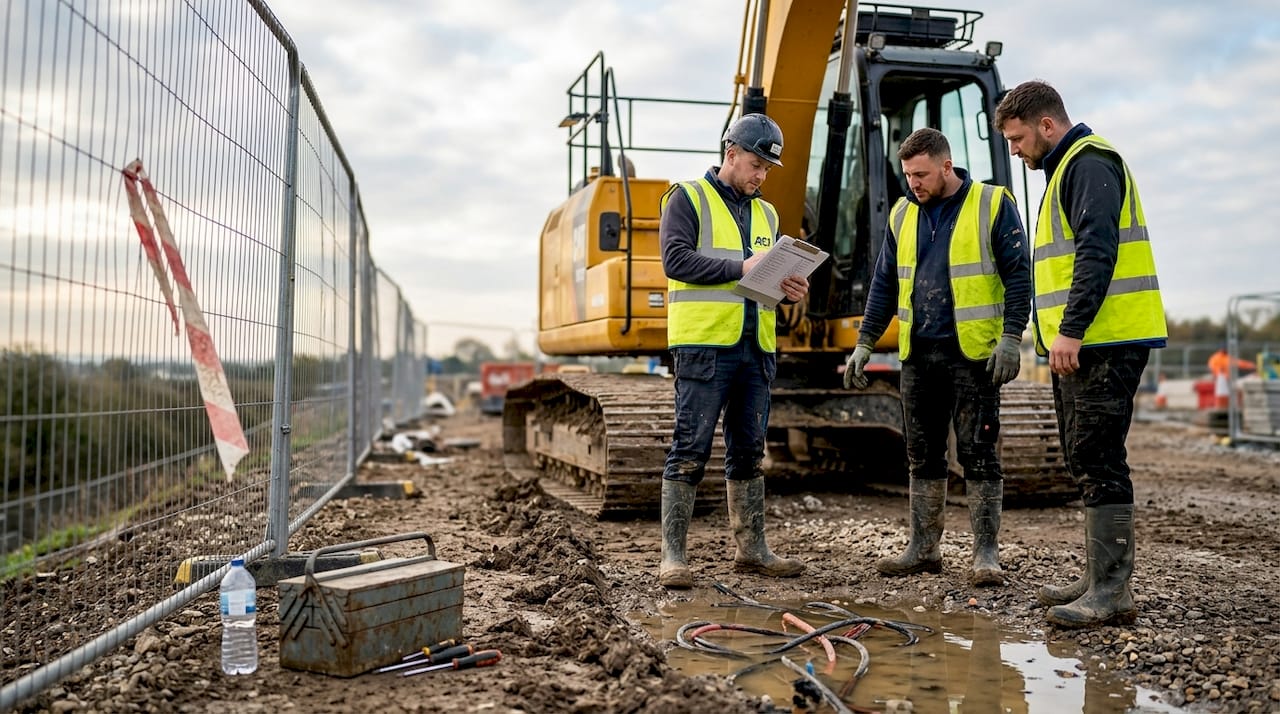
Take a construction site as a practical example. A team arrives to carry out groundworks. The static risk assessment covers excavation hazards, PPE requirements, and traffic management. But overnight rain has made the ground unstable. That is a DRA moment. The site manager assesses the new conditions, decides whether work can safely continue, and either adapts the approach or stops the task. For more on safety essentials for SMEs, including how to handle variable site conditions, it is worth reviewing your overall safety framework too. Similarly, activities like a climbing risk assessment demonstrate how high-variability environments demand real-time thinking as standard.
The five-step methodology for dynamic risk assessment
After identifying relevant situations, here is the actionable process every SME owner or manager should follow.
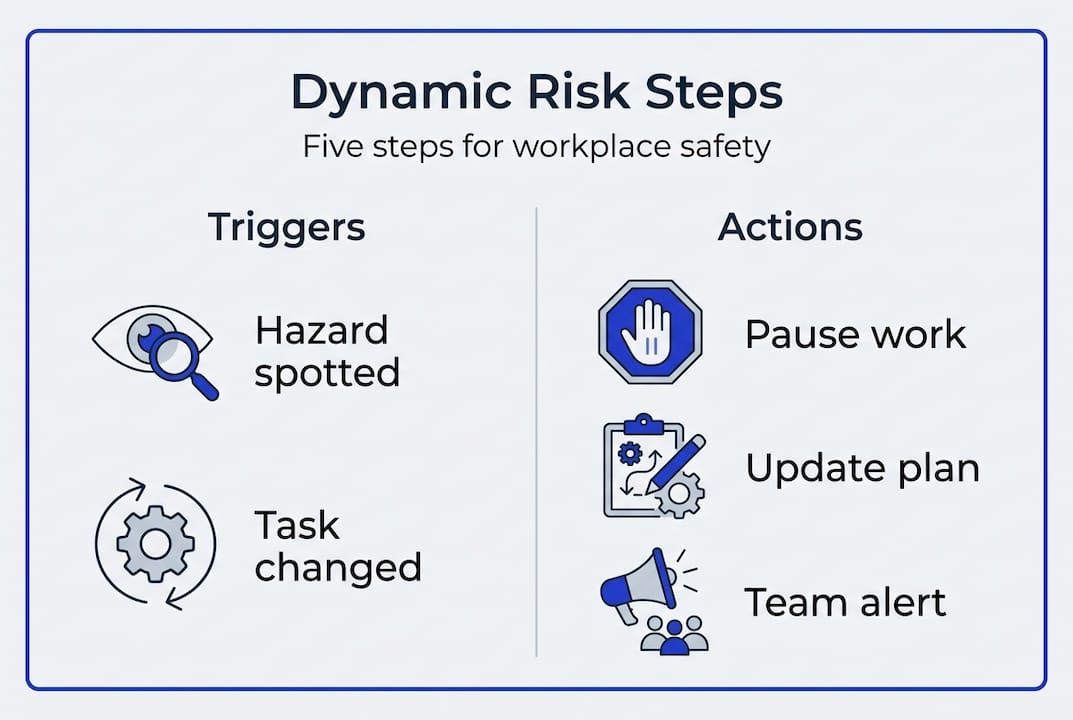
The standard DRA methodology follows five clear steps: identify hazards, consider who could be harmed, assess the level of risk, decide on control actions, and stop and report if the risk cannot be controlled. Simple in theory. Powerful in practice.
- Identify the hazard: What has changed? What new risk is present that was not anticipated?
- Consider who could be harmed: Workers, bystanders, lone workers, members of the public?
- Assess the risk level: Is this low, medium, or high risk? Can it be managed with available resources?
- Decide on control actions: Can you eliminate, reduce, or isolate the hazard right now?
- Stop and report if uncontrollable: If the risk cannot be safely managed, stop the task and escalate immediately.
| DRA step | Construction trigger | Retail trigger | Delivery trigger |
|---|---|---|---|
| Identify hazard | Ground instability after rain | Customer spill near checkout | Blocked access route |
| Consider harm | Workers in excavation zone | Shoppers and staff | Driver and pedestrians |
| Assess risk | High, work near unstable edge | Medium, wet floor | Medium, reversing risk |
| Control actions | Shore up, restrict access | Cordon off, clean up | Find alternative route |
| Stop and report | If ground collapses further | If spill is chemical | If site is inaccessible |
Pro Tip: Build hazard-spotting into your daily routine. Before any task begins, spend two minutes walking the area and asking “what has changed since yesterday?” This simple habit trains your team to think dynamically without it feeling like extra work. Pair this with a risk assessment workflow that supports quick, consistent documentation.
How dynamic risk assessments support compliance and empower staff
With the five steps in hand, let’s explore how DRA improves compliance and empowers your team at every level.
DRA is not just about avoiding accidents. It is about building a safety culture where every worker feels confident to act. Key benefits include preventing incidents, empowering workers with stop-work authority, maintaining compliance, and reducing costly delays. That last one matters to SMEs especially. A serious incident does not just hurt people. It halts operations, triggers investigations, and can cost a business dearly.
Here is what DRA enables from a compliance standpoint:
- Supports HSE’s requirement for suitable and sufficient risk assessments
- Demonstrates active, ongoing hazard management rather than passive paperwork
- Provides evidence of real-time decision-making if an incident is investigated
- Empowers workers to stop unsafe tasks without fear of repercussion
- Reduces the likelihood of enforcement action by showing proactive safety management
The HSE does not use the phrase “dynamic risk assessment” in its formal guidance, but it absolutely expects businesses to think and act dynamically. HSE guidance emphasises that risk assessments must be suitable and sufficient, with regular reviews. That aligns perfectly with dynamic thinking. For practical SME compliance tips and a broader look at your obligations, it is worth reviewing your current approach. Our site safety guide also covers how to embed this kind of thinking across your operations.
Pro Tip: Run short, scenario-based training sessions with your team. Give them a realistic situation, such as arriving at a site to find unexpected scaffolding removed, and ask them to walk through the five DRA steps out loud. Repetition turns theory into instinct.
Best practices: Integrating dynamic and static risk assessments
Having seen the unique strengths of DRA, here is how to blend it with your existing safety strategies for the best outcomes.
The biggest mistake SMEs make is treating static risk assessments as the finish line. They are not. They are the starting point. HSE guidance is clear that suitable and sufficient assessments require regular reviews, and dynamic thinking is a natural extension of that expectation.
Here are the best practice routines to put in place:
- Train all staff in the five-step DRA process, not just managers
- Review formal risk assessments after every near-miss or incident
- Document DRA decisions where possible, even a brief note on a site diary counts
- Conduct toolbox talks that include real-life DRA scenarios relevant to your sector
- Encourage a speak-up culture so workers feel safe raising new hazards without hesitation
Over-reliance on static paperwork is a genuine pitfall. A business that has a beautifully formatted risk assessment but no culture of real-time thinking is still exposed. The paperwork protects you legally up to a point. The dynamic thinking protects your people every single day. For sector-specific guidance, our resources on construction safety in Alderney and construction safety essentials show how this plays out in practice.
Pro Tip: After any near-miss, gather the team and ask three questions: What changed that we did not expect? Did anyone notice it before it became a problem? What would we do differently next time? This turns near-misses into learning moments rather than near-disasters.
Support for dynamic risk and health & safety compliance
Your risk assessment routine is taking shape. Now let us make the documentation side of things a whole lot easier.
At ACI Safety, we know that SMEs do not have time to build compliance documents from scratch. Our health and safety template library gives you instant access to professionally structured risk assessments, RAMS templates, toolbox talks, and policy documents, all ready to edit and use straight away. If you want to understand how digital templates for risk assessment can simplify your workflow, we have a guide for that too. And if your health and safety policy needs a refresh, our customisable policy template is a great place to start. Less time on paperwork. More time running your business safely.
Frequently asked questions
Is dynamic risk assessment mandatory under UK law?
Dynamic risk assessment is not specifically mandated by law, but HSE requires risk assessments to be suitable and sufficient. Dynamic methods help meet this standard in unpredictable environments.
Who should carry out dynamic risk assessments in SMEs?
Any worker facing changing hazards should apply DRA principles. This includes lone workers and subcontractors, site managers, and anyone operating in variable conditions.
How often should dynamic risk assessments be reviewed?
Dynamic risk assessments should be revisited after incidents, near-misses, or significant changes to the work environment, alongside routine reviews of your formal risk assessments.
What training is needed for dynamic risk assessment?
Staff should receive practical, scenario-based training focused on hazard spotting and quick decision-making. Training builds the skills needed to apply DRA confidently in real situations.
Can dynamic risk assessment replace formal risk assessments?
No. DRA complements formal risk assessments but does not replace them. Formal assessments are still needed to satisfy legal documentation requirements under UK health and safety law.