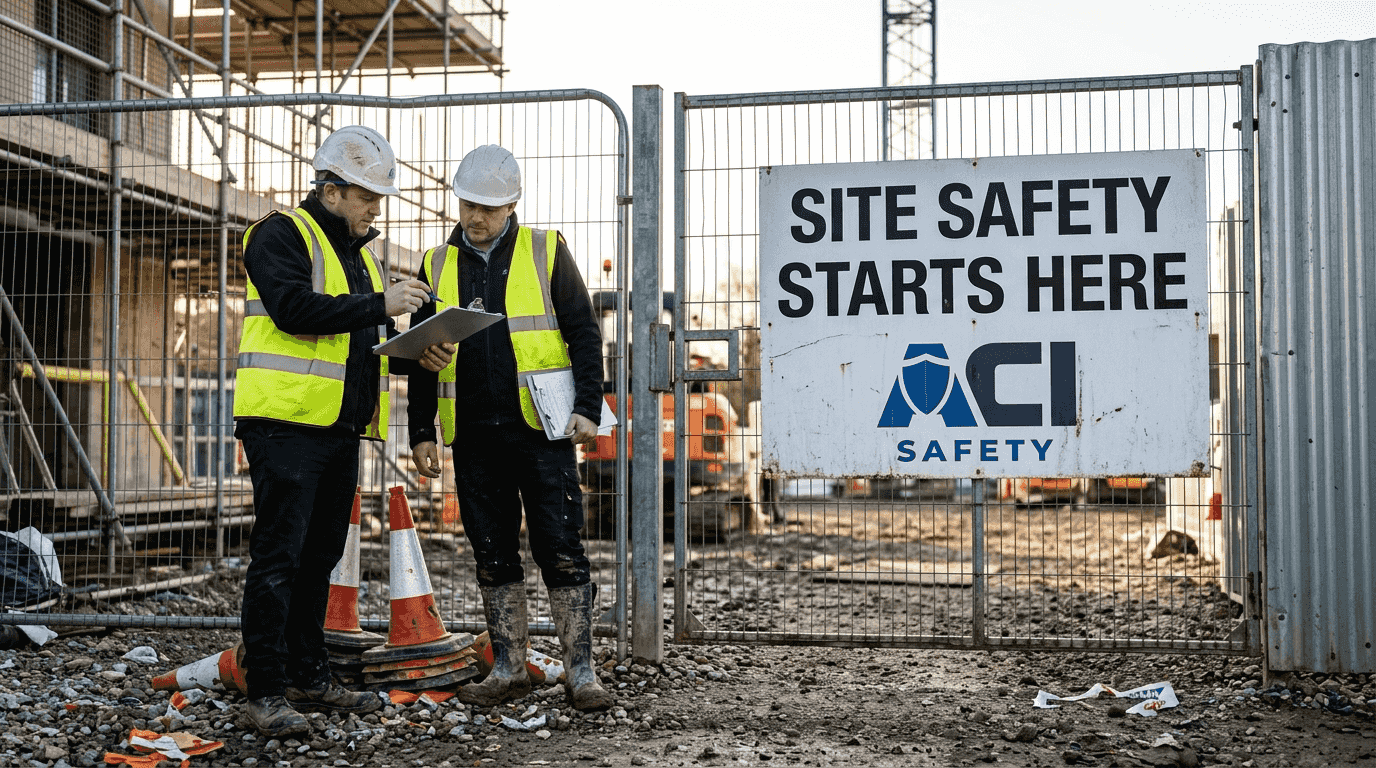
Many UK business owners treat site safety as a box ticking exercise, something to file away and forget. This misconception puts lives at risk and exposes companies to severe legal penalties. Site safety is fundamentally about protecting your workforce and the public through systematic risk control, proper training, and compliance with UK legislation. This guide explains the legal framework governing construction site safety in the UK, identifies the most dangerous hazards causing fatalities and injuries, and provides practical compliance steps for small and medium sized businesses operating on construction sites.
Table of Contents
- Understanding Site Safety: Legal Framework And Essential Components
- Common Risks And Hazards On Construction Sites: What To Watch For
- Implementing Practical Site Safety Measures And Compliance For Smes
- Collaboration And Responsibilities Under Cdm 2015: Sharing Site Safety Duties
- How Aci Safety Supports Your Site Safety Compliance
Key takeaways
| Point | Details |
|---|---|
| Site safety protects lives | Systematic procedures, training, and controls prevent serious injuries and fatalities on construction sites. |
| Legal compliance is mandatory | UK businesses must follow HSWA 1974 and CDM Regulations 2015 to protect workers and avoid prosecution. |
| Falls remain the top killer | Falls from height account for up to half of all construction fatalities in the UK. |
| Documentation supports safety | Risk assessments and method statements identify hazards and establish control measures before work begins. |
| Daily practices matter most | Toolbox talks, competence checks, and visible site rules create genuine safety culture beyond paperwork. |
Understanding site safety: legal framework and essential components
Site safety in UK construction refers to systems, procedures, training, and controls designed to protect workers and the public from harm. It encompasses everything from hazard identification and risk assessment to emergency procedures and welfare facilities. For small and medium sized enterprises, understanding the legal framework is the foundation of effective safety management.
The Health and Safety at Work Act 1974 establishes the core duty: employers must ensure the health, safety and welfare of their employees so far as is reasonably practicable. This means providing safe plant and systems of work, adequate training and supervision, a safe workplace with proper access and egress, and a safe working environment. The Act also requires businesses to protect non employees who might be affected by their work activities, including members of the public.
The Construction Design and Management Regulations 2015 build on this foundation with specific requirements for construction projects. Principal contractors must prepare a Construction Phase Plan, coordinate the work of all contractors, ensure suitable site inductions, verify worker competence, provide welfare facilities, and maintain effective communication between all parties. The regulations create a framework where clients, designers, principal designers, principal contractors, and individual contractors all share responsibility for safety outcomes.
Worker competence verification is a critical element of site safety. CSCS cards demonstrate that individuals have the required health and safety knowledge for their role, whilst SMSTS training equips site managers and supervisors with the skills to manage safety effectively. These credentials provide assurance that your workforce understands hazards and control measures.
Essential components of a robust site safety system include:
- Risk assessments identifying hazards and evaluating risks before work begins
- Method statements detailing safe working procedures for high risk activities
- Site induction programmes ensuring all workers understand site specific rules and emergency procedures
- Welfare facilities providing toilets, washing facilities, drinking water, and rest areas
- Clear site rules displayed prominently and enforced consistently
- Emergency procedures including first aid provision and incident reporting
- Regular inspections and audits to verify controls remain effective
For practical guidance on meeting these requirements, explore our UK construction health and safety overview and legal compliance in UK safety resources.
Common risks and hazards on construction sites: what to watch for
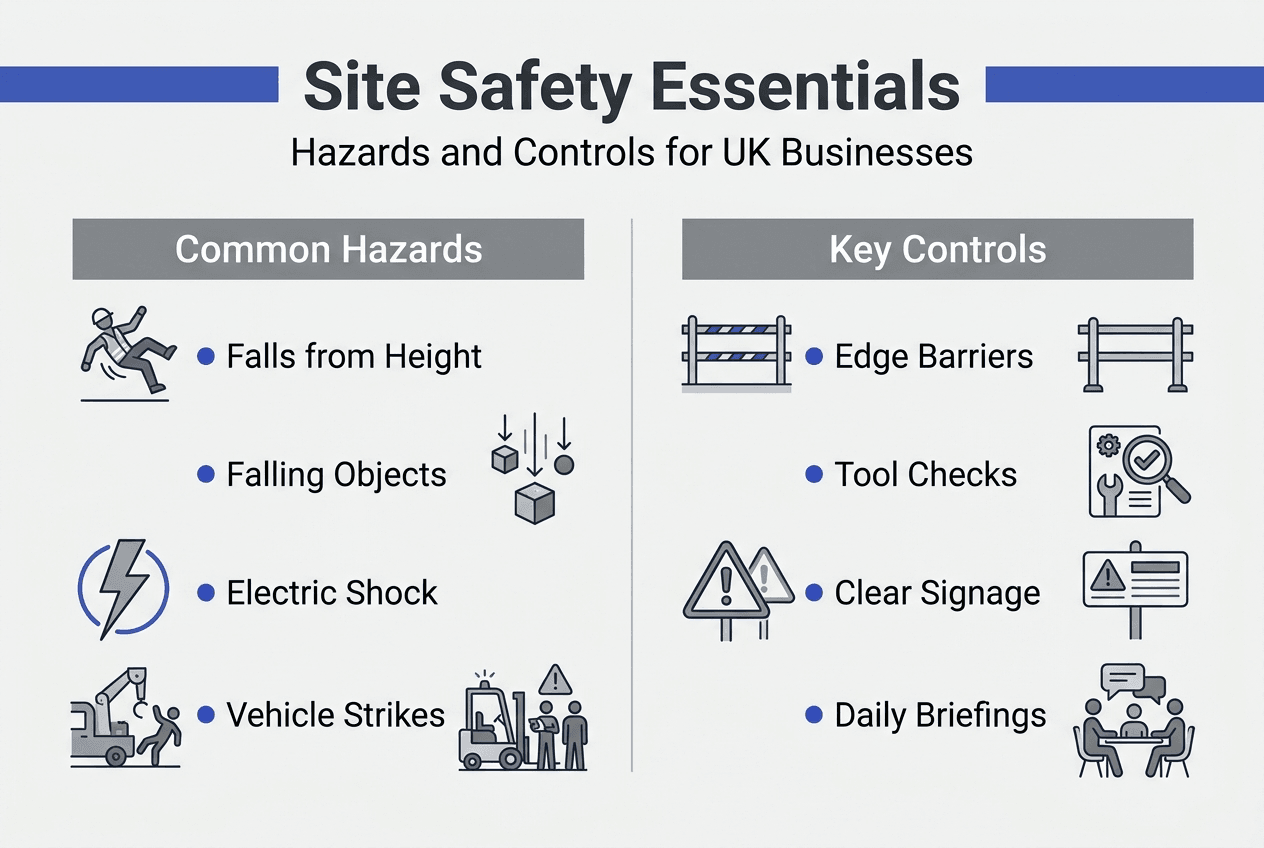
Understanding which hazards cause the most harm helps you prioritise your safety efforts and allocate resources effectively. Recent statistics paint a sobering picture of construction safety in the UK. 2023/24 data shows 51 construction fatalities, 59,000 non fatal injuries, and 78,000 cases of work related ill health. These figures represent real people with families, and many incidents were entirely preventable.
Falls from height account for 26 to 50% of all construction fatalities, making them the single most dangerous hazard on UK sites. Workers fall from scaffolding, ladders, roofs, and through fragile surfaces like skylights. Vehicle strikes and electricity related incidents complete the top three causes of fatal injuries. Each of these hazards requires specific control measures and constant vigilance.
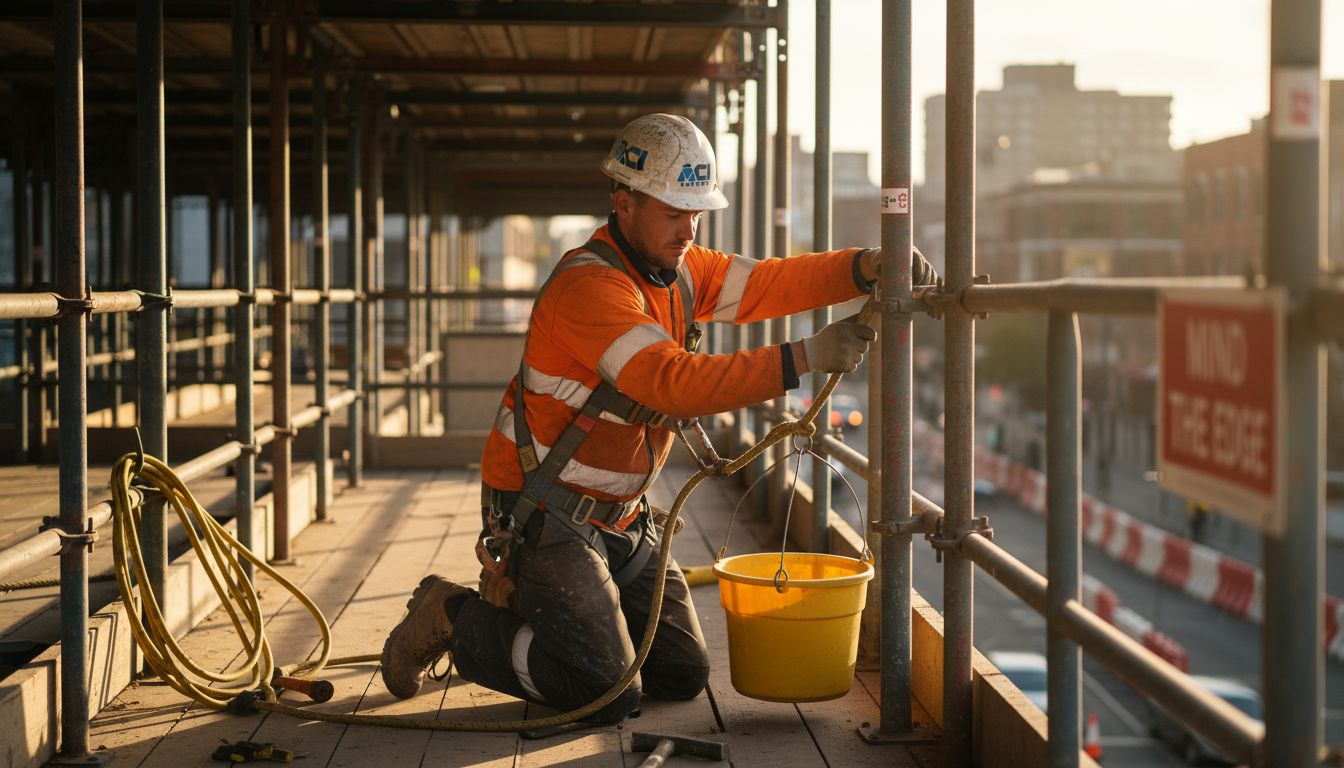
Public safety presents additional challenges. Falling objects can strike pedestrians or motorists near construction sites. Inadequate site boundaries allow unauthorised access by children or members of the public who may not recognise dangers. Dust, noise, and vibration can affect neighbouring properties and businesses.
| Hazard category | Common incidents | Typical consequences |
|---|---|---|
| Falls from height | Unprotected edges, fragile roofs, ladder misuse | Fatalities, spinal injuries, multiple fractures |
| Vehicle movement | Reversing plant, blind spots, pedestrian segregation failures | Crushing injuries, fatalities |
| Electrical risks | Contact with overhead lines, damaged cables, inadequate isolation | Electrocution, burns, cardiac arrest |
| Falling objects | Dropped tools, materials, inadequate edge protection | Head injuries, fatalities to public |
| Manual handling | Lifting heavy materials, repetitive tasks | Musculoskeletal disorders, long term disability |
Recent enforcement action illustrates the consequences of neglecting critical controls. Fines have been issued for unprotected floor openings, companies ignoring prohibition notices, and deaths caused by workers falling through skylights. One construction firm received a £60,000 fine after a worker fell through an unprotected floor opening, suffering serious injuries that could have been prevented with basic edge protection.
Pro Tip: Create a site specific hazard map during your initial risk assessment, marking high risk areas like roof work zones, vehicle routes, and electrical installations. Share this map during every site induction and toolbox talk to maintain awareness.
Identifying hazards is only the first step. Effective control requires a hierarchy of measures: eliminate the hazard entirely if possible, substitute with something safer, implement engineering controls like guardrails, establish administrative controls like permit systems, and finally provide personal protective equipment as a last line of defence. For additional guidance on managing workplace risks, review our workplace safety tips for UK SMEs.
Implementing practical site safety measures and compliance for SMEs
Knowing the regulations and hazards is valuable, but small and medium sized businesses need actionable steps to create safe, compliant construction sites. Practical compliance includes daily briefings, visible site rules, competence verification, equipment testing, incident reporting, and regular audits. These measures transform paperwork into real protection.
Start every working day with a toolbox talk. These brief discussions, typically 10 to 15 minutes, focus on the day’s tasks, associated hazards, and required control measures. They provide an opportunity to check worker understanding, address concerns, and reinforce key safety messages. Document attendance and topics covered to demonstrate your commitment to ongoing training.
Implement a comprehensive site induction programme for everyone entering the site, including visitors and delivery drivers. Cover emergency procedures, welfare facilities, site specific hazards, traffic routes, and reporting requirements. Verify that workers hold appropriate CSCS cards and that supervisors have completed SMSTS training. Keep induction records for audit purposes.
The Plan Do Check Act cycle provides a framework for continuous improvement:
- Plan your safety arrangements by conducting risk assessments, writing method statements, and establishing clear procedures for high risk activities.
- Do implement your plans by briefing workers, providing necessary equipment and training, and monitoring compliance during work activities.
- Check effectiveness through regular inspections, incident investigations, and worker feedback to identify gaps or weaknesses.
- Act on findings by updating risk assessments, revising procedures, providing additional training, or improving equipment and facilities.
Display site safety rules prominently at entry points and gathering areas. Rules should be specific, actionable, and enforced consistently. Generic statements like “work safely” provide little value. Instead, specify requirements such as “hard hats, high visibility vests, and safety footwear must be worn at all times” or “report all near misses to your supervisor immediately.”
Pro Tip: Conduct weekly tool and equipment checks rather than waiting for annual PAT testing. A five minute inspection can identify damaged leads, missing guards, or faulty controls before they cause injuries.
Under RIDDOR, you must report deaths, specified injuries, over seven day injuries, occupational diseases, and dangerous occurrences to the Health and Safety Executive. Maintain detailed records of all incidents, including near misses, as these provide valuable learning opportunities and demonstrate your commitment to improvement. HSE inspectors can arrive unannounced, and comprehensive records show that you take safety seriously.
Effective safety culture requires real controls at points of risk, not just paperwork box ticking. Workers must see that management prioritises their safety through actions, not just words. This means stopping work when conditions become unsafe, investigating incidents thoroughly, and implementing corrective actions promptly.
For detailed guidance on meeting your legal obligations, explore our practical health and safety compliance guide and learn about the importance of enforcing safety procedures.
Collaboration and responsibilities under CDM 2015: sharing site safety duties
Construction projects involve multiple parties, each with specific duties under CDM Regulations 2015. Understanding these roles and fostering effective collaboration is essential for maintaining site safety. Confusion about responsibilities creates gaps where hazards go unmanaged.
The principal contractor plans and manages construction phase safety, prepares the Construction Phase Plan, liaises with the principal designer, coordinates contractors and subcontractors, ensures suitable site inductions, verifies worker competence, provides welfare facilities, and monitors compliance with health and safety legislation. They are the linchpin of site safety, responsible for day to day management and coordination.
Clients have significant duties despite not being present on site. They must appoint competent dutyholders, ensure adequate time and resources are allocated for safe work, provide pre construction information to designers and contractors, and ensure the principal designer prepares a health and safety file. Client decisions about programme and budget directly impact safety outcomes.
Subcontractors must cooperate with the principal contractor, comply with site rules and procedures, provide information about risks their work creates, and ensure their own workers are competent and properly supervised. Shared duties exist because effective site safety requires everyone to play their part. A subcontractor who ignores safe working procedures endangers not only their own team but other trades working nearby.
The principal designer coordinates health and safety during the design phase, identifying and eliminating hazards where possible, preparing pre construction information, and compiling the health and safety file. They work closely with the principal contractor to ensure design intent translates into safe construction methods.
| Dutyholder | Key responsibilities | When duties apply |
|---|---|---|
| Client | Appoint competent parties, provide information, ensure adequate resources | All construction projects |
| Principal designer | Coordinate design phase safety, prepare pre construction information | Projects with more than one contractor |
| Principal contractor | Manage construction phase, prepare Construction Phase Plan, coordinate contractors | Projects with more than one contractor |
| Contractors | Plan and manage own work safely, cooperate with principal contractor | All construction work |
| Workers | Follow instructions, report hazards, use equipment properly | All construction work |
Effective coordination requires clear communication channels, regular site meetings, and shared understanding of project hazards. Principal contractors should hold weekly coordination meetings where all contractors discuss upcoming work, potential clashes, and required control measures. This collaborative approach prevents situations where one trade’s activities create unexpected risks for another.
For more information about regulatory oversight and enforcement, review our guide on the role of HSE in UK construction. Understanding what documentation you need to maintain helps demonstrate compliance during inspections, as detailed in our essential health and safety documents resource.
How ACI Safety supports your site safety compliance
Managing site safety documentation can overwhelm small and medium sized businesses, particularly when you need to focus on delivering projects profitably. ACI Safety provides professionally designed templates that streamline compliance and save valuable time. Our RAMS templates give you structured, editable documents covering common construction activities, allowing you to quickly produce site specific risk assessments and method statements.
Our essential health and safety documentation list helps you understand exactly what records you need to maintain for compliance and audit readiness. We also offer comprehensive guidance through resources like our health and safety file guide, which explains how to compile and maintain this critical CDM requirement. All products are instant digital downloads in Word and PDF formats, giving you the flexibility to customise documents for your specific projects whilst maintaining professional standards that satisfy HSE expectations.
FAQ
What is the role of a principal contractor in site safety?
The principal contractor plans and manages construction phase safety, verifying worker competence and ensuring all personnel receive proper site inductions. They prepare the Construction Phase Plan, coordinate subcontractors, provide welfare facilities, and maintain effective communication between all parties. Their day to day oversight ensures that safety procedures are followed and hazards are controlled throughout the project.
How can small businesses ensure compliance with UK site safety laws?
Small businesses should implement daily toolbox talks covering the day’s tasks and hazards, maintain up to date risk assessments and method statements, and verify that all workers hold appropriate CSCS cards. Conduct regular site inspections using the Plan Do Check Act cycle to identify gaps and implement improvements. Keep detailed records of inductions, training, inspections, and incidents to demonstrate compliance during HSE visits.
What are the most common hazards causing construction site injuries?
Falls from height remain the leading cause of construction fatalities, accounting for up to half of all deaths on UK sites. Vehicle strikes and electrical risks also cause significant numbers of serious injuries and fatalities. Public protection concerns include falling objects from height and inadequate site boundaries allowing unauthorised access. Each hazard requires specific control measures and constant monitoring to prevent incidents.
Why do construction companies receive fines for safety breaches?
Companies receive fines when they fail to implement reasonably practicable control measures, ignore prohibition notices, or allow work to continue in unsafe conditions. Recent prosecutions involved unprotected floor openings, inadequate edge protection, and workers falling through fragile roofs. Fines reflect the severity of potential harm and the company’s failure to meet basic legal duties. HSE takes enforcement action to hold businesses accountable and deter others from similar failures.