
Many UK businesses mistakenly view the health and safety file as another bureaucratic burden or static project archive. In reality, it’s a forward-looking legal document that protects future workers and shields your business from prosecution. Understanding what the file contains, who prepares it, and how to use it properly can prevent costly incidents and ensure compliance with Construction (Design and Management) Regulations 2015. This guide explains everything UK SMEs and contractors need to know about health and safety files, from legal duties to practical application.
Table of Contents
- Understanding The Health And Safety File And Its Legal Foundation
- Who Is Responsible For The Health And Safety File? Roles And Duties Explained
- What Information Must The Health And Safety File Include? Key Contents And Their Purpose
- Health And Safety File Versus Other Documents: What Sets It Apart?
- Using The Health And Safety File: Practical Steps For Risk Management And Compliance
- Explore Ready-To-Use Health And Safety Templates For Your Business
Key takeaways
| Point | Details |
|---|---|
| Legal requirement | Health and safety files are mandatory under CDM 2015 for projects involving multiple contractors. |
| Principal designer duty | The principal designer must prepare, update, and deliver the file to the client at project completion. |
| Critical contents | Files include as-built drawings, residual hazards, materials used, and maintenance requirements for future works. |
| Forward-looking purpose | Unlike archives, the file helps future contractors manage risks safely during maintenance, refurbishment, or demolition. |
| Compliance consequences | Non-compliance risks prosecution, significant fines, and increased liability for workplace accidents. |
Understanding the health and safety file and its legal foundation
The health and safety file is a critical document required under CDM 2015 for construction projects. It serves as a comprehensive record of information that future contractors, maintenance teams, or demolition workers need to manage health and safety risks effectively. The file isn’t optional paperwork. CDM 2015 mandates the file for projects involving more than one contractor, making it a legal obligation for most construction work in the UK.
Every UK business that employs people must comply with health and safety law. Health and safety regulations apply to all UK businesses, with no exemption for being small. The health and safety file sits within this broader framework, linking CDM 2015 to the Health and Safety at Work Act 1974. Together, these laws establish your duty to protect workers, contractors, and visitors from foreseeable harm.
The file’s primary purpose is preventing future accidents. When someone needs to work on a building years after construction, they rely on the file to understand hidden hazards, structural details, and safe working methods. Without this information, workers face unknown risks that could prove fatal. Understanding your legal compliance obligations helps you appreciate why the file matters beyond ticking regulatory boxes.
Key legal points include:
- CDM 2015 applies to all construction projects with more than one contractor
- The file must be prepared during the project and updated as work progresses
- Clients receive the file at project completion and must keep it available
- Failure to comply can result in prosecution under CDM 2015 enforcement provisions
- The file supports reasonable practicability by documenting residual risks
Who is responsible for the health and safety file? Roles and duties explained
The principal designer is responsible for preparing and updating the health and safety file during the project. This role exists specifically to coordinate health and safety planning during the design and construction phases. The principal designer gathers information from designers, contractors, and specialists to create a comprehensive record. They must ensure the file remains current as the project evolves and new information emerges.

The file is a living record updated throughout the project lifecycle. As contractors discover unexpected conditions, design changes occur, or materials get substituted, the principal designer incorporates these updates. This ongoing process ensures the final file accurately reflects what was built, not just what was planned. The principal designer must deliver the completed file to the client when construction finishes.
Clients have responsibilities too. They must appoint a competent principal designer and ensure the file is prepared. After receiving the file, clients must keep it available for anyone who needs it for future construction work. This might include maintenance contractors, refurbishment teams, or demolition specialists. The client’s duty continues throughout the building’s life, not just during the original project.
Failure to comply with CDM 2015 can result in prosecution and significant fines. The Health and Safety Executive takes enforcement action when businesses neglect their duties. Prosecution can lead to unlimited fines in serious cases, plus reputational damage and increased insurance costs. Understanding your role helps you avoid these consequences and protect workers effectively.
Pro Tip: Appoint your principal designer early in the project. Early involvement allows them to influence design decisions that eliminate hazards rather than just documenting them. This proactive approach reduces residual risks and creates a more useful file for future works. Understanding the role of the HSE in UK construction helps you appreciate enforcement priorities.
Key responsibilities include:
- Principal designers must gather comprehensive information from all project contributors
- Designers must provide information about their designs for inclusion in the file
- Contractors must supply details about construction methods, materials, and residual hazards
- Clients must ensure the file is prepared and keep it available after project completion
- Everyone involved shares responsibility for providing accurate, timely information
What information must the health and safety file include? Key contents and their purpose
A comprehensive health and safety file contains specific information that future contractors need to work safely. Essential contents include as-built drawings, maintenance requirements, residual risks, materials used, and key design decisions. These elements work together to paint a complete picture of the structure and its hidden hazards. Without any single component, the file’s usefulness diminishes significantly.
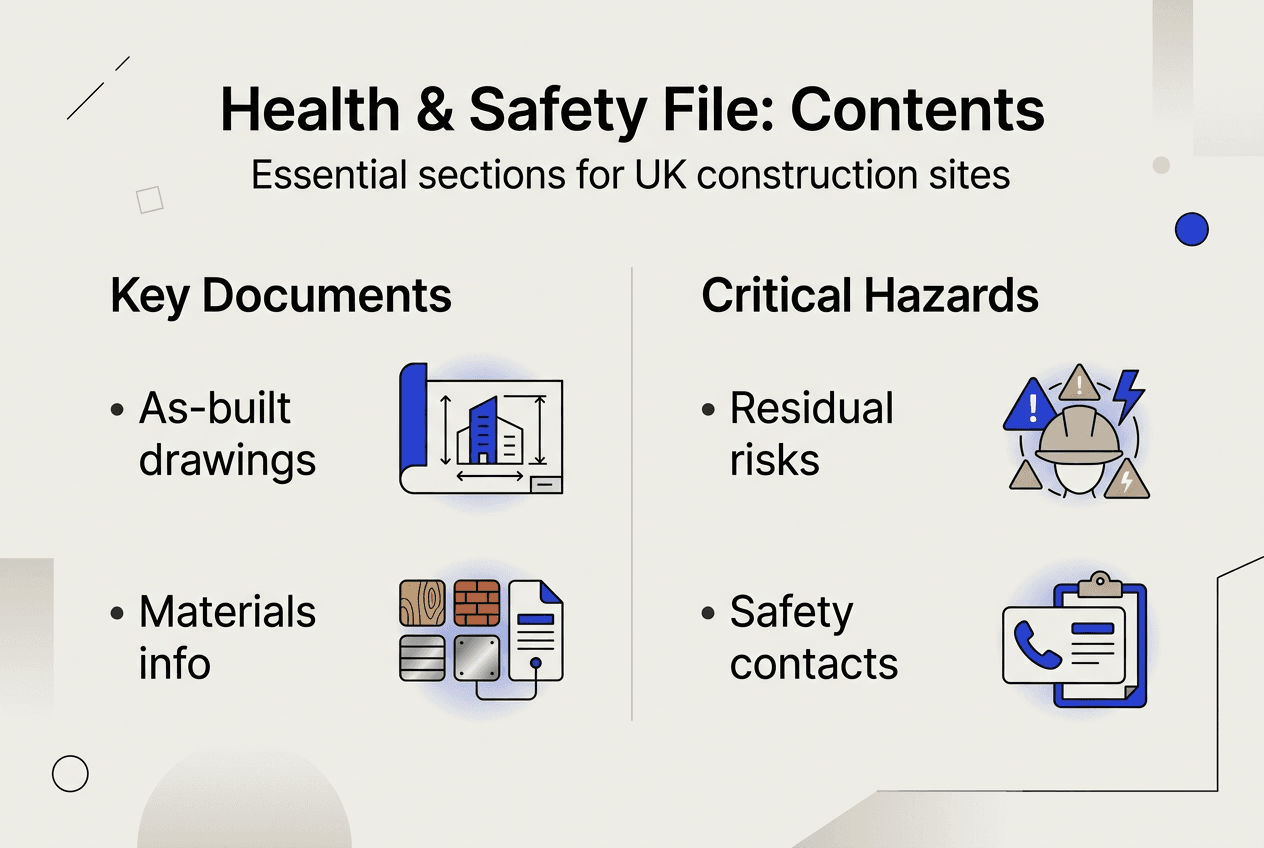
As-built drawings show what actually exists, not what was originally designed. Construction often deviates from plans due to site conditions, material availability, or design changes. Accurate drawings help future contractors locate services, understand structural elements, and plan work without dangerous assumptions. They’re particularly crucial for identifying buried utilities or concealed structural supports.
Materials information prevents exposure to hazardous substances. If asbestos-containing materials were used, the file must document their location and condition. Similarly, information about lead paint, hazardous chemicals in coatings, or materials requiring special disposal helps future workers protect themselves. The file is essential to manage health and safety risks in future construction work effectively.
Residual hazards are risks that couldn’t be eliminated during design or construction. These might include fragile roof materials, confined spaces, structural loading limits, or areas requiring special access equipment. Documenting these hazards ensures future contractors can plan appropriate control measures rather than discovering risks through accidents.
| File Component | Purpose | Examples |
|---|---|---|
| As-built drawings | Show actual construction vs original plans | Service routes, structural modifications, access points |
| Materials information | Identify hazardous substances and special requirements | Asbestos locations, lead paint, chemical treatments |
| Residual hazards | Document risks that couldn’t be eliminated | Fragile surfaces, confined spaces, loading limits |
| Maintenance requirements | Guide safe maintenance procedures | Access methods, specialist equipment needs, inspection schedules |
| Design decisions | Explain critical choices affecting safety | Structural principles, fire protection strategy, ventilation design |
Pro Tip: Keep the file in a format that’s easy to update and access. Digital files stored on secure cloud platforms allow quick searches and remote access for contractors planning work. Include photographs and diagrams to supplement text descriptions, making information clearer for people unfamiliar with the building. Consider how construction health and safety documents integrate with your overall compliance system.
Key content requirements:
- Information must be sufficient for future work to be planned and carried out safely
- Focus on health and safety information, not general project history
- Include only information that will help manage future risks
- Update the file when significant changes occur during the building’s life
- Organise information logically so users can find what they need quickly
Health and safety file versus other documents: what sets it apart?
Many people confuse the health and safety file with other construction documents, but they serve distinct purposes. The health and safety file is not a project history or archive, nor is it identical to O&M manuals. Understanding these differences helps you create a file that fulfils its legal purpose without unnecessary bulk or confusion.
Operation and maintenance manuals focus on how to run and maintain building systems like heating, ventilation, or electrical installations. They contain manufacturer instructions, service schedules, and troubleshooting guides. The health and safety file, by contrast, focuses on risks that future construction workers might face. While there’s some overlap, the audiences and purposes differ significantly.
Project archives contain everything from meeting minutes to procurement records and design iterations. These documents serve historical and contractual purposes but don’t necessarily help future contractors work safely. Including excessive archive material in the health and safety file makes it unwieldy and obscures critical safety information. The file should be concise and targeted, not comprehensive.
| Document Type | Primary Purpose | Key Audience | Typical Contents |
|---|---|---|---|
| Health and safety file | Enable safe future construction work | Future contractors, maintenance teams, demolition workers | Residual hazards, as-built drawings, materials information |
| O&M manuals | Guide building operation and maintenance | Facilities managers, maintenance staff, building operators | Equipment manuals, service schedules, system operation guides |
| Project archive | Record project history and contractual matters | Project team, clients, legal advisers | Meeting minutes, correspondence, design development, procurement records |
The health and safety file is a dynamic document that should evolve with the building. When major refurbishments occur, the file must be updated to reflect new hazards, changed layouts, or different materials. This living nature distinguishes it from static project records that remain unchanged after completion. Your risk assessment and hazard management approach should include processes for keeping the file current.
Practical distinctions to remember:
- The file contains only information relevant to managing future construction risks
- O&M manuals can be referenced in the file rather than duplicated
- Project archives should be kept separately from the health and safety file
- The file must be readily available to anyone planning future construction work
- Clarity and conciseness make the file more useful than comprehensive documentation
Using the health and safety file: practical steps for risk management and compliance
The health and safety file becomes valuable only when you actually use it. Before starting any construction, maintenance, or demolition work, review the file to identify hazards and plan control measures. This simple step can prevent accidents that occur when workers encounter unexpected risks. Most incidents on construction sites are preventable with proper planning and use of documents like the health and safety file.
Follow these steps to use the file effectively:
- Obtain the file from the building owner before planning any construction work
- Review all relevant sections with your project team and safety advisers
- Identify residual hazards that affect your planned work activities
- Incorporate file information into your risk assessments and method statements
- Brief all contractors and workers on specific hazards identified in the file
- Update the file if your work creates new residual hazards or changes existing conditions
- Return the updated file to the building owner when your work completes
Integrating file information into daily site management improves safety outcomes. Use toolbox talks to discuss specific hazards documented in the file before workers start tasks. Reference the file during site inductions to ensure everyone understands building-specific risks. When planning lifting operations or access methods, check the file for structural loading limits or access restrictions.
Health and safety law applies to all UK businesses and includes reasonable practicability to protect employees. Using the health and safety file demonstrates you’ve taken reasonable steps to identify and control risks. This documentation becomes crucial if accidents occur and regulators investigate your planning processes. Courts consider whether you used available information, including health and safety files, when assessing compliance.
Pro Tip: Treat the file as a living document throughout your project. If you discover hazards not documented in the file, add them. If you find errors or outdated information, correct it. This collaborative approach improves the file’s accuracy and protects future contractors. Your customisable health and safety policy should include procedures for using and updating health and safety files.
The health and safety file is not just a compliance document. It’s a practical tool that prevents accidents by ensuring critical information reaches the people who need it. Businesses that embrace this perspective create safer workplaces and reduce their legal exposure.
Practical application tips:
- Make reviewing the file a mandatory step in your project planning procedures
- Train supervisors and project managers on how to interpret and use file information
- Include file review in your pre-construction meetings with clients and contractors
- Document how file information influenced your risk assessments and method statements
- Establish clear processes for updating the file when your work creates new residual hazards
Explore ready-to-use health and safety templates for your business
Managing health and safety files alongside other compliance duties can feel overwhelming for small businesses. That’s where professional templates save time and reduce stress. ACI Safety offers customisable health and safety policy templates designed specifically for UK businesses, providing structured documents you can edit to match your operations.

Our health and safety templates save time by providing professionally designed frameworks you simply customise. Instead of starting from scratch, you get Word and PDF documents structured to meet UK compliance requirements. This approach works particularly well for SMEs and contractors who need quality documentation without expensive consultants. Explore our RAMS templates to enhance your risk assessments and method statements, creating comprehensive safety documentation that integrates seamlessly with health and safety files.
FAQ
What is the difference between a health and safety file and an O&M manual?
The health and safety file focuses on information future construction workers need to manage risks during maintenance, refurbishment, or demolition. O&M manuals guide building operators on running and maintaining systems like heating or electrical installations. While both documents may reference similar equipment, they serve different audiences and purposes. The file is forward-looking for construction safety, whereas O&M manuals support day-to-day building operations.
Who must prepare the health and safety file under CDM 2015?
The principal designer must prepare and update the health and safety file throughout the project. They gather information from designers, contractors, and specialists to create a comprehensive record. The client must receive the completed file when construction finishes and keep it available for anyone planning future construction work. This responsibility chain ensures critical safety information passes to those who need it.
What happens if a business fails to comply with health and safety file regulations?
Non-compliance with CDM 2015 requirements can result in prosecution by the Health and Safety Executive. Courts can impose unlimited fines for serious breaches, particularly if non-compliance contributes to accidents or fatalities. Beyond financial penalties, businesses face reputational damage, increased insurance costs, and potential director disqualification. Meeting legal duties protects workers and shields your business from these consequences.
Can small businesses manage health and safety files without costly consultants?
Small businesses can absolutely comply with health and safety file requirements without expensive consultants. Understanding your legal duties, using simple templates, and following structured processes makes compliance achievable. Focus on gathering essential information about residual hazards, as-built conditions, and materials used. Resources like legal compliance guides for UK SMEs provide practical frameworks that demystify requirements and support cost-effective compliance.