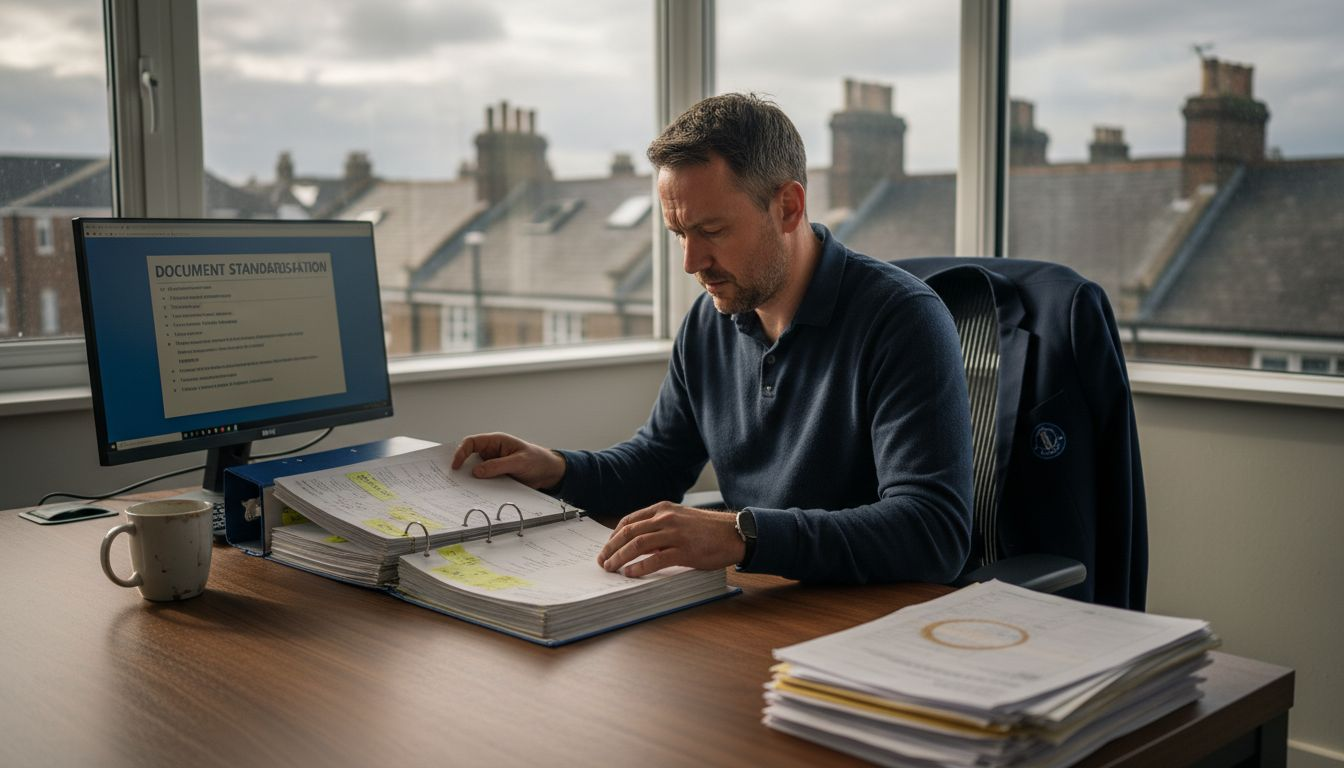
A near miss is usually what forces the issue. Someone slips in a stockroom, a contractor uses the wrong access equipment, or a manual handling task that seemed routine suddenly causes an injury. At that point, a workplace risk assessment guide stops being an admin task and becomes what it should have been all along – a practical way to spot problems before they cost time, money or harm.
For small and medium-sized businesses, the challenge is rarely whether risk assessments matter. It is finding the time to produce documents that are clear, relevant and actually usable by the people doing the work. A good assessment should help you run the job more safely. It should not sit in a folder full of generic wording that nobody looks at again.
What a workplace risk assessment guide should help you do
At its simplest, a risk assessment is a structured look at what could cause harm, who might be affected, and what controls are needed to reduce that risk to an acceptable level. In the UK, employers have legal duties to assess workplace risks, but the real value is operational as much as regulatory.
Done properly, risk assessments help managers brief staff properly, plan work with fewer interruptions and show that safety controls have been thought through in advance. They also support consistency. If different supervisors manage the same activity in different ways, standards drift quickly. A written assessment gives people a common reference point.
That said, not every business needs the same level of detail. A small office-based firm assessing workstation use and trailing cables will not need the same depth as a contractor managing hot works, machinery and public access. The principle is the same, but the complexity depends on the hazards involved.
Start with the real work, not a generic form
One of the most common problems with risk assessments is that they are written around a blank template rather than the actual task. The result is predictable – broad statements, copied hazards and controls that do not quite match what happens on site or in the workplace.
A better approach is to begin with the activity itself. What is being done, where, by whom, using what equipment, and under what conditions? If the work changes by location, time of day, weather, access constraints or the people involved, that should shape the assessment.
For example, unloading goods from a vehicle sounds simple until you consider the environment. Is it a quiet yard or a busy shared delivery area? Is there a forklift in use? Are employees lifting awkward items by hand? Are pedestrians passing through? The hazards only become clear when you look at the task in context.
The five practical stages
1. Identify the hazards
Think in plain terms. What could realistically cause injury, ill health or damage during the task? Slips, trips, falls, manual handling, moving vehicles, electricity, hazardous substances, poor housekeeping, noise and lone working are all common starting points.
It helps to walk the area, speak to the people doing the work and review any previous incidents or near misses. Staff often know where the real pressure points are, especially where a job is awkward, rushed or affected by space and access.
2. Decide who might be harmed and how
This is not limited to employees. Visitors, contractors, members of the public, cleaners, temporary staff and vulnerable workers may all be affected. A delivery route through a reception area, for instance, creates a different risk profile from one confined to a loading bay.
Be specific where it matters. If young workers, new starters or pregnant employees may face additional risks, that should be reflected in the assessment rather than left as a vague note.
3. Evaluate the risk and existing controls
This is where businesses often overcomplicate things. You do not need pages of theory. You need a sensible judgement on whether current controls are enough and, if not, what needs to change.
Ask straightforward questions. Can the hazard be removed entirely? If not, can exposure be reduced by changing the method, equipment, layout, supervision or training? Personal protective equipment has a place, but it should not be the first control if the hazard can be reduced in a more reliable way.
A scored risk matrix can help with consistency, especially across multiple assessments, but it is only useful if the scoring leads to practical action. A tidy-looking matrix does not make an assessment effective.
4. Record your findings clearly
If you employ five or more people, recording significant findings is a legal requirement. Even where the headcount is lower, written records are still sensible. They show what was considered, what controls were decided and who is responsible for action.
Clarity matters more than length. People using the document should be able to understand the activity, the hazards and the controls without reading through padded wording. Short, direct entries usually work best.
5. Review and update when needed
A risk assessment is not a one-off exercise. It should be reviewed if there is an incident, a change in process, new equipment, new substances, changes to staff, or any sign that the controls are no longer suitable.
Periodic review is also worthwhile even when nothing obvious has changed. Small changes in layout, staffing or workload can weaken controls over time without anyone formally noticing.
Common mistakes that weaken a risk assessment
The first is copying generic content without checking whether it fits the job. This is especially common when businesses are under time pressure. A template can save a great deal of time, but it still needs editing to reflect the actual task, location and controls.
The second is being too vague. Phrases such as “take care” or “use appropriate PPE” do not tell staff what is expected. Better wording would state the control clearly, such as using cut-resistant gloves for a specific handling task or keeping pedestrian routes separated from vehicle movements with barriers and marked walkways.
The third is treating the assessment as complete once it is filed. If supervisors do not brief it, staff do not follow it, and changes are never fed back into it, the document adds very little value.
A final issue is writing for the auditor rather than the business. Risk assessments should stand up to scrutiny, but their first job is to support safe work. If they are too wordy, too generic or too awkward to update, they become dead paperwork.
Why editable documents matter
Many smaller businesses know what needs to be done but struggle with the workload involved in producing documents from scratch. That is where professionally prepared, fully editable templates can make a practical difference.
The benefit is not just speed, although that matters. It is starting from a structured format created with the right compliance thinking built in, then adapting it to your own activities. That gives you a better chance of ending up with a document that is both presentable and usable.
There is a trade-off, of course. Templates are efficient, but they are not a substitute for understanding your own operations. The strongest approach is to use them as a professional base and then customise them properly. For many SMEs, that is far more realistic than either writing every document from the ground up or paying for bespoke consultancy for routine paperwork.
A workplace risk assessment guide for day-to-day use
The best assessments are the ones that fit naturally into how work is managed. They support inductions, toolbox talks, supervisor briefings and task planning. They help answer practical questions before work starts rather than after something has gone wrong.
That means keeping them accessible, current and relevant. If a team cannot quickly find the latest version, or if the controls bear little resemblance to the work in front of them, the process breaks down. Good documentation should reduce friction, not add to it.
For businesses that need to keep compliance moving without wasting hours on formatting and layout, using professionally designed editable documents can make the process more manageable. ACI Safety’s approach reflects that reality – clear templates, instant download and the flexibility to tailor documents to your own workplace.
If your current risk assessments feel generic, outdated or hard to use, that is usually the right moment to improve the system. The aim is not to produce more paperwork. It is to make safer decisions faster, with documents your team can actually work from every day.