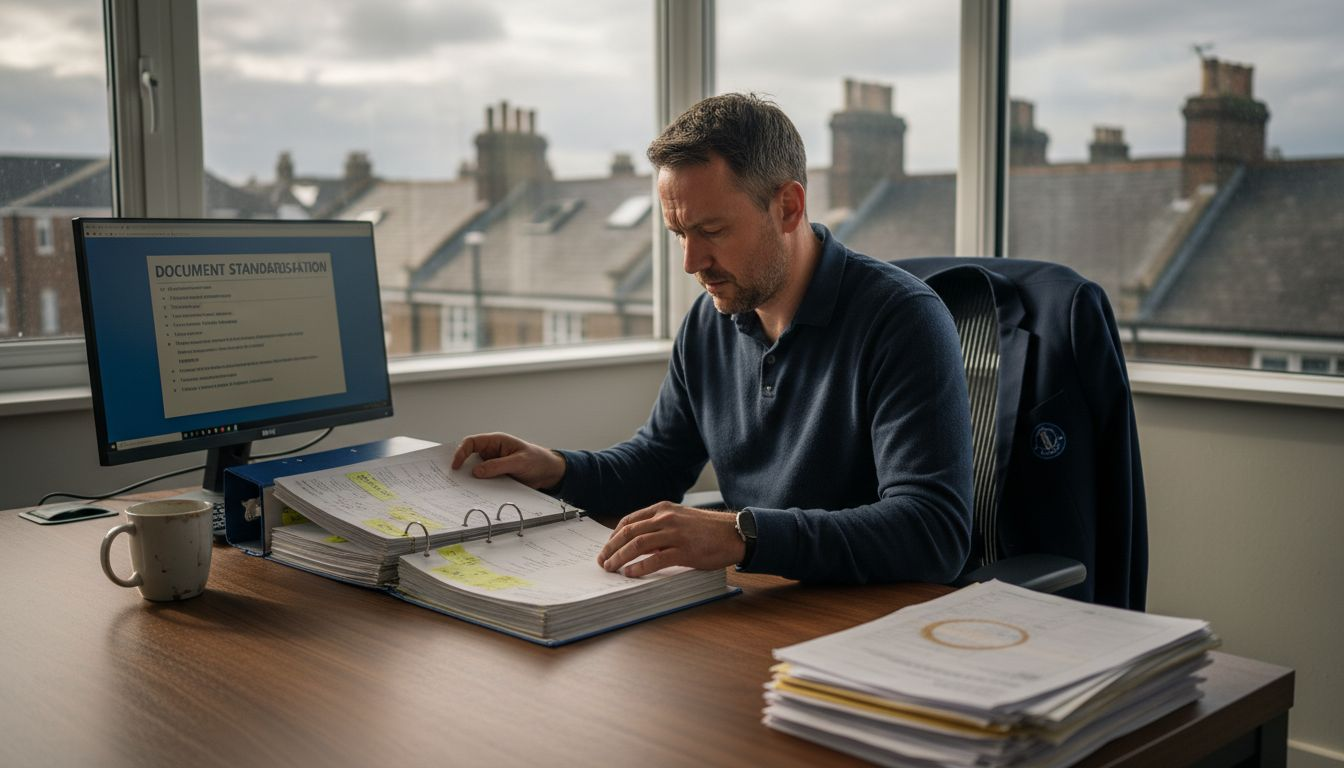
A near-miss gets reported on site, a contractor needs the latest RAMS before starting, and someone asks for the current fire logbook – all before 10am. That is why health and safety admin trends matter. For most small and medium-sized businesses, the pressure is not just meeting legal duties. It is keeping documents accurate, available and usable without turning compliance into a full-time job.
The biggest shift is simple. Businesses are moving away from patchy, reactive paperwork and towards systems that save time, reduce duplication and make day-to-day compliance easier to manage. That does not always mean expensive software or a complete overhaul. In many cases, it means better templates, clearer version control and documents that can be edited quickly when the work changes.
The health and safety admin trends businesses are actually adopting
There is a lot of noise around digital transformation, but most firms are looking for practical gains. They want to find the right document quickly, update it without starting again, and show a clear audit trail if asked. That is why the most useful health and safety admin trends are the ones that remove friction from routine tasks.
One of the clearest trends is standardisation. Businesses are reducing risk by using consistent formats for risk assessments, method statements, policies, inspection forms and registers. When documents follow the same structure, staff spend less time working out where information belongs and more time checking that the content is right. It also helps when several people contribute to compliance admin, because everyone is working from the same base.
Another trend is moving from static files to editable working documents. A PDF may look tidy, but it is rarely ideal when a task changes, a site layout is updated or a control measure needs tightening. Editable Word and Excel documents suit the reality of operational health and safety. They can be tailored, saved as new versions and reused sensibly across similar activities.
There is also a stronger focus on accessibility. Safety records are no longer seen as something that sits in a folder until an inspection. Teams want documents available when they are needed – on a desktop in the office, on a shared drive for managers, or ready to print for site use. The practical point is speed. If key paperwork takes too long to find, people either delay the job or work from an out-of-date version.
Better admin is replacing more admin
For many businesses, the old approach to compliance admin was to create more paperwork whenever a gap appeared. The problem is that volume does not equal control. A bloated system often hides the important things.
Current practice is moving towards leaner document sets with clearer purpose. Instead of multiple overlapping forms, firms are reviewing what each document is for, who uses it and how often it needs updating. That tends to expose duplication. Two inspection sheets may be collecting the same information. A policy may be longer than anyone needs. A method statement may contain generic wording that adds pages but not much value.
This is where document quality is becoming more important than document quantity. A shorter risk assessment that reflects the actual task is more useful than a lengthy one copied from an unrelated job. The same applies to toolbox talks, induction forms and registers. Admin is improving when the paperwork supports the work rather than slowing it down.
That creates a trade-off. Standard templates save time, but they still need business-specific editing. Firms that rely too heavily on generic wording can end up with documents that look compliant but do not match what happens on site or in the workplace. The stronger trend is not off-the-shelf for its own sake. It is using a professionally structured starting point, then adapting it properly.
Version control is now a compliance issue
One of the least glamorous but most important changes in health and safety admin is the way businesses handle document versions. If an outdated RAMS pack is issued to a contractor, or an old policy is still in circulation, the problem is not just administrative. It can affect how work is carried out.
That is why more businesses are introducing simple version control rules. Documents are dated clearly. Revisions are recorded. Superseded copies are removed from shared folders. Naming conventions are standardised so staff can tell which file is current without opening three near-identical versions.
This does not need a complicated system. In fact, smaller businesses often do better with straightforward controls that people will actually follow. A tidy folder structure and consistent file naming can solve more problems than an overbuilt process that nobody maintains.
The same applies to review cycles. Not every document needs constant revision, but key records should be reviewed when there is a change in task, equipment, site conditions, personnel or legislation. Admin trends are increasingly tied to triggers rather than arbitrary dates. That is a more sensible use of time.
Health and safety admin trends are becoming more operational
Another noticeable shift is that admin is being pulled closer to operations. Health and safety paperwork used to be seen by some businesses as a separate function – something produced in the office and handed over to the people doing the work. That gap is narrowing.
Operations managers, site managers and supervisors are now more involved in document updates because they are closest to the task. They know when delivery routes have changed, when access equipment is different, or when a subcontractor introduces a new step in the sequence of work. The paperwork is more accurate when those details are captured early.
This matters particularly for RAMS and task-specific risk assessments. A polished document is not much use if it ignores the practical realities of the job. The better trend is collaboration between whoever manages the admin and whoever manages the work. That usually produces documentation that is easier to brief, easier to follow and more credible if reviewed externally.
For busy businesses, the challenge is time. Operational staff are not always keen to spend hours formatting documents. That is where ready-made, editable templates earn their place. They cut out the repetitive setup work, so teams can focus on the content that actually needs thought.
Digital does not mean fully automated
There is growing interest in digital compliance tools, but most smaller businesses are not looking for automation everywhere. They are looking for control without unnecessary cost or complexity.
Some admin tasks suit software well, especially reminders, central storage and quick sharing. Other tasks still need human judgement. A risk assessment cannot be treated like a box-ticking exercise just because it sits in a digital folder. A method statement still needs to reflect the sequence of work. A policy still needs to match how the business operates.
That is the balance many firms are now trying to strike. Use digital tools for speed, consistency and access, but keep professional judgement at the centre of document preparation. It is a more grounded approach than chasing every new platform.
For that reason, plenty of businesses continue to rely on editable document packs rather than full subscription systems. A one-time purchase model can make sense where the main need is to create, amend and issue professional documents efficiently. If the templates are well structured and written by qualified health and safety professionals, they can offer a practical middle ground between doing everything from scratch and paying for bespoke consultancy on routine documentation.
What these trends mean for smaller businesses
For SMEs, the real value in these trends is not theory. It is admin that takes less time, creates fewer mistakes and gives managers more confidence that records are in order.
That might mean replacing inconsistent legacy forms with a single document set. It might mean improving file management so the latest version is always easy to find. It might mean reviewing whether your risk assessments and method statements are genuinely editable and reusable, rather than copied and retyped every time a job comes in.
The common thread is efficiency with control. Businesses want systems that are easier to maintain, but they also want documents that stand up to scrutiny. Those two goals are not in conflict if the starting point is sound. A practical template, used properly, can save a substantial amount of admin time while still supporting a credible compliance process.
ACI Safety sits squarely in that space. For businesses that need professionally produced health and safety documents without the delay or cost of bespoke drafting for every routine requirement, editable templates are often the most workable option.
The direction of travel is clear. Health and safety admin is becoming faster, more standardised and more closely tied to operational reality. The businesses getting ahead are not necessarily the ones with the most technology. They are the ones with documents people can find, edit, understand and use with confidence.
If your paperwork still feels harder to manage than the work it is meant to support, that is usually the sign to simplify the system before adding anything new.