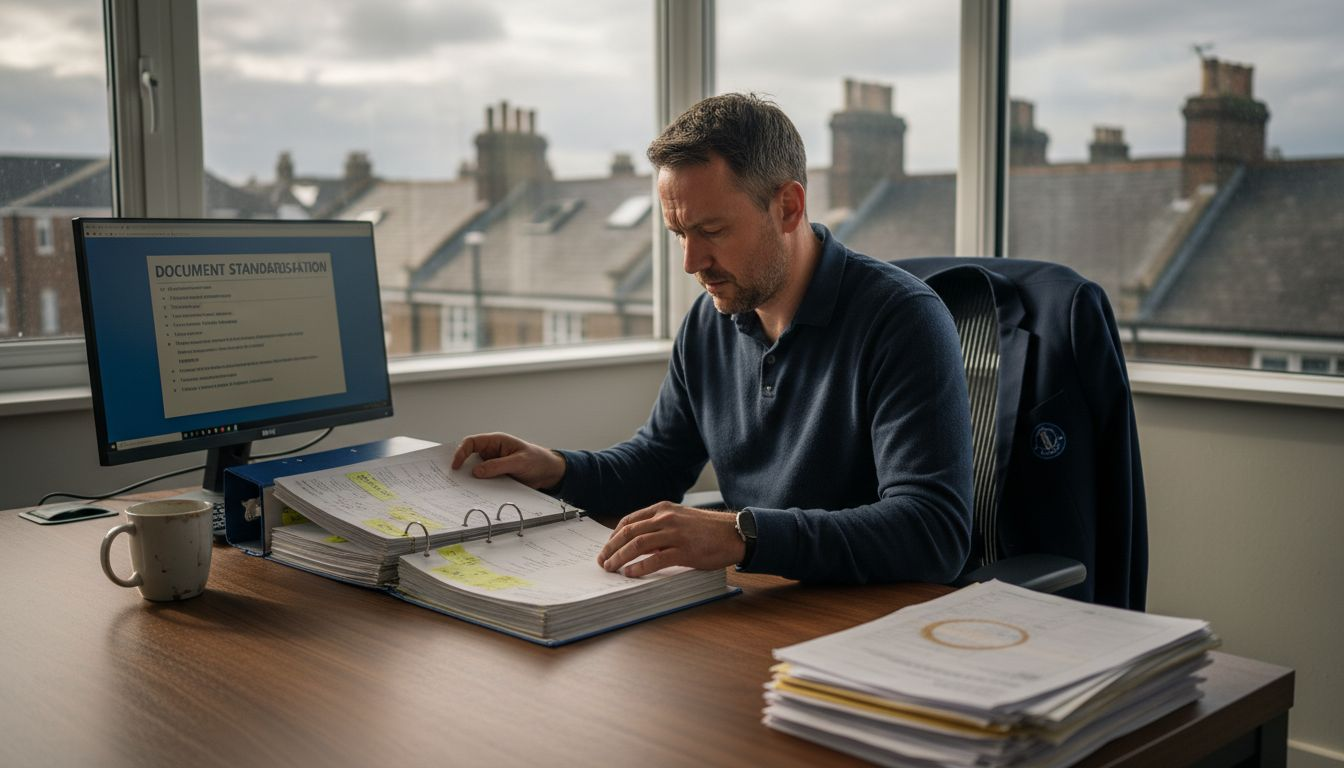
When a client asks for RAMS by close of play, the real question is not whether you need them. It is whether a RAMS template versus consultant is the better fit for the job in front of you. For many small and medium-sized businesses, that decision comes down to speed, cost, internal capability and how complex the work really is.
If you are managing routine jobs, repeatable tasks or standard site activities, paying a consultant every time can be more than you need. If the work is unusual, high risk or contractually sensitive, a consultant may still be the right call. The sensible choice is rarely about ideology. It is about getting suitable documents in place without wasting time or money.
RAMS template versus consultant – what is the actual difference?
A RAMS template gives you a professionally structured starting point. It is usually supplied as an editable document, with the framework, headings and core compliance wording already in place. You tailor it to your own activities, people, equipment, hazards and control measures, then issue it as part of your site documentation.
A consultant, on the other hand, provides a bespoke service. They may visit site, review the job, speak to supervisors, assess unusual hazards and draft documents specifically for that project or operation. That can be valuable, but it also means higher cost, more lead time and a process that depends on someone else’s availability.
For many businesses, the distinction is simple. A template helps you produce RAMS internally, faster and at lower cost. A consultant provides additional judgement and support where the task goes beyond routine documentation.
When a RAMS template makes more sense
Templates work well when your business carries out similar work again and again. If your team already understands the task and simply needs a solid document to capture the risks, sequence of work and control measures, a template is often the efficient option.
This is common in maintenance, facilities work, cleaning, minor construction activities, electrical work, mechanical servicing, landscaping and other operational tasks where the basic process stays broadly consistent. In those cases, starting from a blank page is slow and unnecessary. A good template saves admin time and helps you keep documentation consistent across jobs.
There is also a commercial advantage. A one-off template purchase can be edited and reused for future projects, provided you review and adapt it properly each time. That is very different from paying consultancy fees every time a client requests updated RAMS.
Another benefit is control. When the document is fully editable, your business can update names, dates, locations, equipment, PPE, permits, emergency arrangements and site-specific controls without waiting for an external consultant to turn it around. If you regularly have short notice jobs, that matters.
When a consultant is worth the cost
There are situations where a template alone is not enough. If the work involves unusual hazards, multiple contractors, complicated interfaces, specialist plant, high-risk methods or significant public safety issues, external support may be the safer choice.
The same applies where your business does not have enough internal knowledge to review and amend RAMS properly. A template is a tool, not a substitute for competent judgement. If nobody in the business can confidently adapt the document to the actual work, then the gap is not the paperwork. It is the competence behind it.
A consultant can also help when a principal contractor, client or insurer is asking for something more detailed than your team is used to producing. In those cases, paying for expert input may prevent delays, rejected submissions or documentation that does not reflect the real job.
Cost is not just the invoice
Most businesses start with price, and understandably so. A RAMS template is usually far cheaper than appointing a consultant. But the better comparison is total cost.
With a consultant, you are paying not only for document production but also for meetings, revisions, calls, possible site visits and waiting time. That may be justified for a complex project. It is harder to justify for routine activities you already carry out every week.
With a template, the upfront spend is lower, but your team still needs time to edit and review it. If the document is poor quality, overly generic or difficult to amend, the apparent saving disappears quickly. That is why professionally designed templates matter. They should reduce effort, not create more of it.
For smaller firms especially, the strongest value usually comes from having a reliable template library for day-to-day compliance, then using consultancy selectively when the risk profile or contract requirements genuinely demand it.
Speed matters more than most firms admit
Health and safety documentation is often needed at the point work is about to start, not weeks in advance. A site manager needs RAMS approved. A client wants documents before granting access. An operations team needs to mobilise quickly.
That is where templates have a clear advantage. Instant-access documents in editable Word or Excel formats let businesses respond quickly without compromising structure. You can download, tailor and issue documents on your timetable.
A consultant can still be fast, but not always. Their workload, availability and process will affect lead times. If you rely on external support for every RAMS request, you may find that documentation becomes a bottleneck.
For businesses that handle frequent, similar jobs, internal capability backed by quality templates is often the more practical system.
RAMS template versus consultant for compliance confidence
Some businesses assume a consultant automatically means better compliance. That is not always true. Good compliance comes from documents that are suitable, relevant and actually used by the people doing the work.
A bespoke document written by an external party can still miss practical details if the information provided to them is incomplete. Equally, a well-built template that is properly edited by someone who knows the job can produce a clearer and more workable result.
The issue is not template versus consultant in isolation. It is whether the final RAMS reflects the real task, site conditions and control measures your team will follow.
That said, there is a risk with templates if businesses treat them as finished documents rather than starting points. Generic wording copied across every job without proper review is poor practice. If your process is simply to change the company name and press send, you are creating paperwork, not managing risk.
A practical way to decide
The easiest way to choose is to ask four questions.
First, is the work routine or unusual? Routine work leans towards a template. Unusual work leans towards consultancy.
Second, do you have someone internally who understands the task well enough to edit the document properly? If yes, a template is often sufficient. If not, expert support may be needed.
Third, how quickly do you need the RAMS? If turnaround is tight, editable templates give you more control.
Fourth, what are the consequences of getting it wrong? If the risk level, contractual exposure or operational sensitivity is high, extra scrutiny may be worth paying for.
That approach helps remove the false choice. You do not need to commit to one route forever. Many businesses are best served by both, used at the right time.
The strongest option for many SMEs
For most SMEs, the most efficient model is straightforward. Use professionally prepared RAMS templates for routine and repeat work. Build an internal process for reviewing and customising them. Keep consultancy support in reserve for complex, high-risk or unusual activities.
That gives you speed without cutting corners and cost control without relying on generic paperwork. It also helps your team become more confident in managing documentation internally, which reduces friction every time a client asks for risk assessments or method statements.
This is exactly why businesses buy editable digital documents rather than commissioning every file from scratch. A well-structured template created by qualified health and safety professionals gives you a practical head start. If your operation regularly needs RAMS, that head start adds up quickly.
ACI Safety fits that model well because the focus is not on making compliance look complicated. It is on giving businesses instant-download, editable documents they can use with confidence and adapt to the way they actually work.
The mistake to avoid
The wrong decision is not choosing a template when you should have hired a consultant, or vice versa. The wrong decision is using either option lazily.
A consultant still needs accurate information from your business. A template still needs proper review, job-specific edits and competent sign-off. In both cases, the quality of the final RAMS depends on whether the document matches the work on site.
If you treat RAMS as a live operational document rather than a box-ticking exercise, the best route usually becomes obvious. Use templates where they make sense. Bring in consultancy when the work goes beyond routine. That is a practical standard, and for most businesses, it is the one that keeps compliance manageable without slowing the job down.
The smartest choice is usually the one that gives you suitable documents at the right time, for the right level of risk, without creating more process than the job actually needs.