
Many small UK businesses struggle to keep up with complex health and safety compliance requirements, risking costly fines and workplace injuries. Without a clear process, identifying and addressing compliance gaps becomes overwhelming. This guide provides a practical, step-by-step approach specifically designed for UK SMEs to conduct effective health and safety gap analyses, reduce risks, and achieve measurable improvements in workplace safety.
Table of Contents
Key Takeaways
| Point | Details |
| Gap analysis definition | Systematic comparison of current practices against legal and industry standards to identify compliance weaknesses. |
| Essential prerequisites | Clear scope definition, cross-functional team with H&S expertise, complete documentation, and allocated resources. |
| Structured workflow | Eight-step process from defining scope to implementing corrective actions with risk-based prioritization. |
| Common pitfalls | Unclear scope, insufficient expertise, poor prioritization, and missing risk assessment lead to ineffective outcomes. |
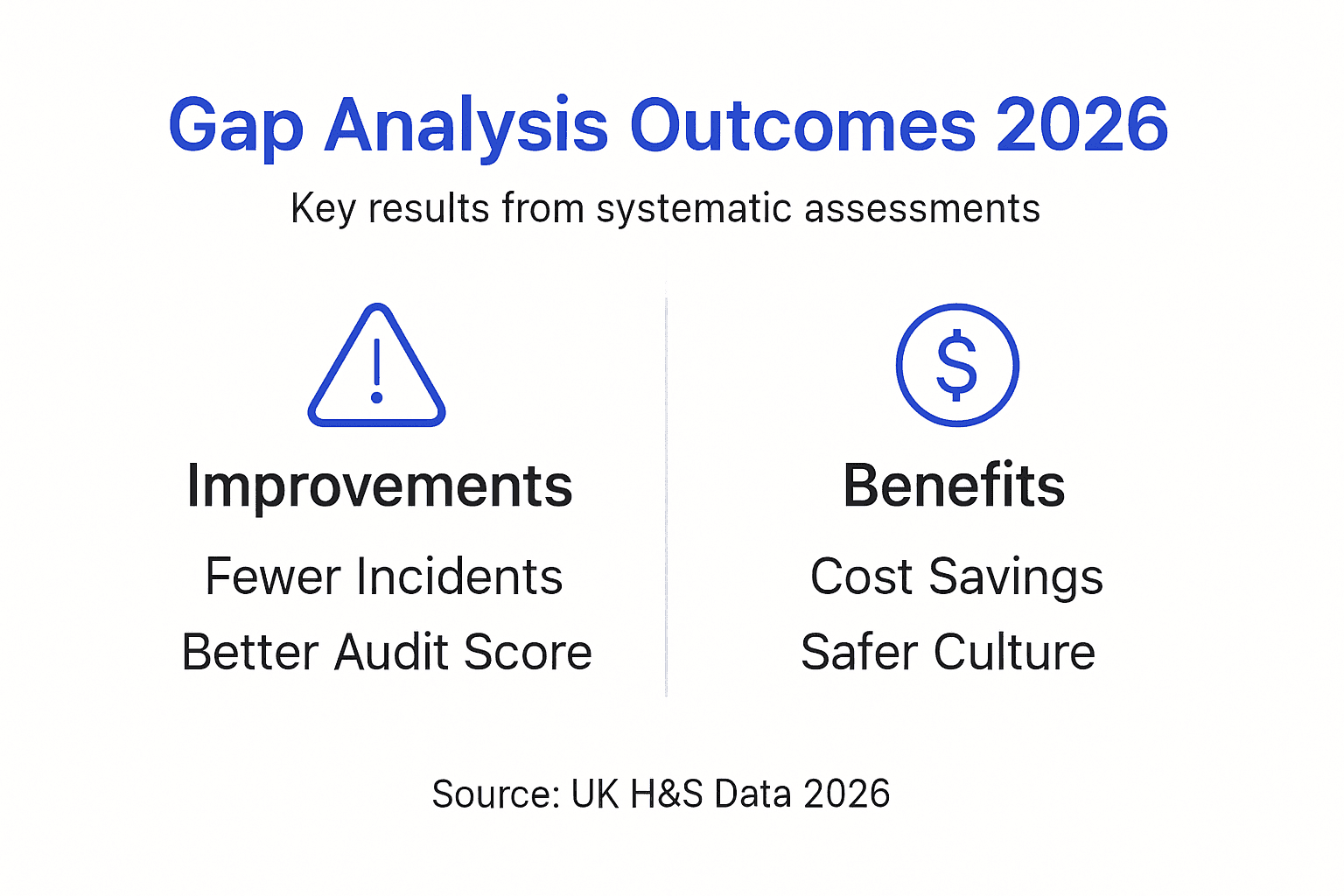
| Expected results | Up to 30% reduction in workplace incidents, improved compliance scores, and significant cost savings. |
Introduction to Health and Safety Gap Analysis
A health and safety gap analysis systematically compares an organisation’s current management system against legal and best practice standards to identify compliance gaps. This structured evaluation reveals where your business falls short of UK health and safety legislation and highlights opportunities for improvement.
The purpose extends beyond mere compliance checking. Gap analysis helps you understand precisely which areas need attention, prioritize improvements based on risk severity, and develop targeted action plans. For UK SMEs, this process translates into tangible benefits including legal compliance, reduced accident rates, lower insurance premiums, and enhanced reputation with clients and employees.
Under UK law, businesses employing more than five people must maintain documented health and safety policies. Gap analysis ensures these policies aren’t just paperwork exercises but reflect actual working practices. The process identifies discrepancies between what you document and what actually happens on site.
“Systematic gap analysis transforms health and safety from a reactive burden into a proactive business advantage, creating safer workplaces while reducing operational costs and legal exposure.”
Many SME managers assume comprehensive gap analysis belongs only to large corporations. This misconception leaves smaller businesses vulnerable. The truth is, scaled appropriately, gap analysis is more accessible and valuable for SMEs than larger operations because targeted improvements have immediate, visible impact across the entire organization.
Prerequisites for an Effective Gap Analysis
Before starting your gap analysis, establish these essential foundations. Success depends on thorough preparation rather than rushing into assessment.
Define your scope clearly. Attempting to assess everything simultaneously dilutes focus and wastes resources. Concentrate on high-risk operations, recent incident areas, or upcoming regulatory changes. A narrow, deep analysis delivers more value than a broad, superficial sweep.
Effective gap analyses require a knowledgeable cross-functional team including health and safety professionals, operational staff, and optionally external auditors. Your team should include:
-
Someone with formal health and safety qualifications or training
-
Supervisors or managers familiar with daily operations
-
Employees who understand ground-level realities
-
Optional external consultants for objectivity and specialized expertise
Gather current documentation before fieldwork begins. Collect existing health and safety policies, risk assessments, training records, incident reports, and previous audit findings. Missing documentation often represents your first significant gap.
Allocate realistic time and resources. A meaningful gap analysis for a small business typically requires one to three days onsite plus follow-up planning time. Budget for potential consultant fees, corrective actions, and staff time away from regular duties.
Consider involving external auditors selectively. While COSHH assessments for small businesses can often be managed internally, complex situations benefit from fresh perspectives. External experts bring objectivity, specialized knowledge, and credibility with regulators. Review health and safety resources to understand when external support adds value versus when internal capability suffices. For businesses with limited internal expertise, understanding COSHH responsibility clarifies accountability from the start.
Step-by-Step Gap Analysis Workflow
Typical gap analysis steps include selecting focus areas, collecting field observations, comparing to standards, identifying gaps, and developing prioritized action plans. Follow this detailed sequence for thorough results.
-
Define scope precisely. Focus on specific high-risk operations rather than attempting organization-wide coverage. For example, target machinery safety, manual handling, or chemical storage rather than all areas simultaneously.
-
Assemble your qualified team. Ensure representation from management, frontline staff, and health and safety expertise. Diverse perspectives catch gaps that homogeneous teams miss.
-
Gather relevant documentation. Collect current policies, procedures, risk assessments, training records, incident logs, and previous audit reports. Document what exists and what’s missing.
-
Conduct thorough onsite assessment. Walk through operations observing actual practices. Interview employees about procedures they follow daily. Compare documented processes against observed reality. Take detailed notes and photographic evidence where appropriate.
-
Compare practices against standards. Measure current state against UK health and safety legislation, industry standards like ISO 45001, and best practices. Create a comparison matrix showing required standards versus actual compliance.
-
Identify and document gaps systematically. Record each discrepancy with specific evidence. Vague findings like “training inadequate” are useless. Instead, note “only 3 of 12 machine operators have received mandatory training in past 24 months.”
-
Prioritize gaps by risk severity. Use structured risk assessment to rank findings. High probability, high consequence gaps demand immediate attention. Low risk gaps can follow scheduled improvement timelines.
-
Develop detailed action plans. For each prioritized gap, specify corrective actions, assign responsibility, set realistic deadlines, and identify required resources. Vague commitments fail.
-
Implement and monitor progress. Execute corrective actions according to plan. Track completion, verify effectiveness, and adjust as needed. Gap analysis without follow-through wastes everyone’s time.
| Priority Level | Action Timeline | Example Gap Types |
| Critical | Immediate (1-7 days) | Imminent danger, serious legal breach |
| High | Short term (1-4 weeks) | Significant risk, regulatory requirement |
| Medium | Medium term (1-3 months) | Moderate risk, efficiency improvement |
| Low | Long term (3-12 months) | Minor improvement, best practice adoption |
Pro Tip: Start with a pilot area rather than tackling your entire operation. Success in one department builds momentum and expertise for broader rollout. Learn from mistakes on smaller scale before committing organization-wide resources.
Integrate editable health and safety policy templates into your documentation process from the start. Standardized templates ensure consistency and completeness while reducing administrative burden.

Common Mistakes and Troubleshooting
Common mistakes include unclear scope, insufficient team expertise, overextending coverage areas, and failure to prioritize gaps based on risk severity. Recognize these pitfalls to avoid wasted effort.
Unclear or overly broad scope produces unfocused findings that overwhelm rather than guide. SMEs attempting to assess everything simultaneously generate massive lists of minor issues while missing critical gaps. Fix this by narrowing focus to high-risk areas or recent problem zones.
Insufficient team expertise undermines accuracy and credibility. Gap analysis requires genuine health and safety knowledge to distinguish serious compliance failures from cosmetic issues. A team lacking qualified members produces unreliable findings. Address this by including trained professionals or engaging external consultants for guidance.
Overextending coverage dilutes resources and attention. Attempting annual comprehensive reviews when quarterly focused assessments would deliver better results represents poor planning. Concentrate efforts where they matter most rather than spreading thin across everything.
Failure to prioritize identified gaps based on risk leaves critical issues unaddressed while resources get consumed fixing minor problems. Without structured risk assessment, you might repair cosmetic policy wording while ignoring immediate physical dangers. Always rank findings by severity and probability before allocating corrective resources.
Omitting detailed action mapping with clear accountability ensures findings gather dust rather than driving improvement. Gap lists without assigned owners, deadlines, and resources represent wasted effort. Every identified gap needs a specific corrective plan.
Pro Tip: Schedule brief weekly progress reviews during implementation phase rather than waiting months for comprehensive updates. Frequent touchpoints catch problems early and maintain momentum. Five-minute stand-ups achieve more than quarterly meetings.
Understand health and safety common mistakes before they undermine your efforts. Learning from others’ experiences saves time and prevents predictable failures. Review documented common gap analysis mistakes and fixes to build resilience into your process from day one.
Expected Results and Measurable Outcomes
A typical health and safety gap analysis can be completed within 1-3 days onsite, with subsequent action planning and implementation taking weeks to months depending on organisational size and complexity. Set realistic expectations to maintain stakeholder support.
Onsite assessment duration depends on business size and scope. A focused review of specific high-risk areas in a small business might require just one day. Comprehensive assessment of a medium-sized operation with multiple sites could extend to three days. Plan accordingly and communicate timelines clearly.
Action planning and implementation phases typically span four to twelve weeks. Simple corrective actions like updating documentation or arranging training complete quickly. Significant changes requiring equipment purchases, facility modifications, or process redesigns take longer. Build appropriate buffer time into schedules.
Effective gap analysis implementation has shown to reduce workplace incidents by up to 30% in SMEs that follow action plans tailored through comprehensive gap analysis. This statistic reflects real-world results when organizations properly execute corrective actions rather than merely identifying gaps.
Increased compliance with UK health and safety legislation follows naturally. Systematic gap identification and remediation brings operations into alignment with legal requirements. This reduces regulatory risk and improves performance in external audits or inspections.
“The financial case for gap analysis is compelling: every pound invested in systematic health and safety improvement returns multiple pounds through reduced incidents, lower insurance costs, decreased absenteeism, and avoided regulatory penalties.”
Cost savings accumulate from multiple sources. Fewer workplace accidents mean lower insurance premiums, reduced sick pay, and avoided compensation claims. Better compliance prevents regulatory fines. Improved processes enhance operational efficiency. These benefits typically exceed gap analysis costs within the first year.
| Outcome Category | Typical Measurement | Expected Improvement |
| Incident rates | Accidents per 100,000 hours | 20-30% reduction |
| Compliance scores | Audit findings or regulatory ratings | 15-25% improvement |
| Cost metrics | Insurance premiums, fines, claims | 10-20% savings |
| Culture indicators | Near-miss reporting, safety suggestions | 30-50% increase |
Measure success through incident reduction, compliance audit scores, and improved safety culture indicators like increased near-miss reporting. Track these metrics before and after implementation to demonstrate value and justify continued investment in health and safety improvements.
Tools and Documentation to Support Gap Analysis
Editable health and safety documentation templates ensure consistent record keeping while reducing administrative burden. Digital tools streamline the entire process from initial assessment through ongoing monitoring.
Standardized templates accelerate gap analysis workflow significantly. Rather than creating assessment frameworks from scratch, start with proven structures covering essential compliance areas. This saves weeks of development time while ensuring comprehensive coverage.
Audit checklists covering policies, training records, risk assessments, and emergency procedures streamline compliance checking. Structured checklists prevent oversight of critical areas and create consistent documentation across multiple assessments or sites.
Digital data collection during onsite assessments improves accuracy and speeds analysis. Mobile apps or tablets allow immediate recording of observations, photographs, and employee interviews. This eliminates transcription errors and accelerates report generation.
Integration capabilities matter for growing businesses. Tools that connect gap analysis findings with action tracking, training management, and incident reporting create unified safety management systems. This integration prevents information silos and supports continuous improvement.
| Document Type | Purpose | Key Features |
| Policy templates | Establish documented management system | Customizable, legally compliant, role definitions |
| Risk assessments | Identify and evaluate hazards systematically | Structured methodology, scoring matrices, control measures |
| Audit checklists | Ensure comprehensive coverage | Regulatory alignment, evidence requirements, scoring |
| Digital tools | Streamline data collection and reporting | Mobile access, photo integration, automated analysis |
Leverage edit-friendly health and safety policy templates to establish compliant documentation quickly. These professionally designed templates provide solid foundations that you customize to your specific operations.
For chemical handling operations, COSHH assessment templates streamline substance risk evaluation. Pre-structured formats ensure you capture all required information while maintaining consistency across multiple assessments.
Explore comprehensive health and safety templates covering various compliance needs. Having ready-made frameworks available accelerates both gap analysis and subsequent corrective documentation.
Alternative Approaches and Their Trade-offs
Alternative approaches to gap analysis include external audits, self-assessment checklists, and integrated safety management system reviews, with each varying in cost, depth, and resource requirements. Understanding these options helps you choose the right method for your situation.
External audits provide thoroughness and expert recommendations. Experienced consultants bring specialized knowledge, objectivity, and regulatory expertise. However, external audits typically cost two to three times more than in-house gap analyses. This premium buys credibility with insurers and regulators but may exceed SME budgets.
Self-assessment checklists offer a low-cost entry point. Downloadable templates guide internal teams through basic compliance checking. While affordable and quick, self-assessment may lack sufficient rigor to catch nuanced gaps. This approach works best for straightforward operations with internal health and safety expertise.
Integrated health and safety management systems support continuous improvement through ongoing monitoring rather than periodic snapshots. These systems require initial setup investment and ongoing maintenance but deliver sustained value through embedded safety culture. Organizations pursuing ISO 45001 certification naturally adopt integrated approaches.
| Approach | Typical Cost | Depth/Rigor | Objectivity | Best For |
| External audit | £2,000-£5,000 | Very high | Excellent | Complex operations, certification prep |
| In-house gap analysis | £500-£1,500 | High | Good | SMEs with internal expertise |
| Self-assessment | £0-£300 | Moderate | Limited | Simple operations, initial screening |
| Integrated system | £1,000-£3,000 setup | Ongoing | Excellent | Long-term continuous improvement |
Choose based on your business size, available expertise, budget, and objectives. Small businesses with straightforward operations might start with self-assessment before progressing to structured in-house analysis. Organizations facing complex risks or pursuing certification benefit from external audit investment. Growing businesses should consider integrated systems for scalable, sustainable safety management.
Conclusion and Next Steps
Systematic gap analysis is essential for proactive health and safety compliance in UK SMEs. The structured approach outlined here transforms vague compliance anxiety into clear, actionable improvement plans. Proper preparation, focused scope, qualified teams, and risk-based prioritization avoid common pitfalls while maximizing return on effort.
Measurable outcomes justify investment. Up to 30% reduction in workplace incidents, improved audit scores, and significant cost savings demonstrate tangible value. These results require following through on corrective actions rather than merely identifying gaps.
Digital tools and professional templates make gap analysis scalable and efficient for resource-constrained SMEs. Starting with proven frameworks rather than reinventing processes accelerates progress while ensuring comprehensive coverage.
Consider alternative methods based on your resources and complexity. External audits suit organizations needing certification or specialized expertise. Self-assessment works for simple operations. Integrated management systems support long-term continuous improvement.
Start your gap analysis today. Begin with a focused pilot area, apply the structured workflow, prioritize findings by risk, and implement corrective actions systematically. Each completed cycle builds expertise and momentum for broader application. Your safer, more compliant workplace starts with that first assessment.
Enhance Your Health and Safety Compliance with ACI Safety
Transforming gap analysis findings into compliant documentation requires quality templates designed specifically for UK businesses. ACI Safety provides customisable health and safety policy templates that save time while ensuring your documentation meets current legal standards.
Our ready-made templates cover essential compliance areas including COSHH assessment templates for chemical safety and risk assessment method statement (RAMS) templates for operational activities. Each template is professionally structured, fully editable in Word or PDF formats, and available as instant digital downloads. This means you implement corrective actions immediately rather than waiting weeks for custom documentation development. Explore our complete template library to address gaps identified in your analysis quickly and confidently.
Frequently Asked Questions
What exactly does a health and safety gap analysis involve?
A gap analysis systematically compares your current health and safety practices against UK legal requirements and industry standards. It involves reviewing documentation, observing actual workplace practices, interviewing staff, and identifying discrepancies between what should happen and what actually occurs. The process produces a prioritized list of improvements needed for compliance.
How often should SMEs conduct a gap analysis?
Most SMEs benefit from annual focused gap analyses targeting high-risk areas rather than less frequent comprehensive reviews. Conduct additional assessments whenever you introduce new processes, equipment, or substances, after serious incidents, or when regulations change. Quarterly mini-reviews of specific areas maintain continuous improvement between annual assessments.
Can small businesses do gap analyses internally or do they need external consultants?
Small businesses with qualified health and safety personnel can conduct effective internal gap analyses using structured methodologies and templates. External consultants add value for complex operations, certification preparation, or when internal expertise is limited. Many successful SMEs start with guided self-assessment before progressing to independent internal reviews.
What are the main benefits of prioritizing findings in a gap analysis?
Prioritization ensures limited resources address the most serious risks first rather than wasting effort on minor issues. Risk-based ranking prevents critical safety gaps from being overlooked while cosmetic improvements consume attention. Structured prioritization also helps justify investment to senior management by demonstrating focus on high-impact areas.
How long after a gap analysis can results be expected?
Initial improvements often appear within weeks as quick fixes get implemented. Significant incident rate reductions typically become measurable after three to six months once major corrective actions are complete and new practices are embedded. Full cultural transformation and sustained compliance improvements develop over twelve to eighteen months of consistent effort.